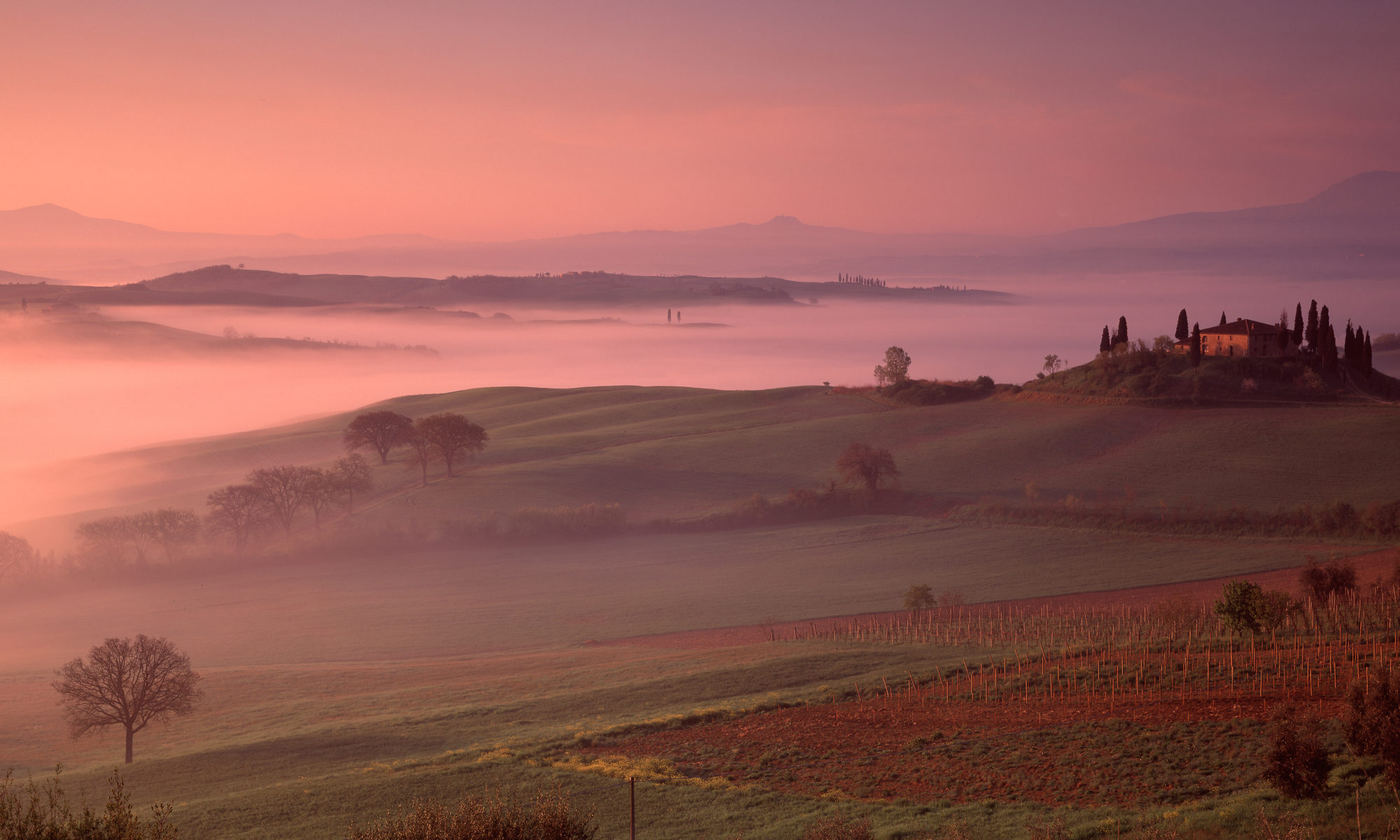
A couple of years ago we drove down from Umbria to Rome, where we picked up two friends at the airport, and then continued south. We drove down all the way to the “toe”, and crossed the strait to Sicily on the ferry. I’ve written about that visit to Sicily already in my post on A Return to Palermo, but the trip itself took us through some interesting and photogenic places, so here is an account of that journey.
Cilento
I had planned to break the journey twice on the way, and not to spend more than about four hours on the road each day. Four hours from Fiumicino would get us to an area called Cilento, south of Salento. Cilento is an famously scenic area and national park that is also known for its hardy and independent inhabitants. I had wanted to visit for some time, so this was a perfect opportunity.
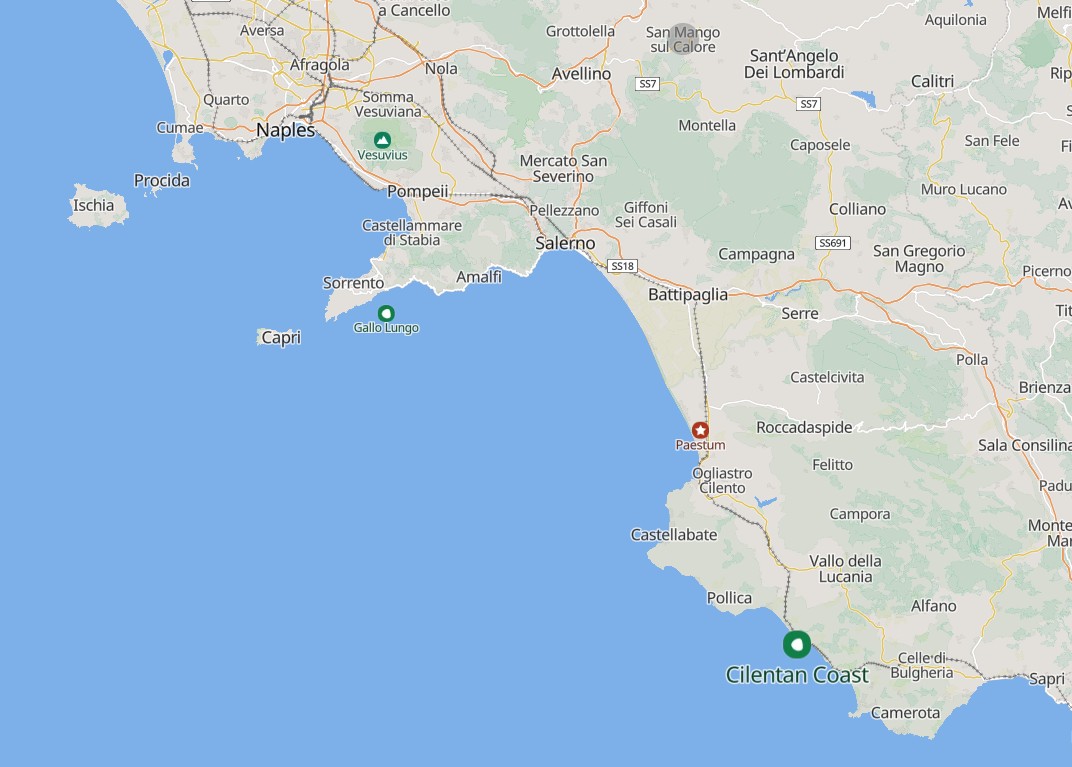
On the map above, Naples is at the top left. Continuing down the coast you get the Sorrentine Peninsula, the southern side of which is the Amalfi Coast. South of Salerno there is a stretch of coastal plain – it was that flat area that made the Gulf of Salerno the choice for the Allied landings in 1943. At the southern end of the gulf is the mountainous area of the Cilento.
I was driving a new leased Citroën and wanted to make sure that it was in good condition for the trip. It was equipped with a tyre pressure monitoring system but this would not work until the tyres were checked at the correct pressure, and the system then initialised. I did all that before we got to the airport, but it turned out to have been a big mistake. For the remaining four months of the lease, at random intervals between one hour and a few days the tyre pressure alarm would go off with that panicky noise that modern cars always make, to distract you precisely when you are in a difficult situation on the road. I would then pull into a service station and check the tyres, which would be perfectly fine.
These joys lay in the future though as we picked up our friends at Fiumicino, loaded up the car, drove back to the Rome Ring Road (the Gran Raccordo Annulare, signposted as GRA, which Romans just pronounce “grah”) and found our way onto the motorway south towards Naples.
Buffalo
Rather than going into Naples, we went around the back of Vesuvius and came down to the coast near Salento. Before long we noticed more and more caseifici (cheese shops) beside the road, advertising buffalo mozzarella. Not surprising as such, because Campania is famous for this extra-creamy fresh cheese. But where were the buffalo?
It wasn’t long before we saw (and smelt) them. Large farmyards held herds of buffalo, with long shelters under which the animals lay in the shade (it was July and the sun was hot). But that started me thinking. When and how were buffalo introduced to Italy? To the extent that I had given it any thought, I would have guessed that they arrived from southeast Asia in the 19th Century, but it turns out that I would have been wrong.
When and from where is subject to dispute, but it is known that they were established in Campania by the Middle Ages – It might have been in late antiquity or the early Middle Ages, and it might have been through Byzantine or Arab contacts, although there is apparently a tradition that buffalo arrived with the Lombards. The latter sounds inherently less plausible to me – the Lombards were hardly likely to be bringing herds of buffalo over the alps from Central Europe.
Our route took us very close to the famous Greek temples at Paestum, but to my intense regret we didn’t go there, partly because our friends had just got off a 20-hour flight from Australia, and partly because I didn’t want to leave the car with everyone’s luggage in it in a public car park. So we continued, and Paestum went onto the list of places I will make another attempt to get to one day.
Castellabate
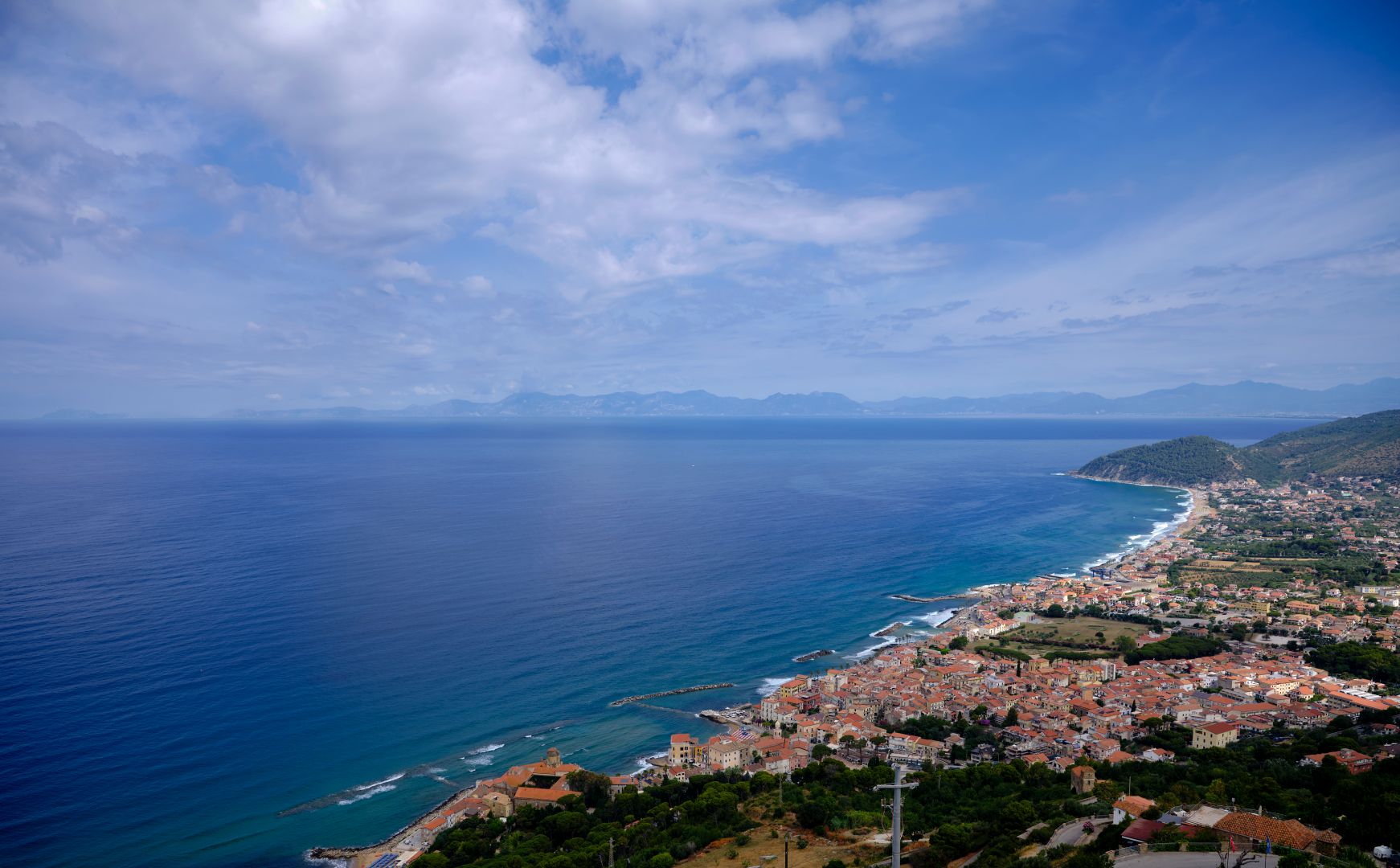
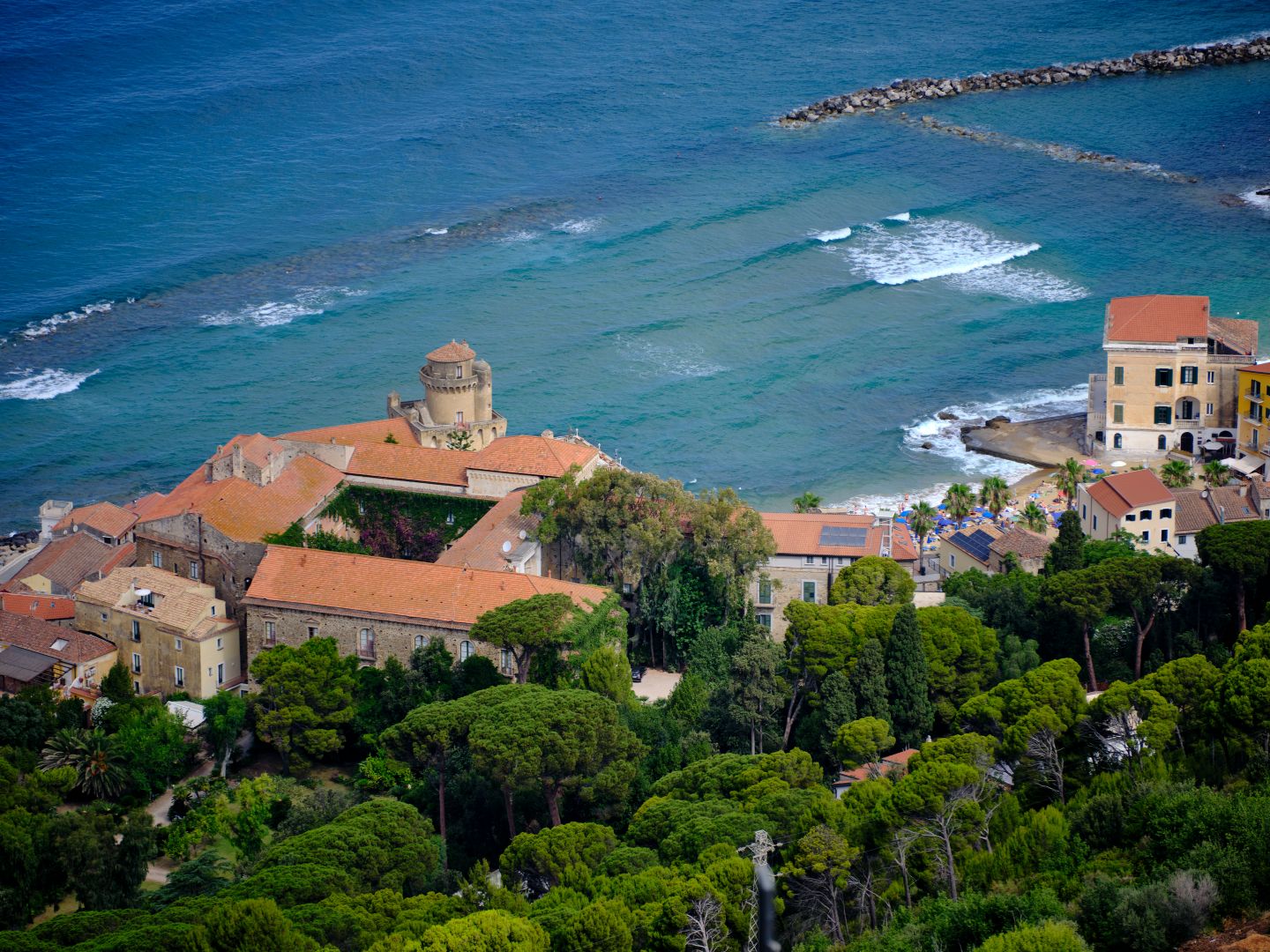
Our first stop was in Castellabate, a name meaning “Castle of the Abbot”, implying both military and ecclesiastical origins. If you look on the map above you will see that it is more or less on the first rocky bit sticking out south of the Gulf of Salerno. It is a little fortified town built on top of a steep hill, for defensive reasons.
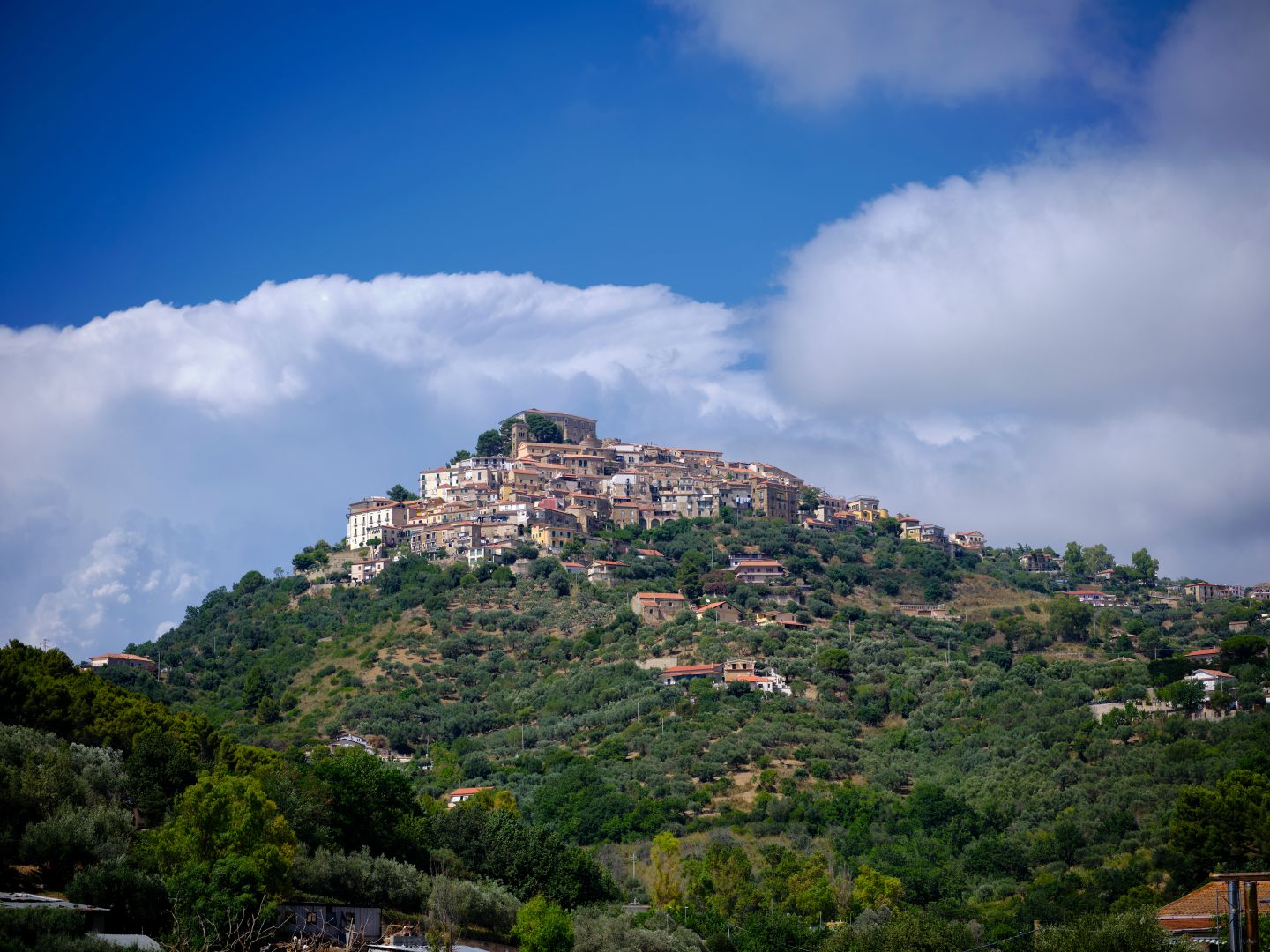
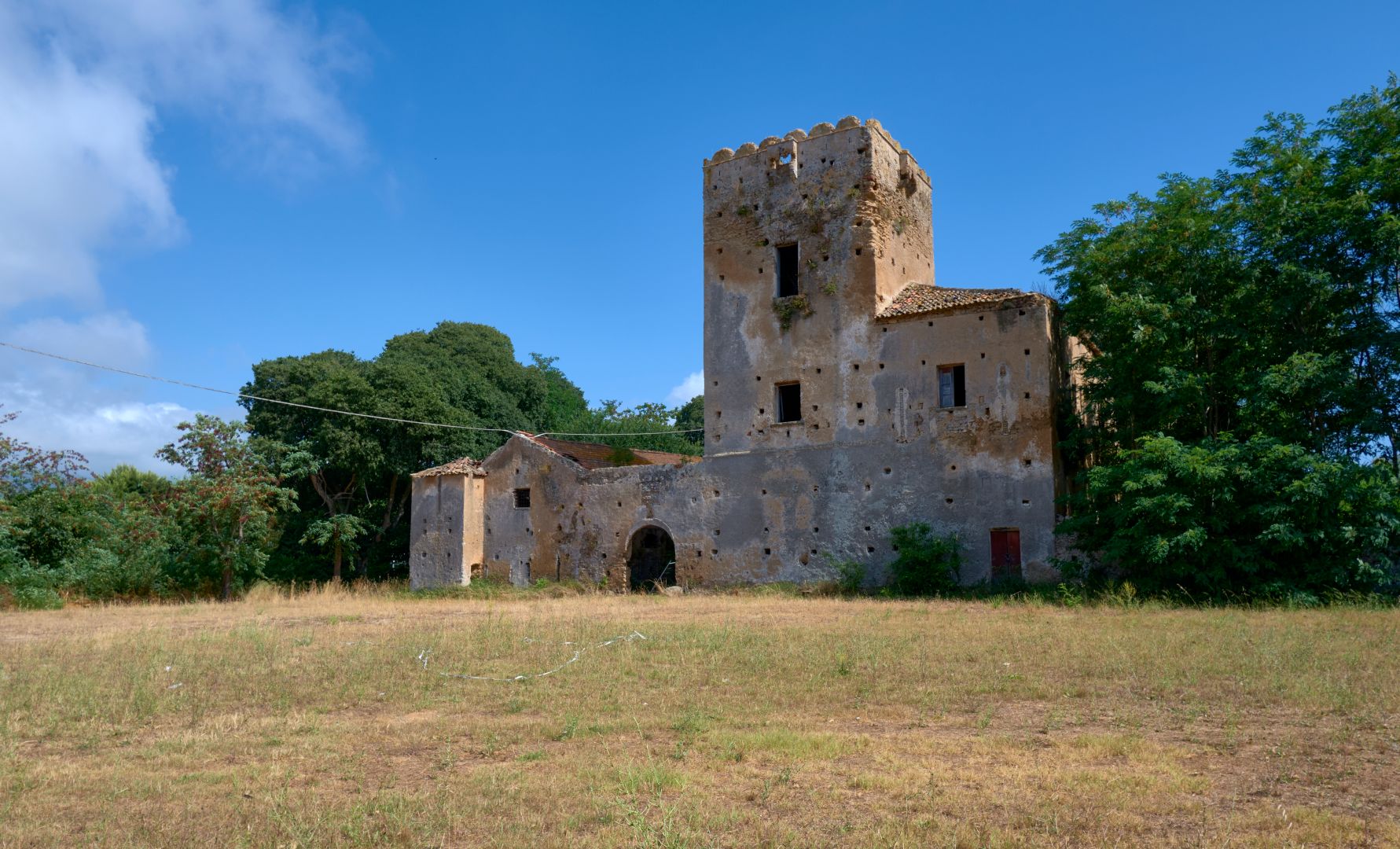
And very good reasons they would have been. After the fall of the Western Empire, the place was fought over by Goths, Byzantines and Lombards. And even when armies were not marching up and down, the coast was plagued by Saracen pirates, some of whom set up semi-permanent strongholds here. For those with farms to defend on the low-lying land, here as elsewhere in southern Italy the tendency was to build the fortified farmsteads called masserie (many of which are now holiday accommodation).
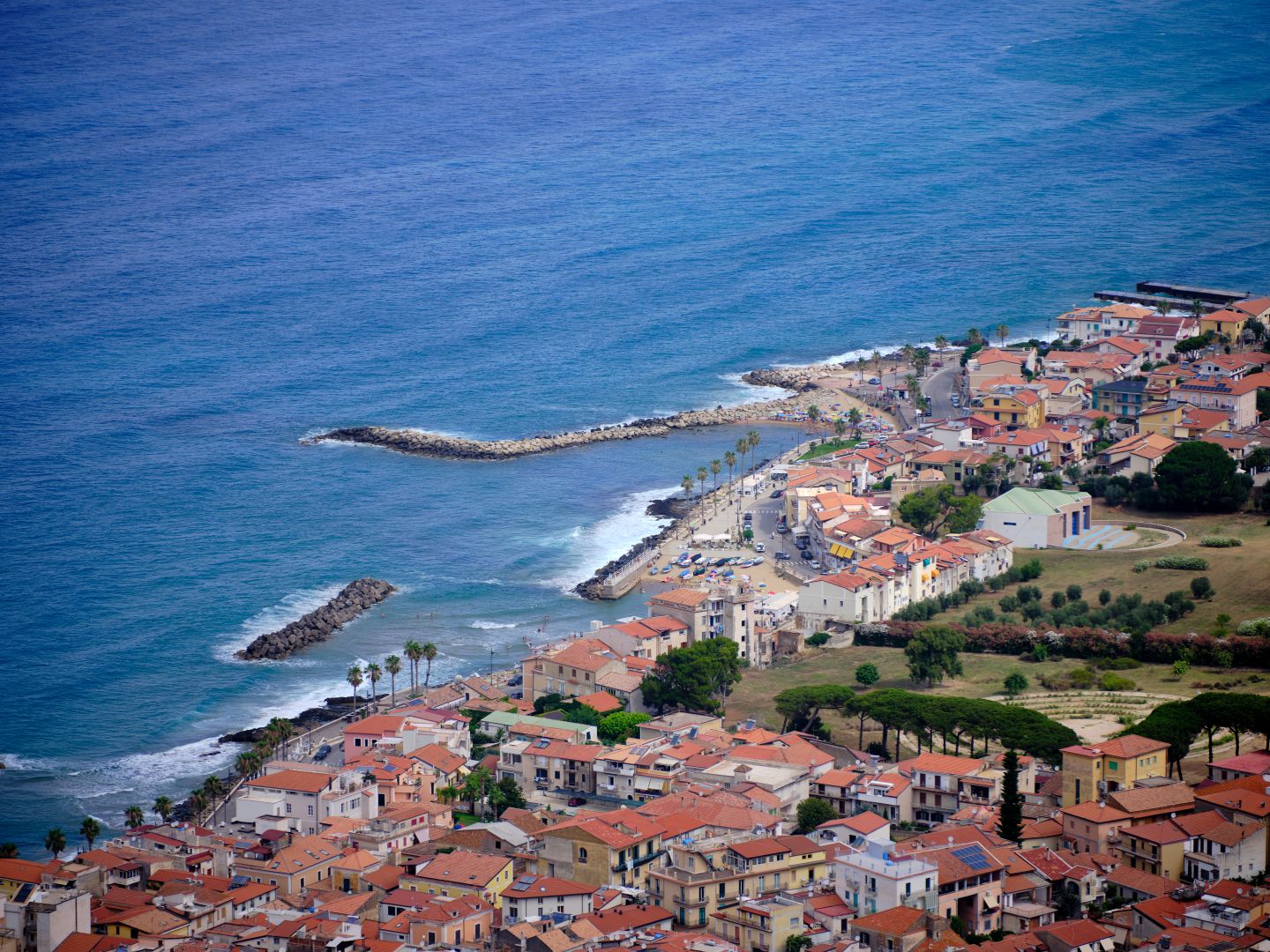
In later, more peaceful, centuries a series of fishing and farming villages arose along the coast below the castle, with names like San Marco di Castellabate and Santa Maria di Castellabate. These days they make a good living out of the tourist industry, although as far as we could tell this is almost entirely Italian domestic tourism, as we saw very few foreigners.
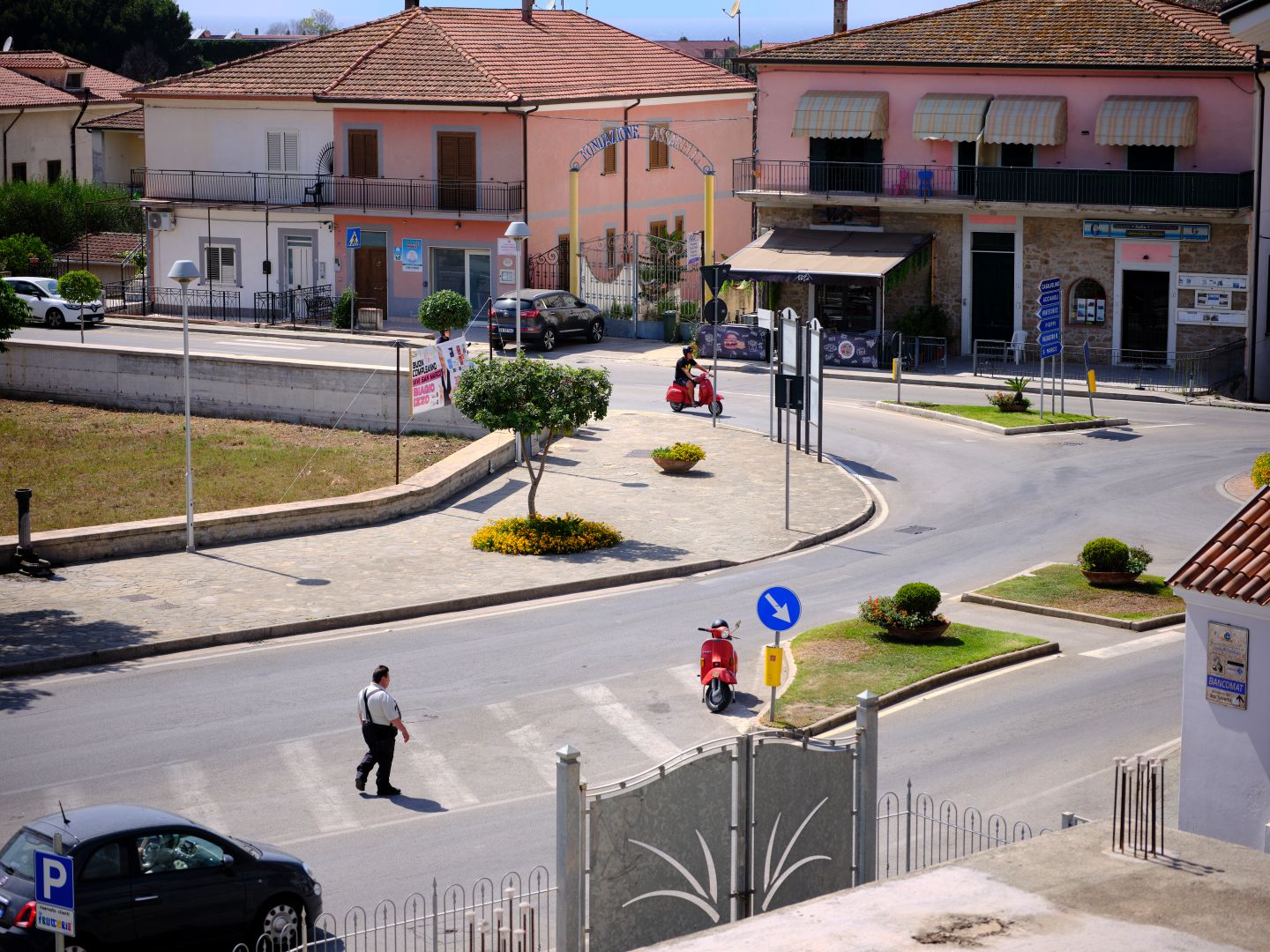
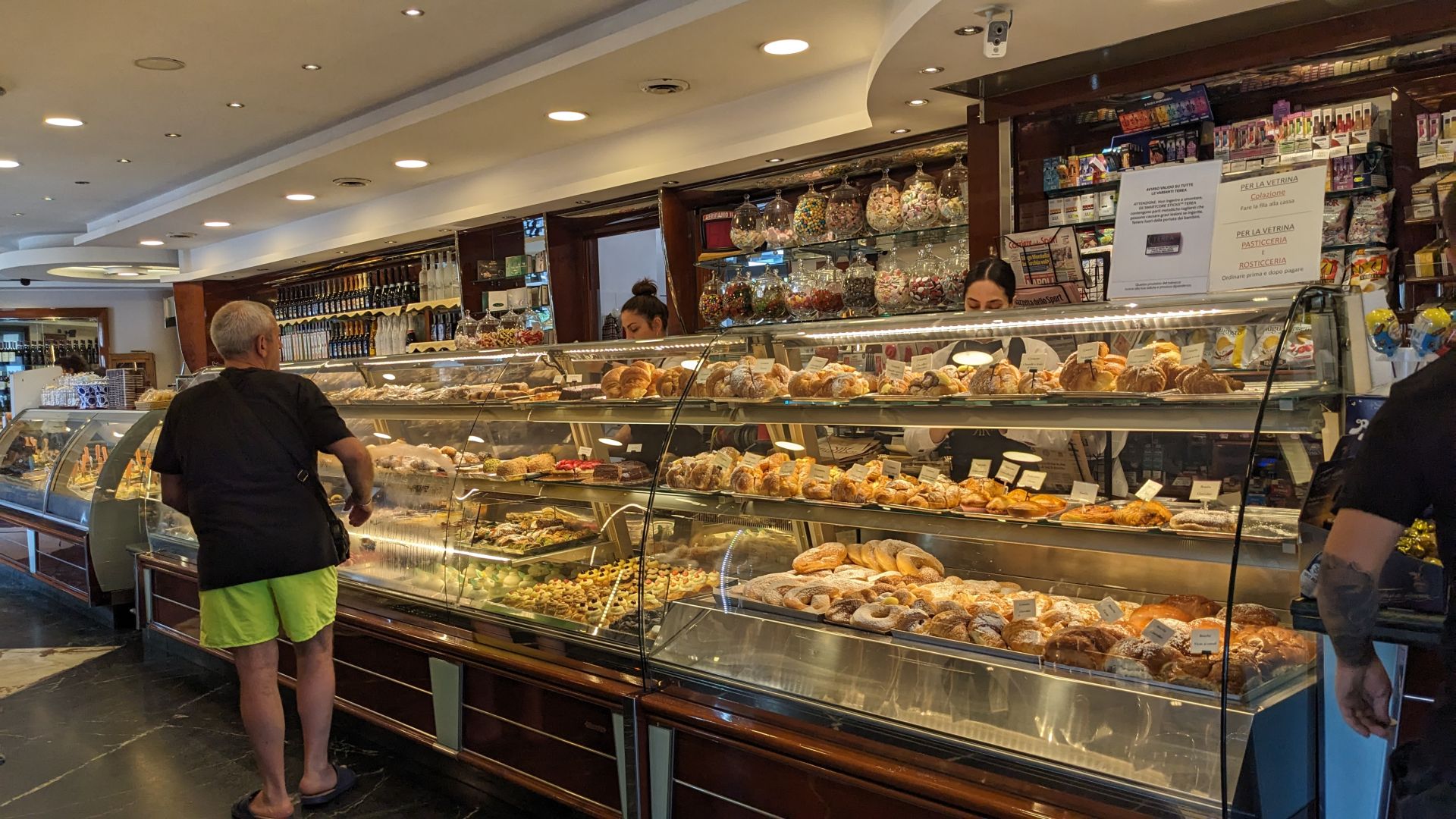
Our accommodation was in a rather nondescript area, but there was free parking across the road and the hosts were charming. Our bookings included breakfast, and the lady, obviously concerned that we would not expire from hunger the next day, was keen to take our orders for the next morning in some detail. What sort of pastries? What sort of fillings? It was all a bit challenging, especially for the two of us that were still on Australian time. Later on we realised that the need for specificity was because breakfast was going to be ordered from the bakery and bar next door.
Having sorted out the important stuff we decided to walk down to the harbour at San Marco di Castellabate, which turned out to be a very pretty spot, with children jumping in and out of the water while their parents watched from the shade of harbourside bars.
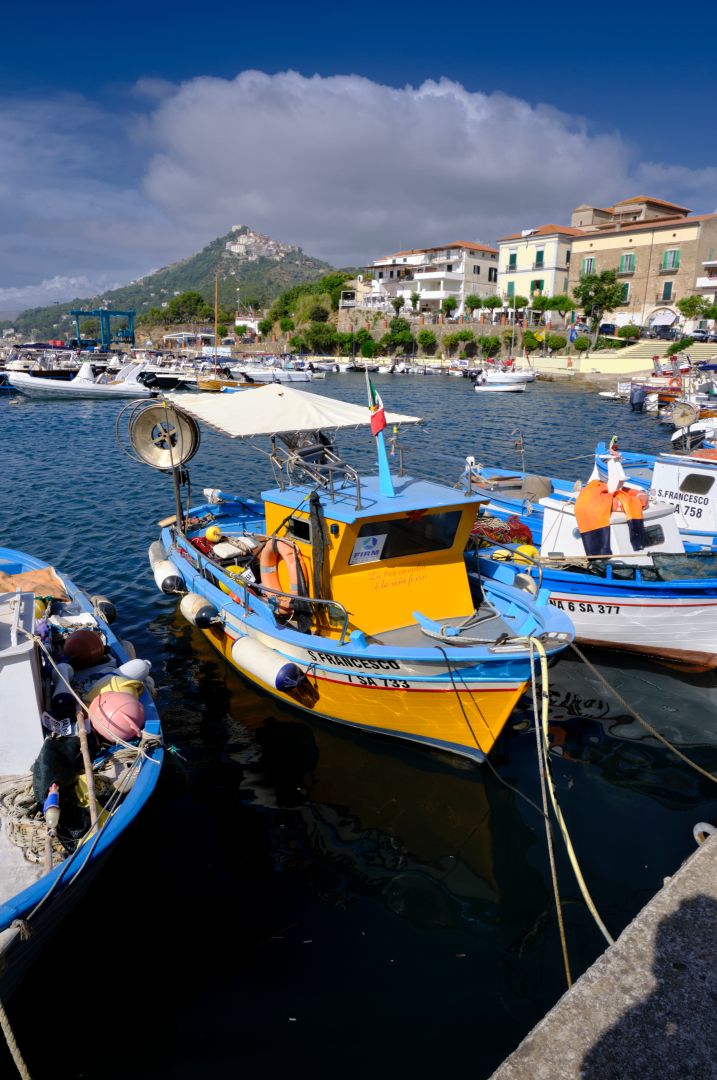
That evening we headed into Santa Maria di Castellabate for dinner. We had already chosen a restaurant based on online reviews, and told our hosts that was where we were going. Not only, it seemed, was the restaurant run by a friend of theirs, but despite our demurrals they insisted on ringing the restaurant to arrange the booking themselves and to ensure we were treated properly. To be honest, I’m not sure this intervention was really necessary because the people at the restaurant seemed pretty nice and the sort who would probably have been perfectly hospitable without a personal recommendation. But this sort of thing happens a lot in Italy, particularly the South, and at the very least it’s an insurance policy against being ripped off or being served bad food. But if you are in a part of Italy where most of the tourists are Italians, and being Italians probably return to the same spot every year, the relationship between host and guest is very different from what you might experience in Rome or Florence.
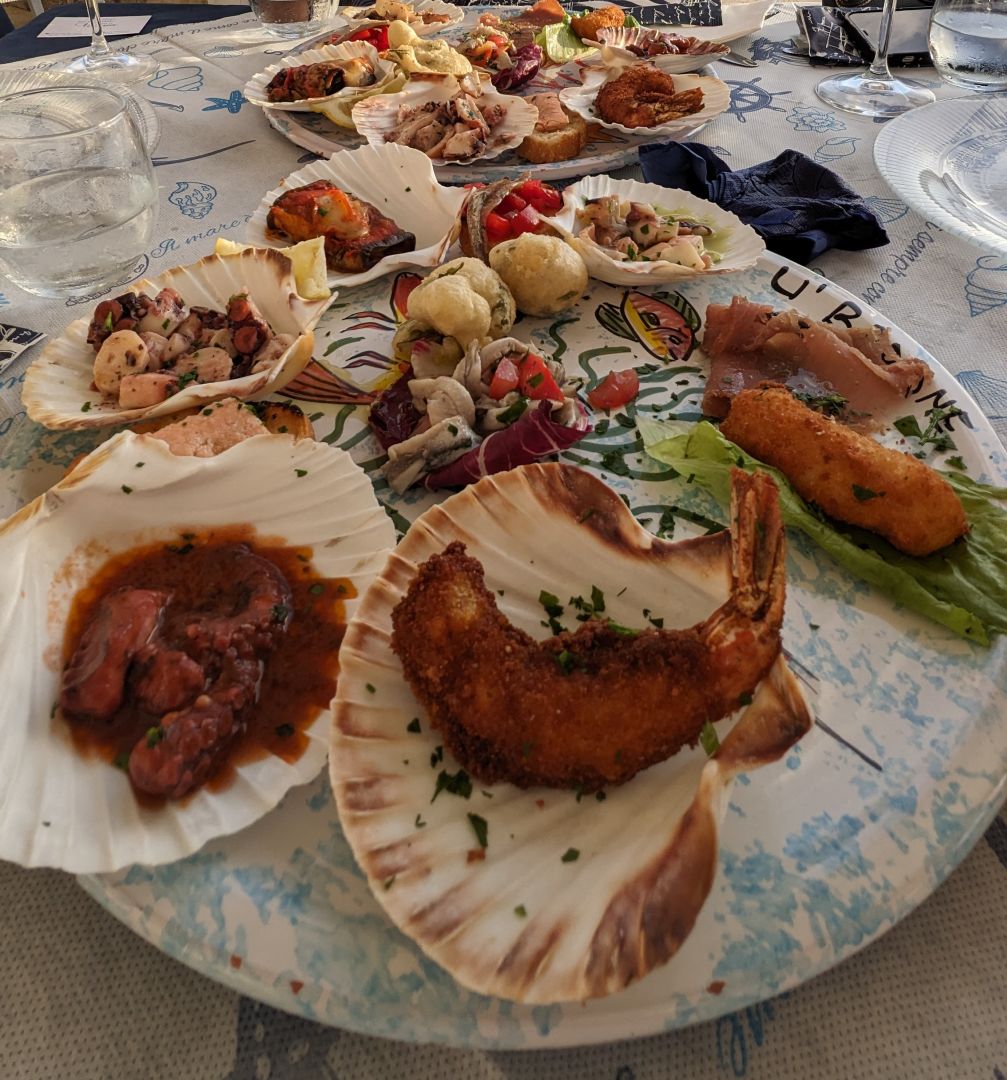
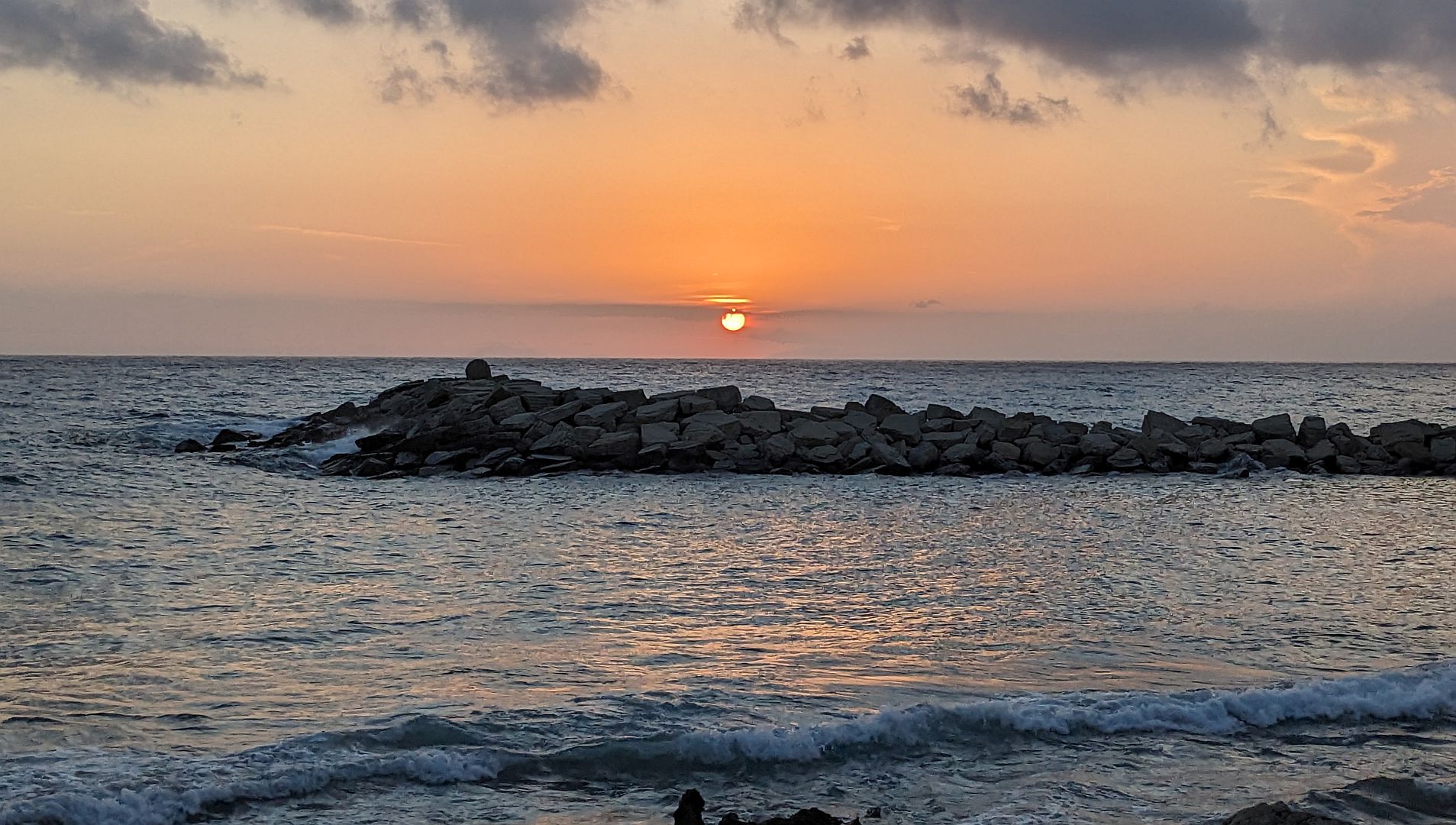
When the meal arrived, it met our most optimistic expectations, and moreover the setting – in the open, by the sea, as the sun sank towards the horizon – added considerably to the experience. Two years later, our friends still talk about it. This isn’t supposed to be a travel-foodie blog, but here’s a photo of dinner anyway, and one of the sunset.
The next morning, amply fortified by the breakfast pastries, we set off on the next leg of our southward journey, heading for Tropea near the “toe”. It was not an enormous distance, so instead of taking the motorway I had planned a leisurely, and hopefully very scenic, route that started by following the coast of the Cilento peninsula. This turned out to have been a bad idea, because we had not got all that far when we found a sign in the middle of the road that seemed to be telling us that to proceed would be very hazardous and that anyone foolish enough to do so would do it at their own risk. Given that, the inland motorway started to sound attractive after all, so we turned inland to try and join up with it.
The road grew narrower, steeper, and more winding. And while the views were indeed most attractive, there was a rather tense atmosphere in the car, not helped by the fact that every thirty minutes or so the Citroën’s tyre pressure alarm would go off, and there was no human habitation to be seen, let alone any garages.
Eventually and to everyone’s relief, we came upon the motorway. I should have chosen that route to start with, because the views were spectacular. Every so often we would zip across some high viaduct with rugged, heavily-wooded terrain stretching away on either side, and impossibly picturesque villages perched on some of the pointiest hilltops. Unfortunately I didn’t stop to take any photographs, because my attention was taken up by the fact that the damn tyre pressure alarm kept going off. In due course we came to an area servizio and I pulled in and checked all the tyres. They were all fully inflated.
Tropea
All Italians are familiar with Tropea – they are reminded of it when they go to the greengrocer’s because its bulbous red onions are famous. And indeed they are everywhere – as we approached there were stalls selling them by the roadside, and in Tropea itself they feature on every menu as well as in wall decorations.
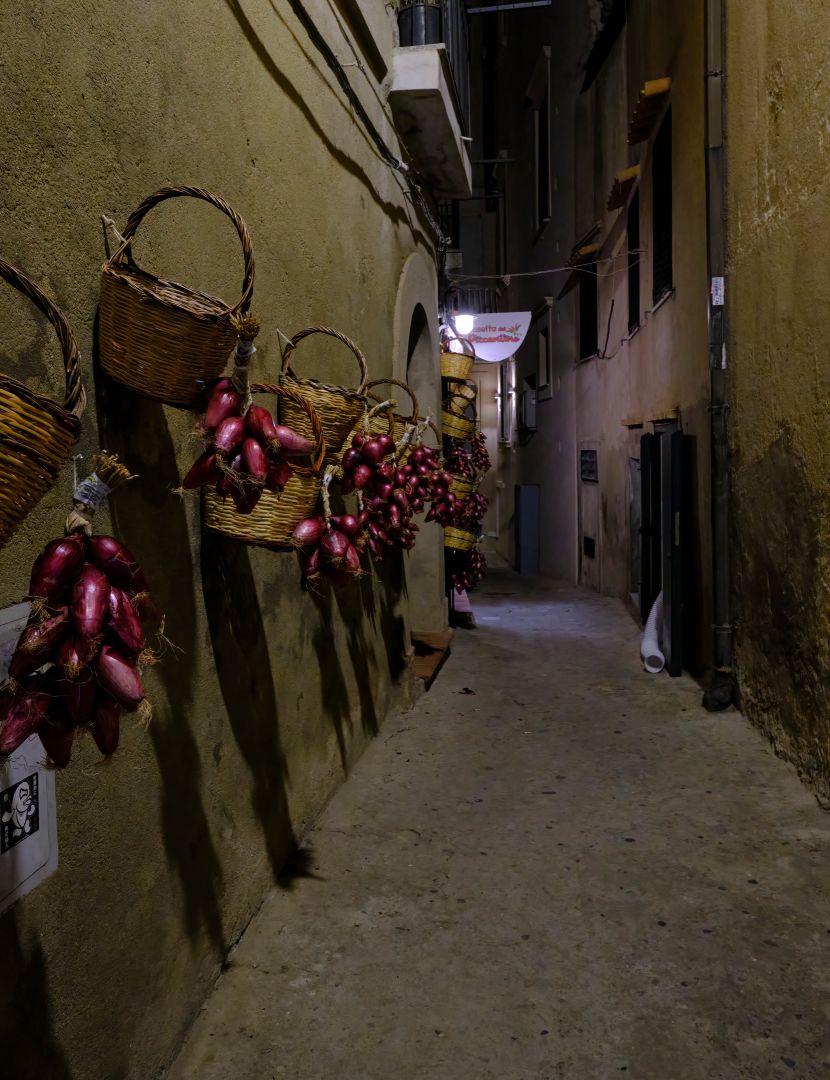
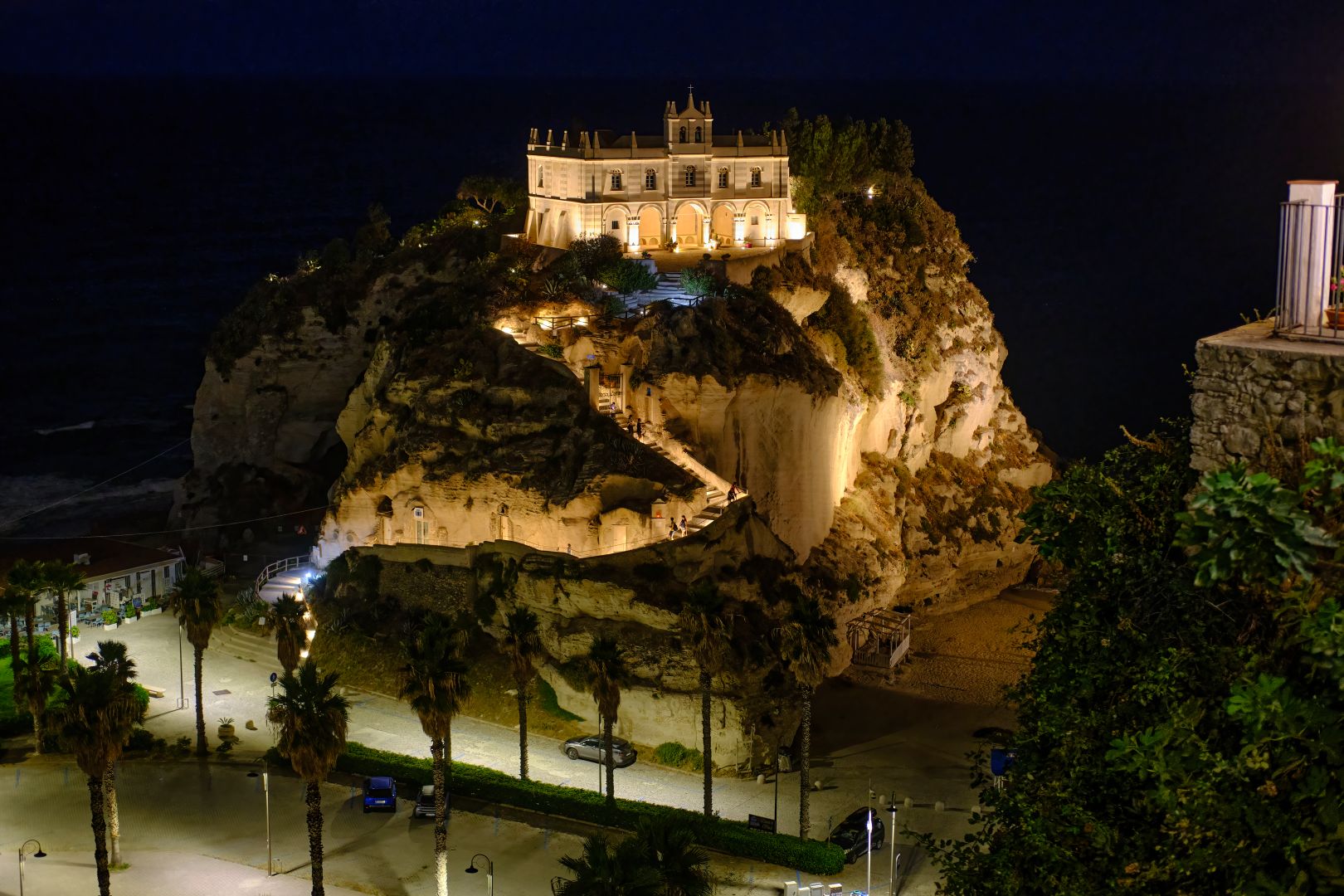
But Tropea would be famous even without the onions, because it is spectacularly pretty (its Wikipedia page tells me that it was named “most beautiful village in Italy” in 2021.
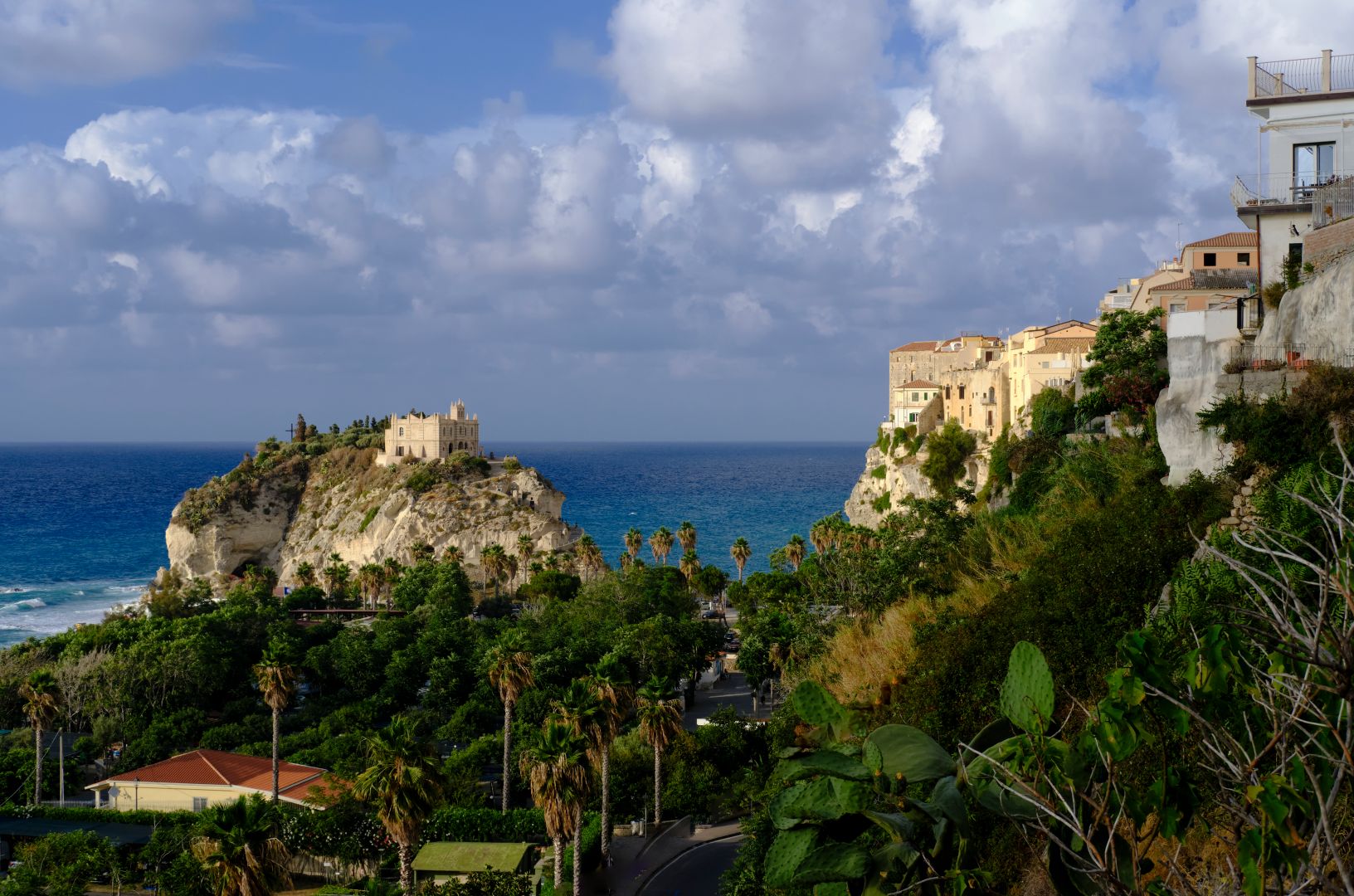
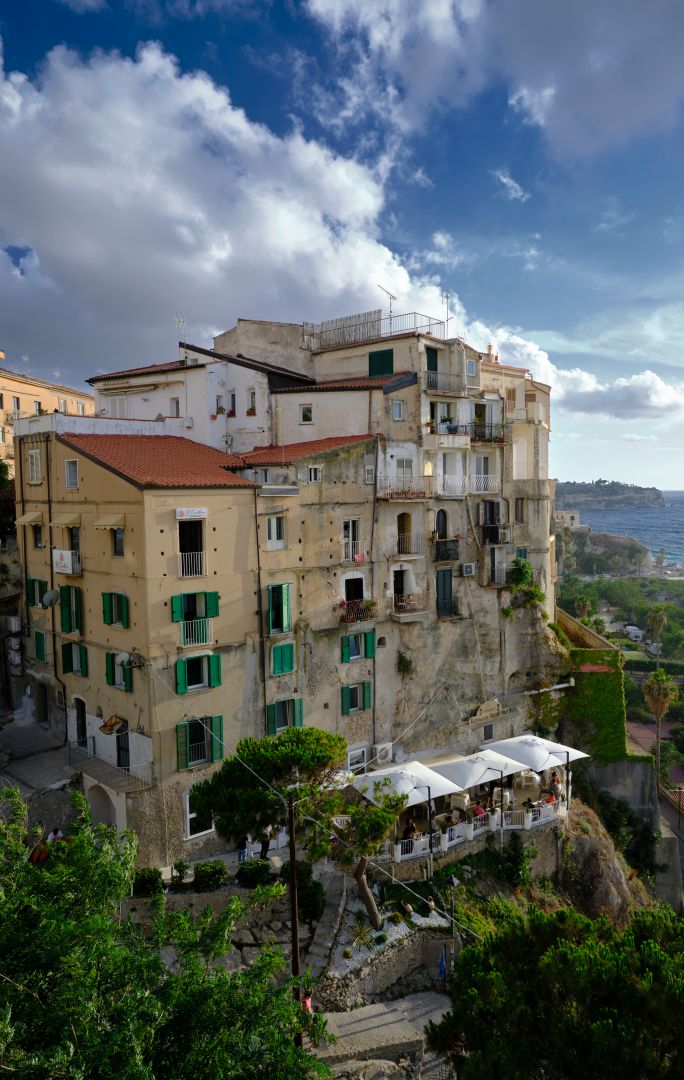
Although Tropea is in Magna Graecia, the area of southern Italy colonised by Greek settlers in antiquity, and although its name probably derives from a Greek word, it really only came to the notice of history in late antiquity and the early Middle Ages. Some Byzantine-era fortifications are known traditionally as “The Walls of Belisarius” which if true would date them to the Gothic Wars of the 6th Century (Belisarius being the general who reconquered Italy for the Byzantine Emperor Justinian).
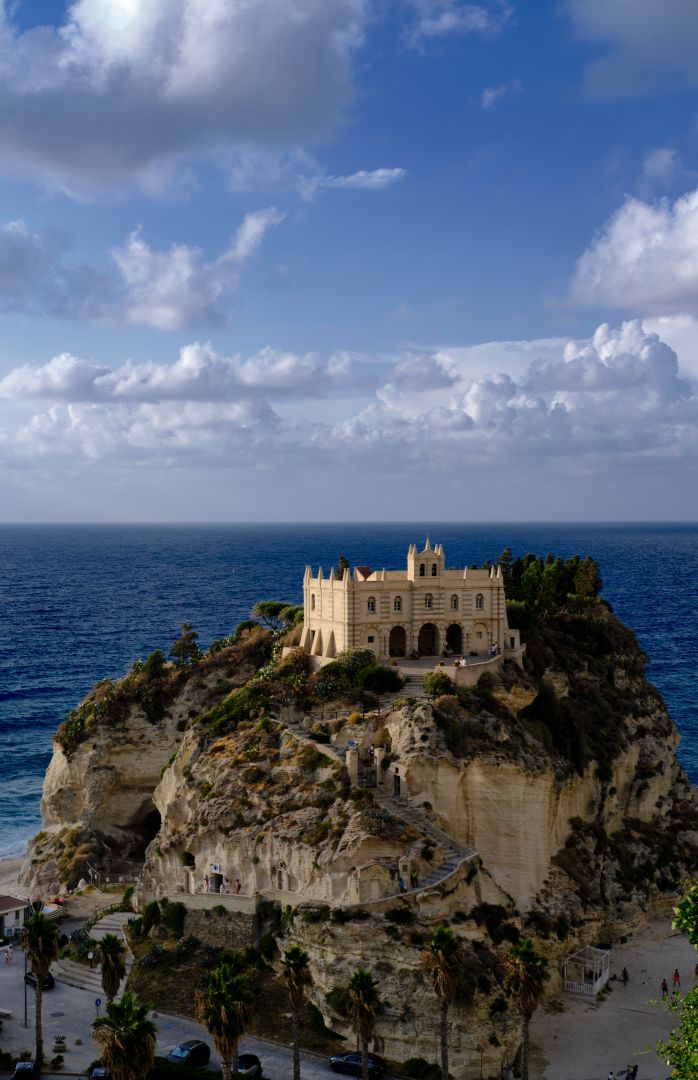
Byzantine power in Southern Italy was always too attenuated to last, and at some point Tropea was captured by Arab Pirates, who ruled it, sort of, until the Normans seized it in the mid-11th Century. Under Norman rule the town prospered, and you can still see a fine Norman cathedral in the town.
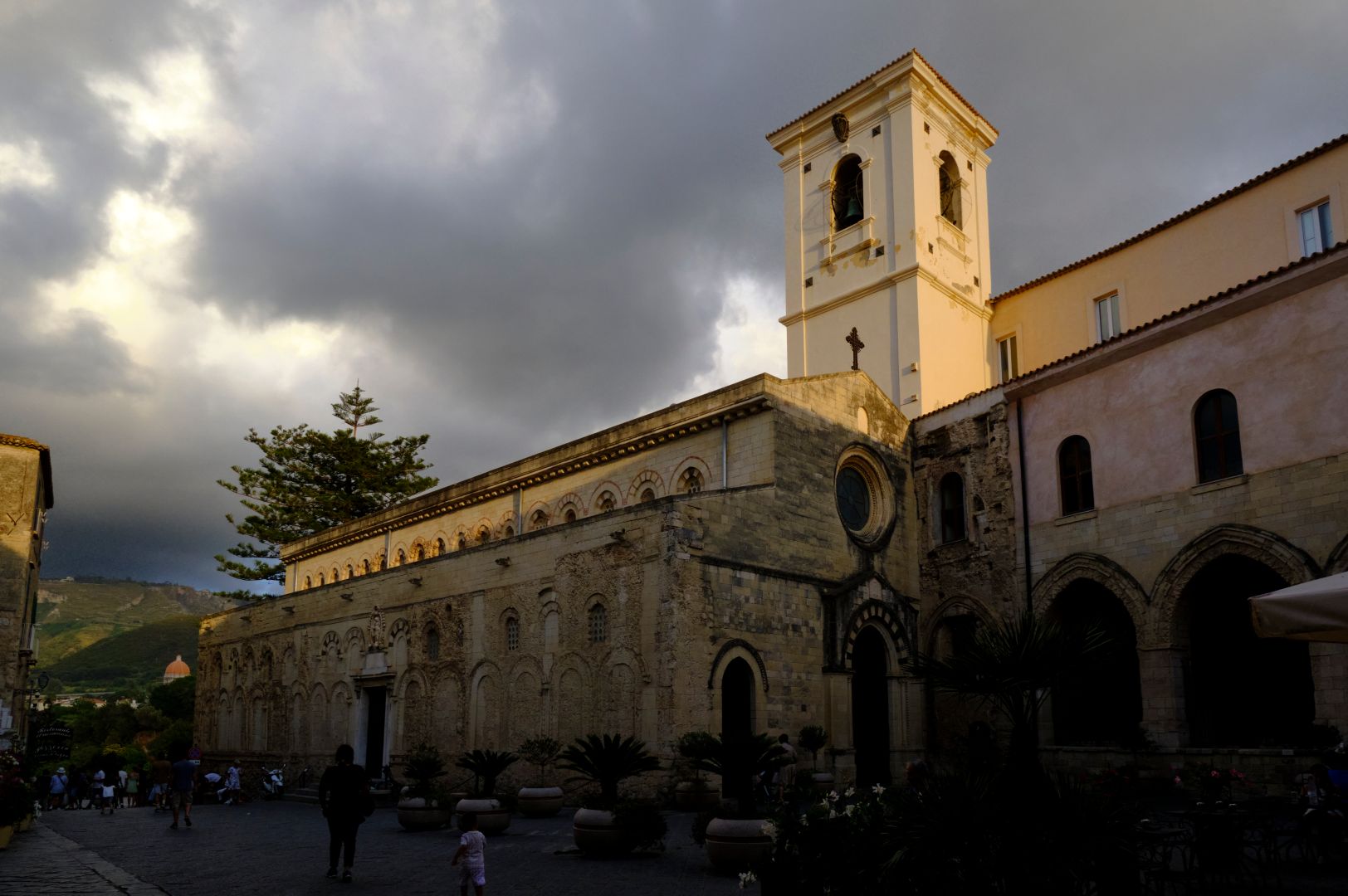
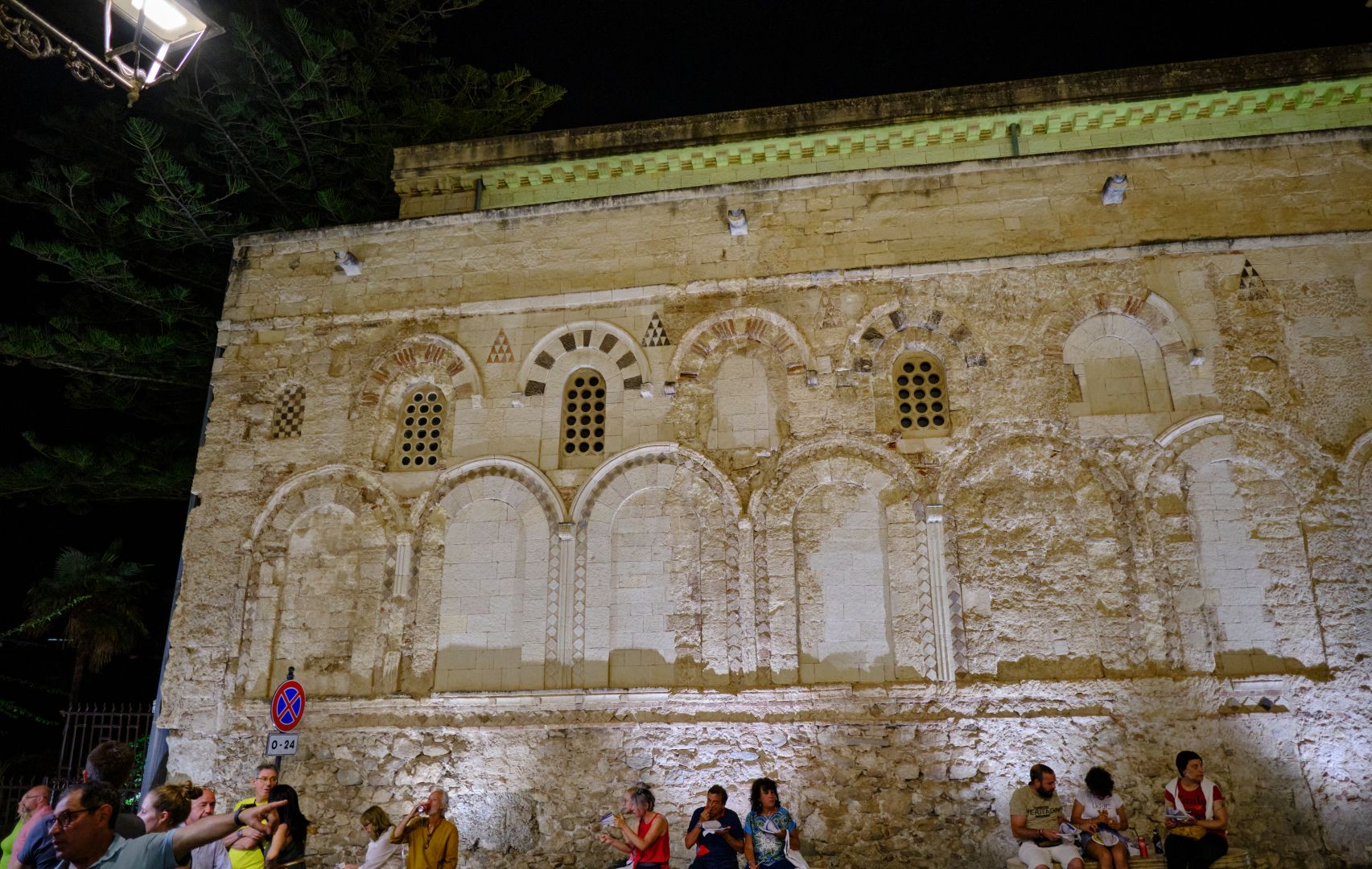
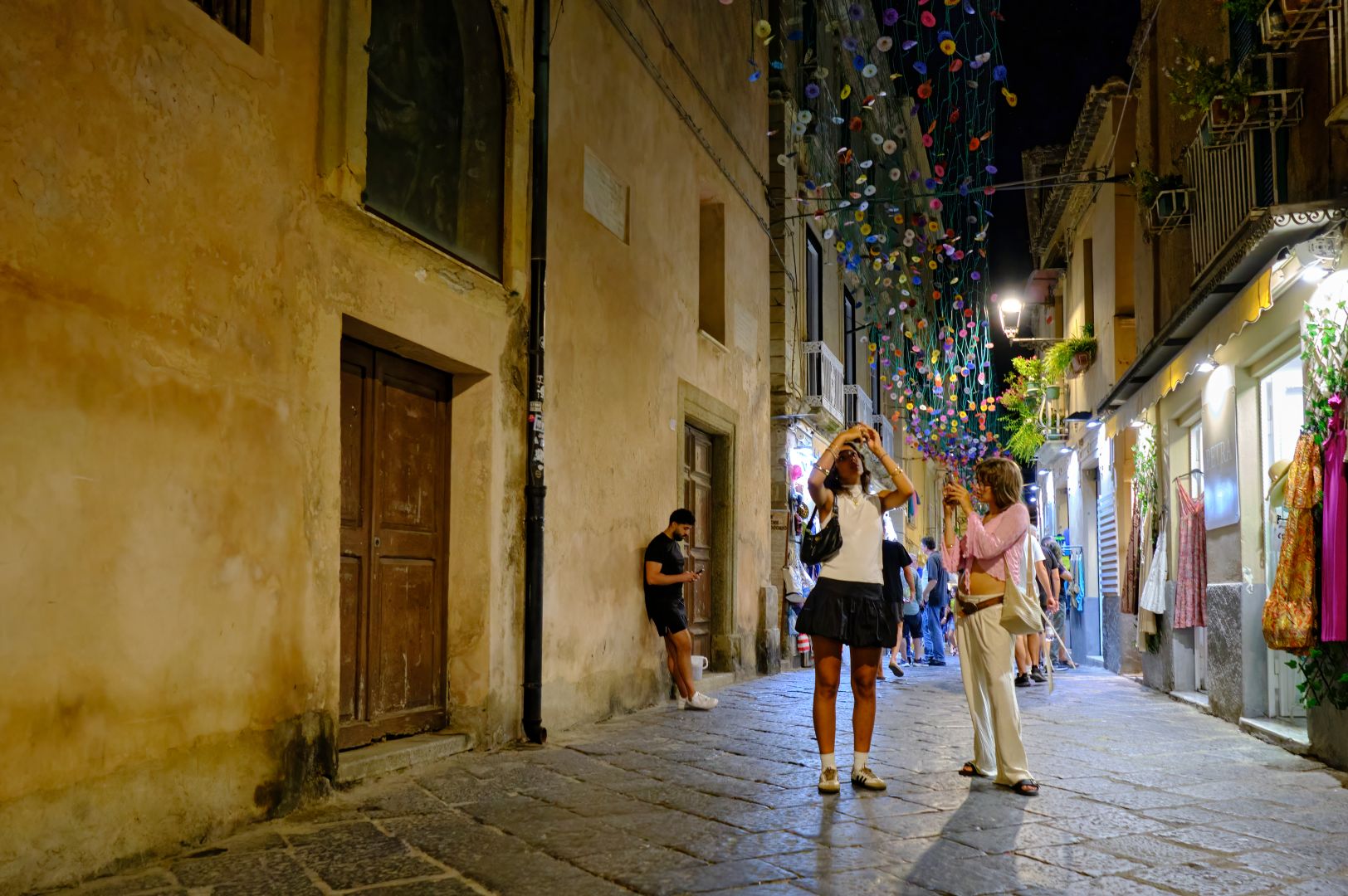
After a meal featuring, among other things, onions, we strolled through the streets. A warm July evening had followed the hot day, and the streets were full of cheerful tourists (mostly Italians) buying ice creams and taking selfies. It was a lot more heavily touristed than the Cilento Coast had been, with a large number of shops selling fridge magnets, snow domes and the like.
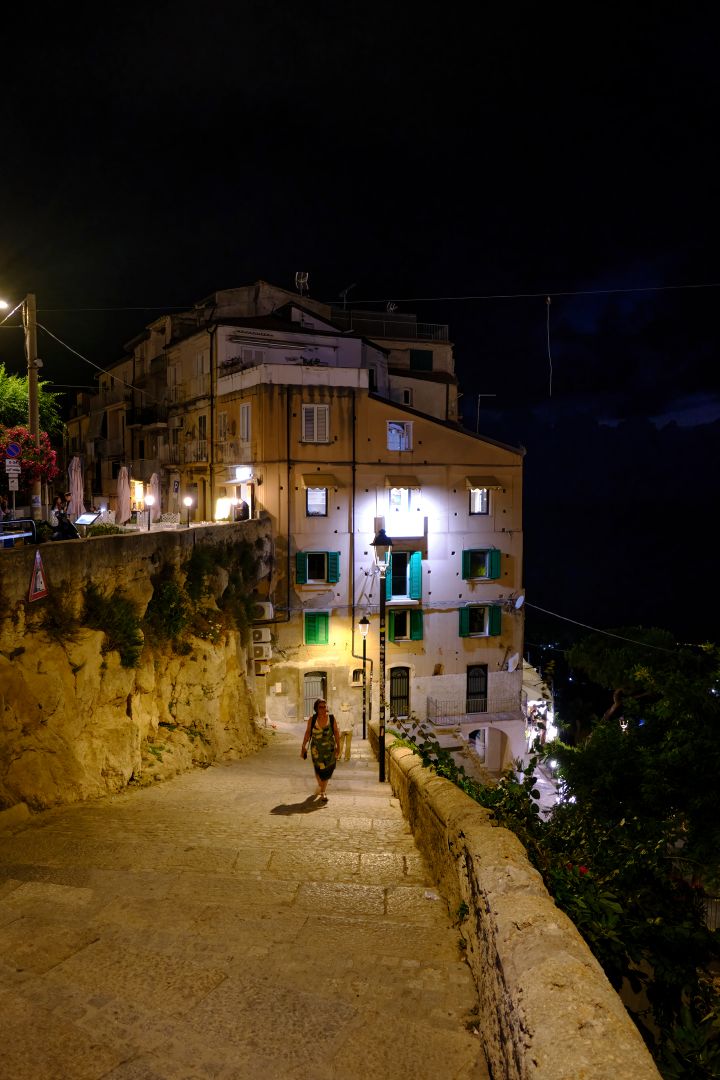
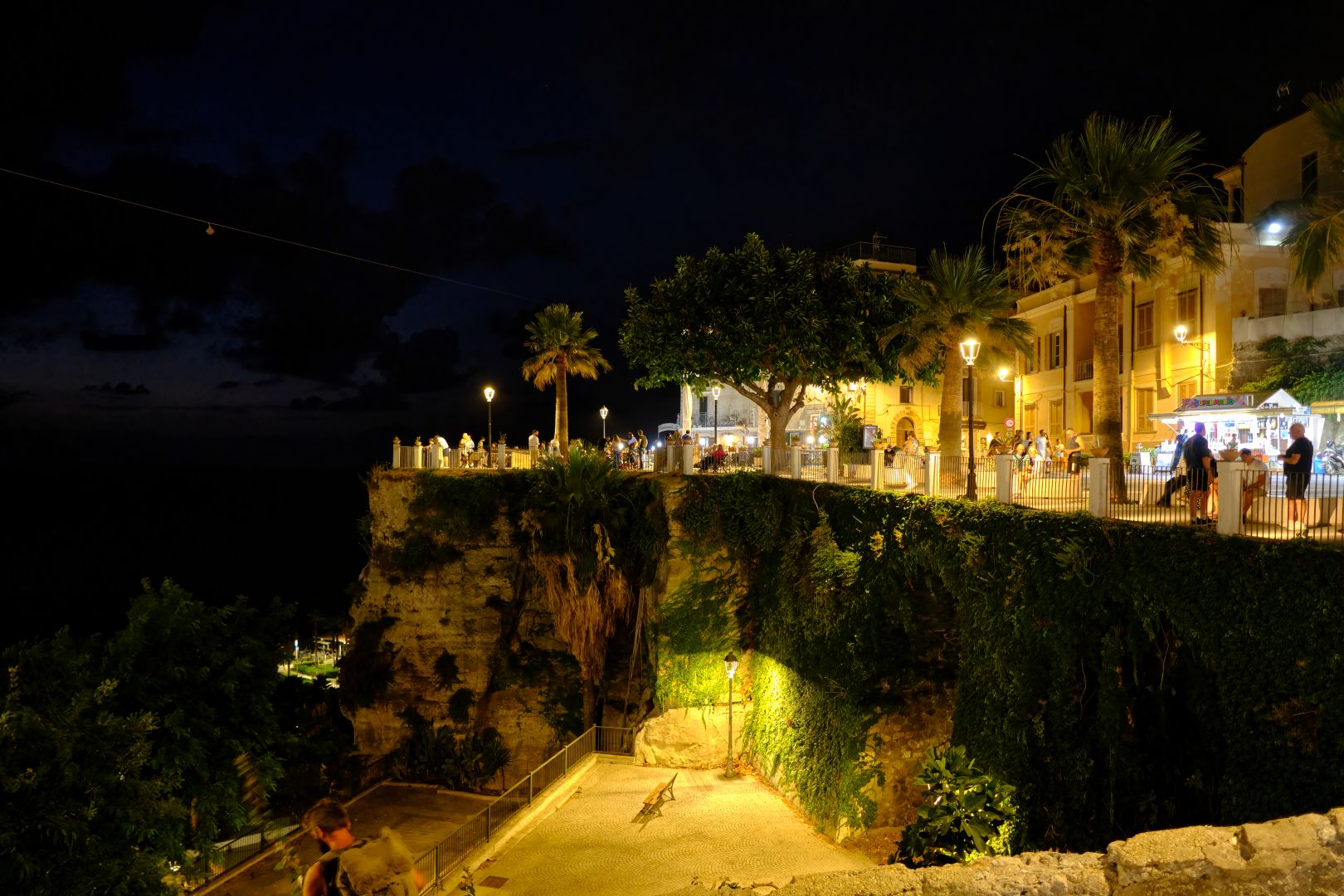
The next morning we headed out with our bags to load up the car, to find out that the Citroën had played a nasty trick on us. After a couple of days of bombarding us with false alarms about tyre pressure, the Citroën Who Cried Wolf had now developed a marked list to the aft starboard corner, in other words it had a flat tyre.
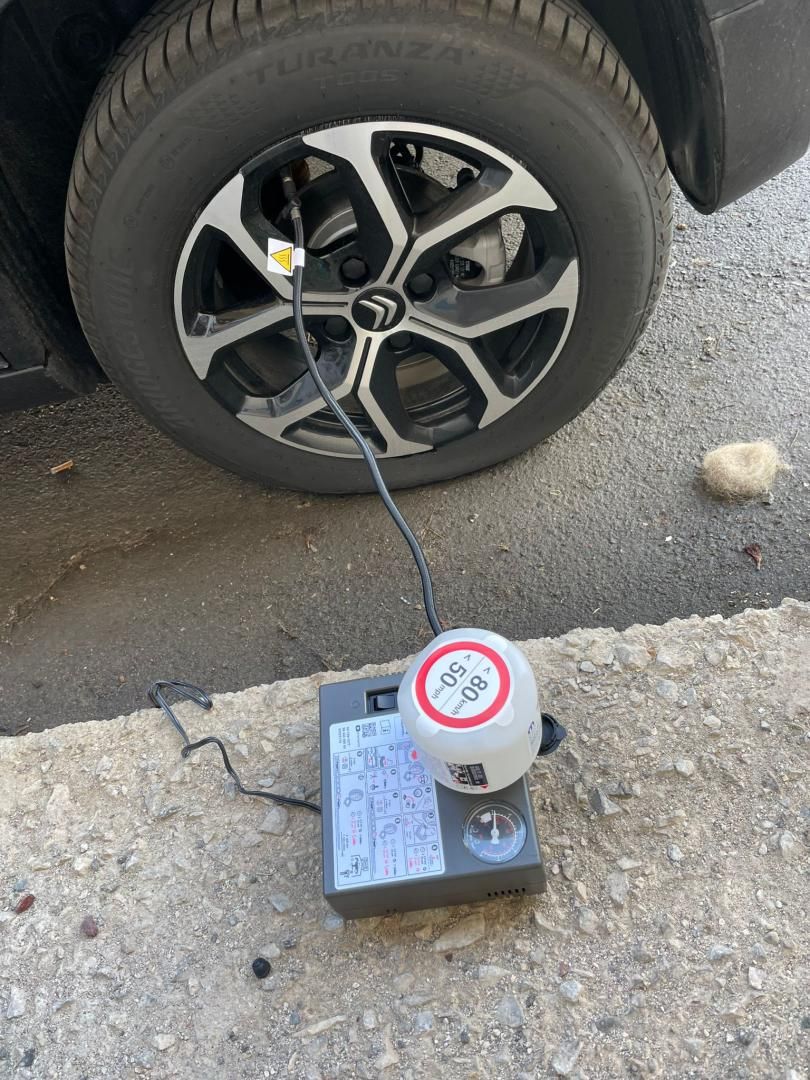
To make things worse, like most cars now sold in the EU, it did not have a spare wheel, not even one of those bicycle-sized emergency ones. Instead we were expected to use one of those kits where an electric compressor injects air and sealant goo into the tyre. There is never going to be a good time to learn to use one of these, but a sunny morning in a back street of Tropea was preferable to the side of a motorway in the rain.
The instructions on the compressor made it clear that after re-inflation one must proceed at under 80 km/h to seek assistance. With the generosity typical of Italians when someone is in difficulties, our host from the night before had come out and we followed him on his motor scooter to his gommista (tyre dealer) mate nearby, who replaced the tyre.
While all this was happening Lou was on the phone to the car leasing company. They sent us instructions to lodge an insurance claim, saying they needed A DETAILED INCIDENT REPORT WITH POLICE REPORT IF APPROPRIATE. It had not occurred to me to report my flat tyre to the police, so later I just submitted the following detailed incident report:
Report on Replacement of Flat Tyre
My tyre went flat. I had it replaced. Photos and receipts attached.
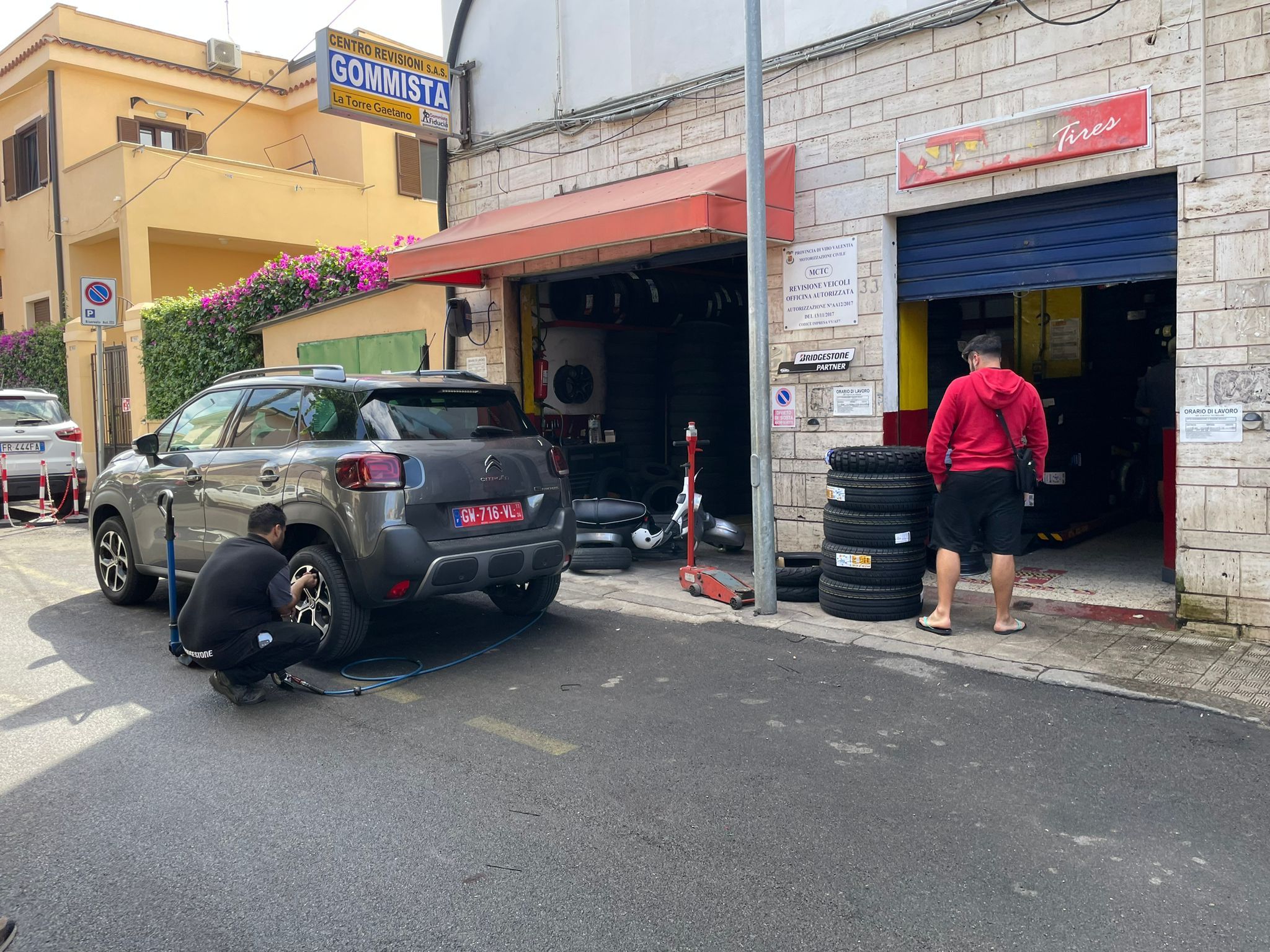
Of course having now used our one can of sealant, we would be in trouble if another tyre went, so the leasing people sent us a list of nearby Citroën dealers where we might buy a replacement can of tyre sealant, so we made a bit of a detour along roads lined with onion sellers to a town called Vibo Valentia where we were able to do so. The entire episode only delayed us by an hour or so, although it felt longer. And crises are always useful for building one’s vocabulary (sigillante – sealant).
Villa San Giovanni
The next bit of excitement was getting across the Strait of Messina to Sicily. It comes as a surprise, the first time, to realise how narrow the strait is. The satnav delivered us to a port called Villa San Giovanni and into the queue for tickets without issue, after which it became a bit chaotic. We were directed into a lane by a man wearing a cap that said POLICE but who was clearly not a policeman. However I could not recall from my preliminary research any references to a notorious Calabrian ferry ticket scam so we waited while all the other lanes emptied, then eventually purchased a return ticket that was valid for three months. We then followed the lane through several hairpin turns and down into the port area. We had not realised that, even though we had been through the ferry ticket gates, we were still on public roads, until we followed the guy in front into an ordinary downtown street. We were pleased to see we were not the only ones making a six-point turn back towards the real entrance to the ferry terminal.
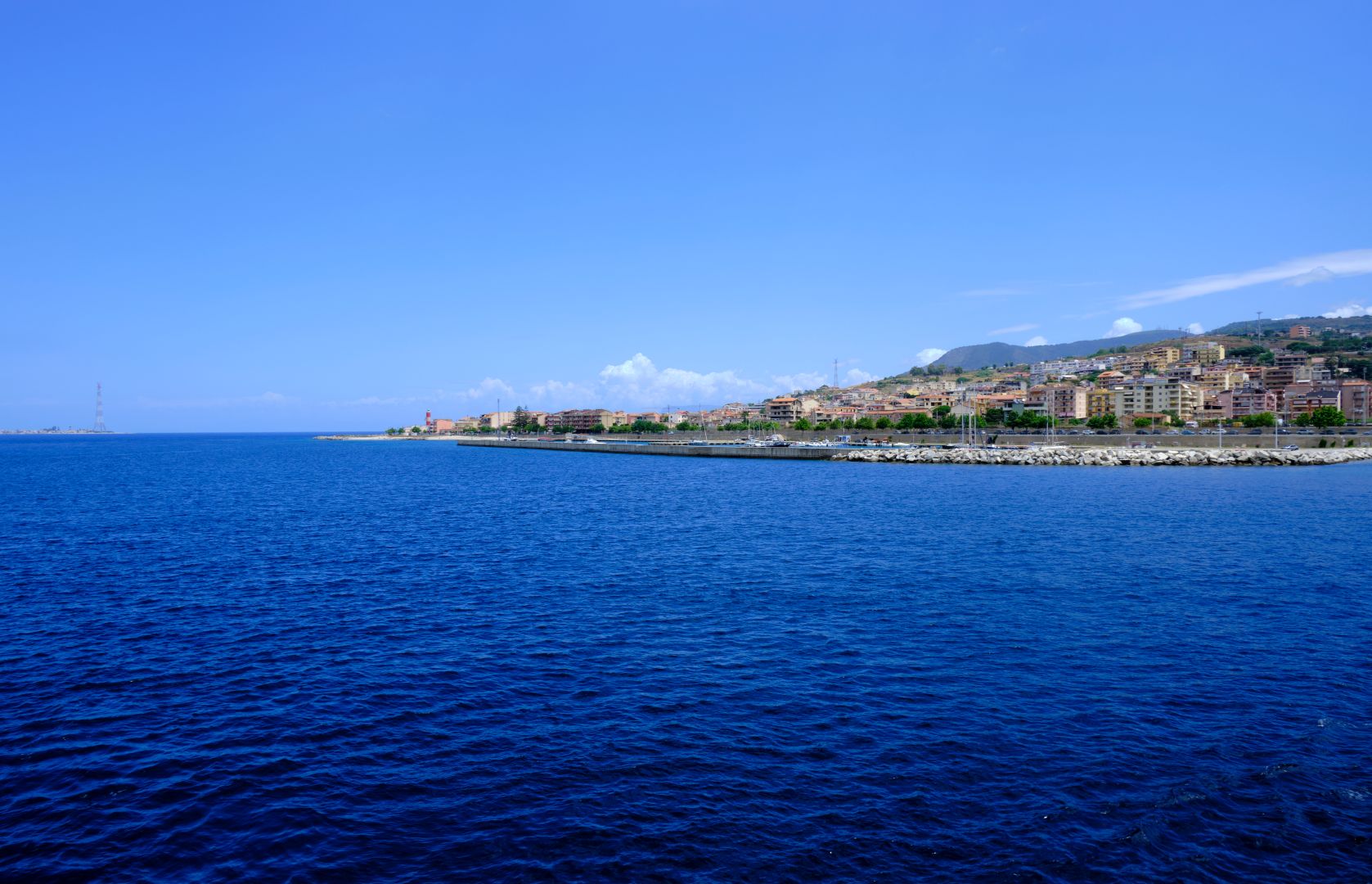
The trip across took only about twenty minutes. Those who remember Homer’s Odyssey will remember the monster Scylla and the whirlpool Charybdis that lay on either side of a narrow strait. This was in fact the Strait of Messina and there were indeed various tidal effects visible that didn’t bother a car ferry but might have troubled an oared galley of the Mycenaean era.
As I said at the start, the next part of the story can be found in A Return to Palermo.