Town and Gown in Bologna – The Archiginnasio

The Archiginnasio of Bologna was at one time the home of the world’s oldest university, and Bologna is still a vibrant university town.

We like Bologna. It has great food, lots of interesting history, and the buzz of being both a wealthy modern city and also a university town. It is also only about three hours away by road from Umbria, so not hard for us to get to. If you are staying anywhere in the Po Valley you will find it easy to get to by car on fast motorways, and it is well-served by high-speed rail services. We’ve met up with friends there a couple of times and enjoyed it very much. I’ve written before about the photographic opportunities Bologna presents in my posts on Street Photography in Bologna and Night Photography in Bologna.

Bologna
Bologna, the centre of town. Taken from the museum in the Palazzo Comunale. Fujifilm GFX 50R medium format digital camera, 32-64mm lens (click to enlarge).

A University Town for Over 930 Years

Not only is Bologna a university town, it has the distinction of being home to the world’s oldest university, founded in 1088. These days the university is based in the Palazzo Poggi, northeast of the centre of town, in a district now full of young people, funky bars and cafes, bookshops, and places that will print and bind your thesis for you.

These days Bologna has a reputation for being both wealthy and left-wing. I read somewhere that the city’s modern politics can be traced back to the centuries of Papal domination, when the combination of suffocating theocratic rule and the intellectual ferment of the university led to a deep-rooted tradition of anticlericalism. The relationship of Italians to the Catholic Church and the implications for their politics are very complicated subjects, and after many years of visiting and several years of part-time residency, all I can say is that it is complicated.

Open-Air bookshop in Bologna's university district
Bologna, open-air bookshop in the university district. Fujifilm GFX 50R medium format digital camera, 32-64mm lens (click to enlarge).
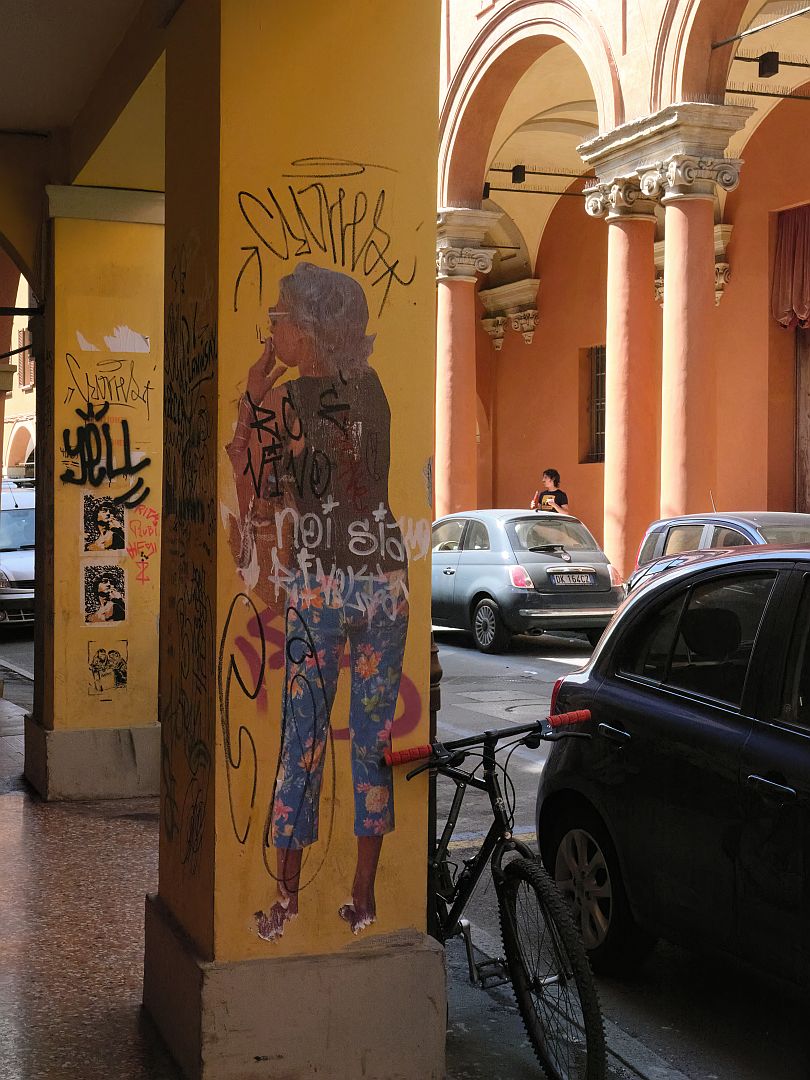
Modern graffiti and Renaissance architecture
Bologna – Renaissance architecture and modern street art in the university district. Fujifilm GFX 50R medium format digital camera, 32-64mm lens (click to enlarge).
Bologna university district
Bologna, university district. Fujifilm GFX 50R medium format digital camera, 32-64mm lens (click to enlarge).

In medieval Italy the term università was applied to any group of people who got together for a common purpose, like a trade guild or a charitable organisation. The correct term for a university in the modern sense was therefore a università degli studi or “university of studies”, a form you still see used in some contexts in Italy.

Most medieval universities did not have anything like colleges and certainly not a separate campus. Students lodged where they could, often in the houses of lecturers, and lectures took place wherever space might be found. Over time that changed, with kings, princes and – in Italy – wealthy churchmen founding colleges. I’m not sure how things had developed in medieval Bologna, but in the 16th Century the centre of town around the Piazza Maggiore was rebuilt to take on the form it has today, with the various palazzi, the Duomo and the Fountain of Neptune. And as part of this, the university was to find a home.
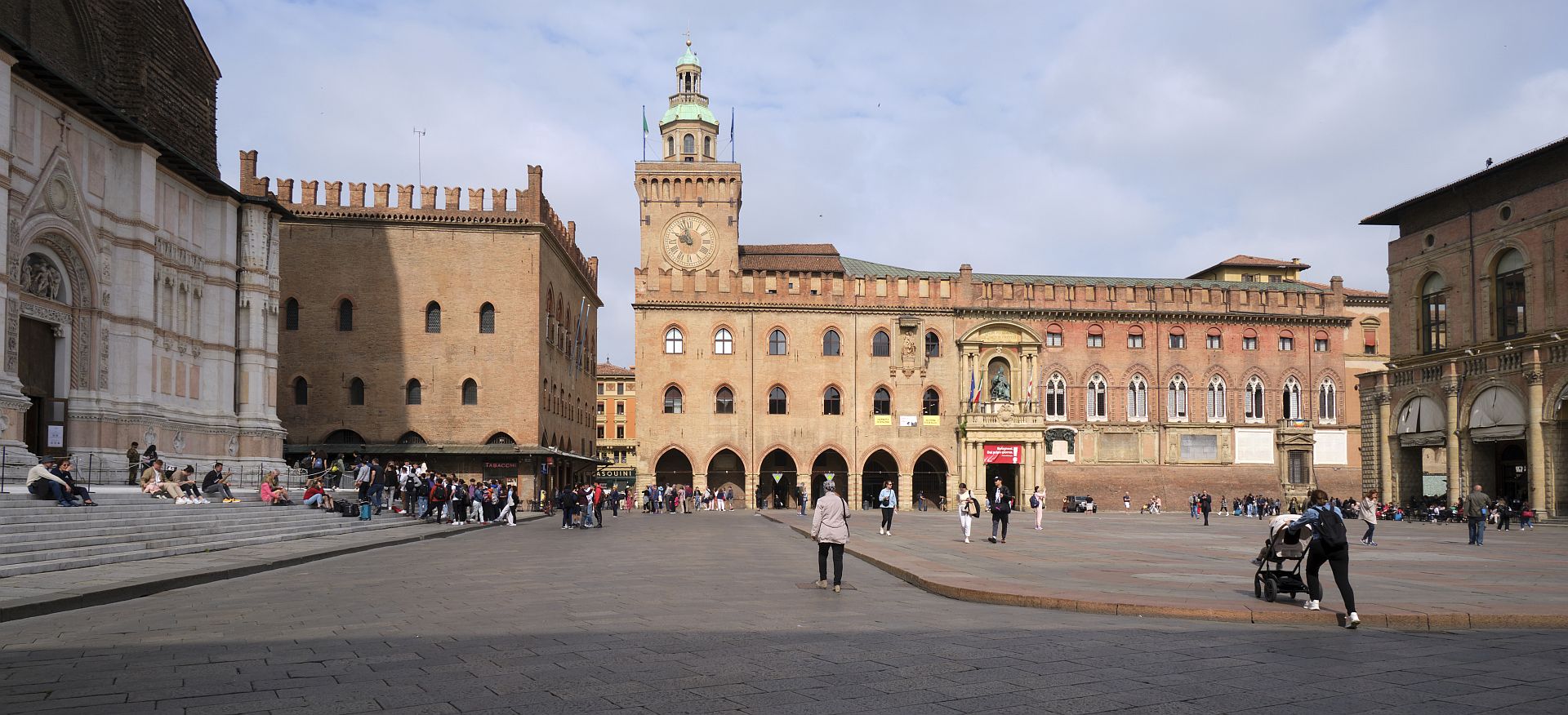
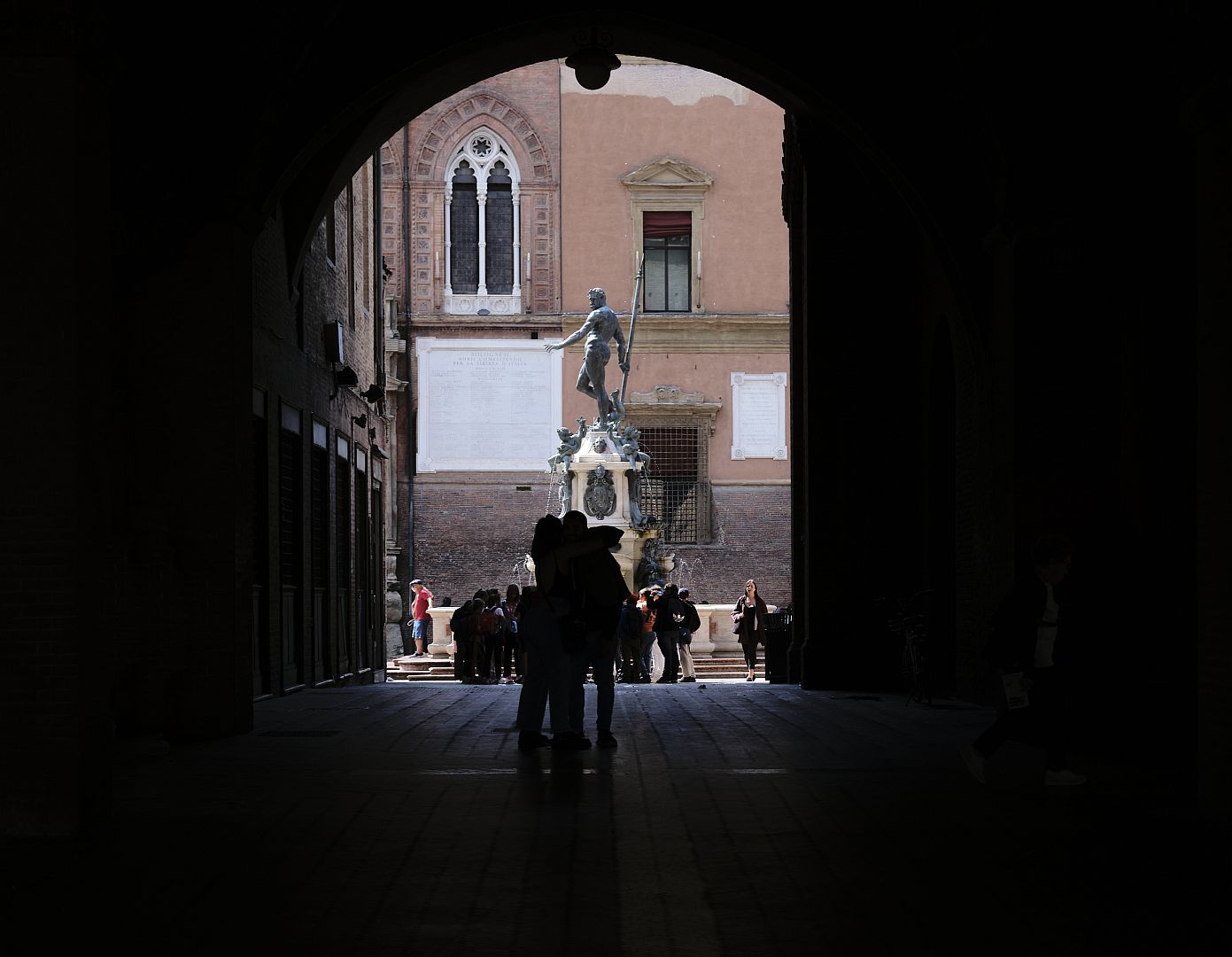
Bologna Piazza Maggiore
Bologna, the Piazza Maggiore more or less as it has been since the 16th Century. Fujifilm X-Pro 3 digital camera, 16mm lens (click to enlarge).
Bologna, a young couple embrace in the vault under the Torre Lambertini, part of the complex of buildings in the Piazza Maggiore, with the Fountain of Neptune in the background. This vault is also a “whispering gallery” – if two people stand at opposite sides of the vault, they can hear each other speaking quietly. Fujifilm GFX 50R medium format digital camera, 32-64mm lens (click to enlarge).

The Archiginnasio

On the southeastern side of the Duomo, the papal legate Carlo Borromeo (later canonised for helping organise the Counter-Reformation) found space in 1562 for construction of a single building to house both elements of the university – the schools of civil and canon law, and the schools of the “arts” – philosophy, medicine, mathematics, music and so on. This building was called the archiginnasio, or “arch-gymnasium”. In that era the Greek-derived term “gymnasium” was often used to describe a secondary school. I am guessing therefore that a place for tertiary education could therefore be called an “arch-gymnasium”.

The façade, with a long neoclassical colonnade, runs alongside the Duomo and Piazza Galvani. These days the colonnade hosts a few swanky cafes – the sort with uniformed waiters – and some expensive-looking shops.
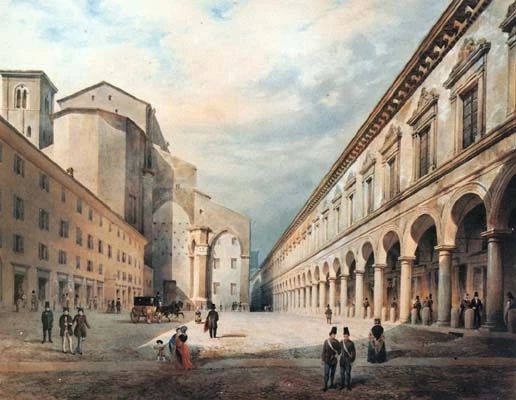
!9th Century painting of the Archiginnasio
A 19th-Century painting of the facade of the Archiginnasio, on the right, with the Duomo at the far left. Unattributed painting from the website of the Biblioteca Comunale dell’Archiginnasio (click to enlarge).
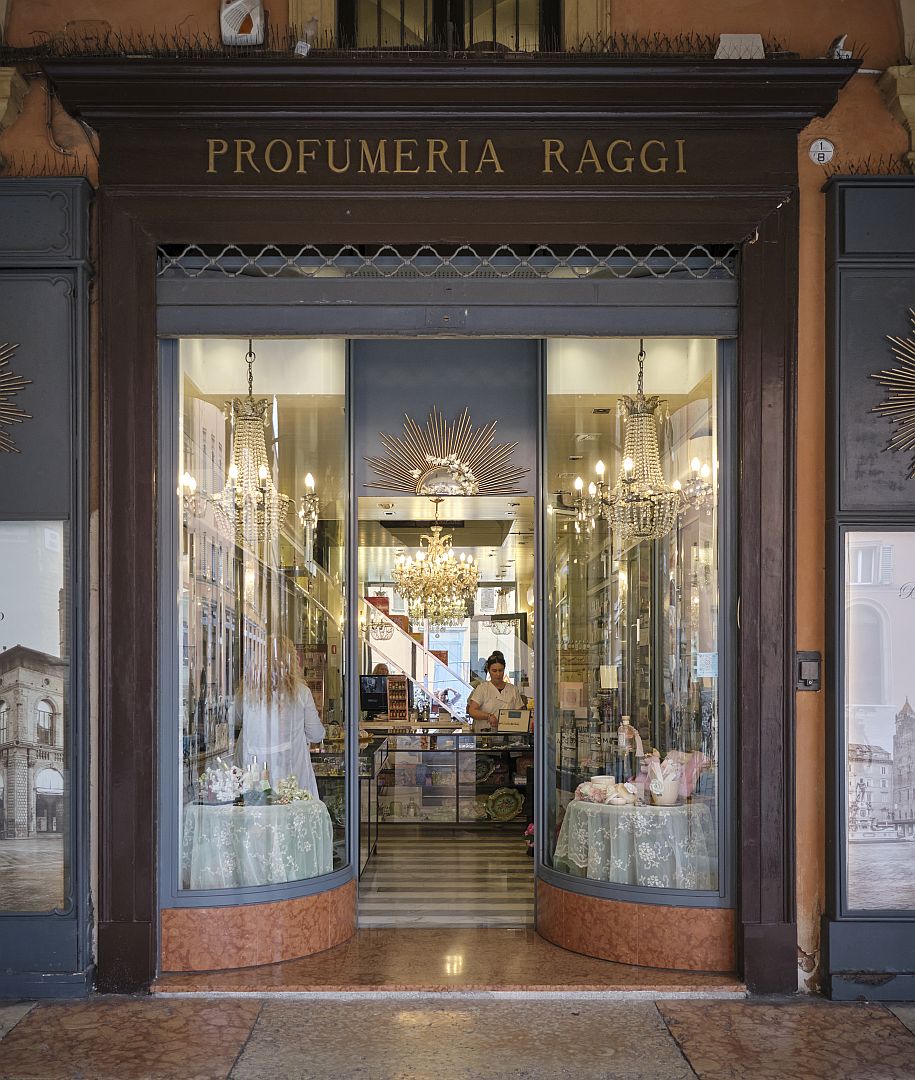
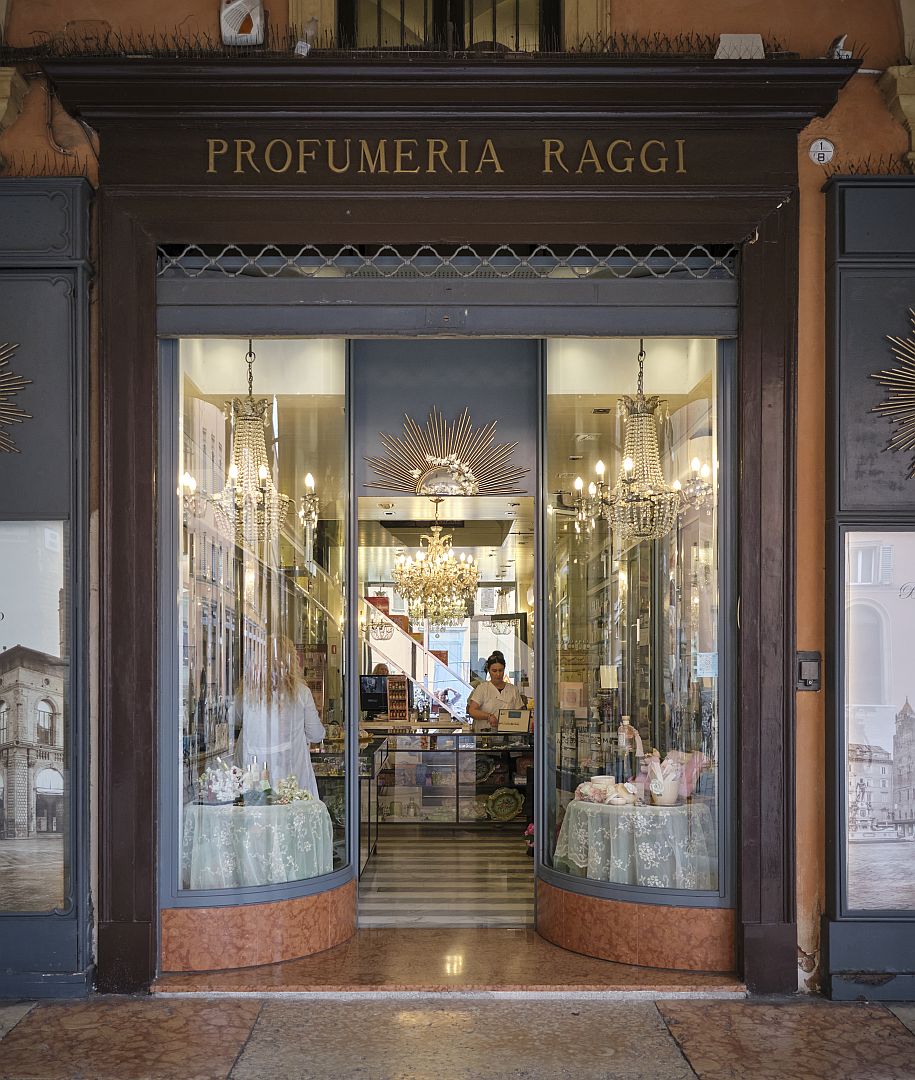
Profumeria Raggi
An expensive-looking perfume shop in the gallery behind the colonnade. Fujifilm X-Pro 3 digital camera, 16mm lens, cropped (click to enlarge).
Carvings on the entrance to the archiginnasio
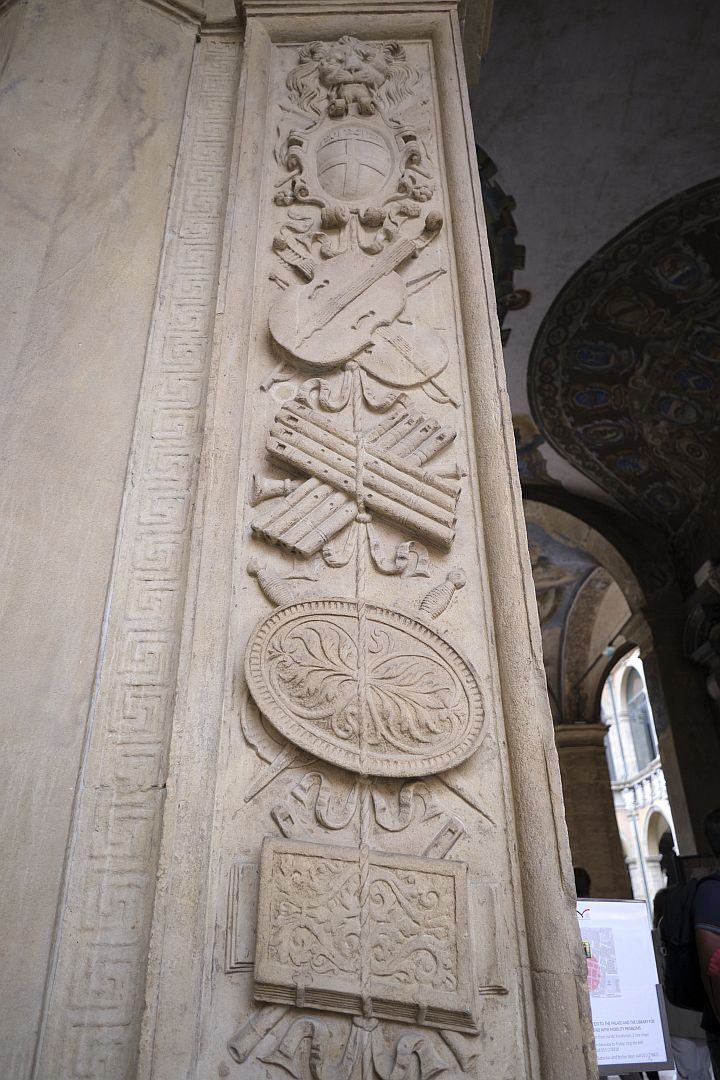
Carvings on the doorway of the Archiginnasio. Music was studied here, which explains the musical instruments. But the swords and shield? It wasn’t a military academy as far as I know. Fujifilm X-Pro 3 digital camera, 16mm lens (click to enlarge).

The Coats of Arms

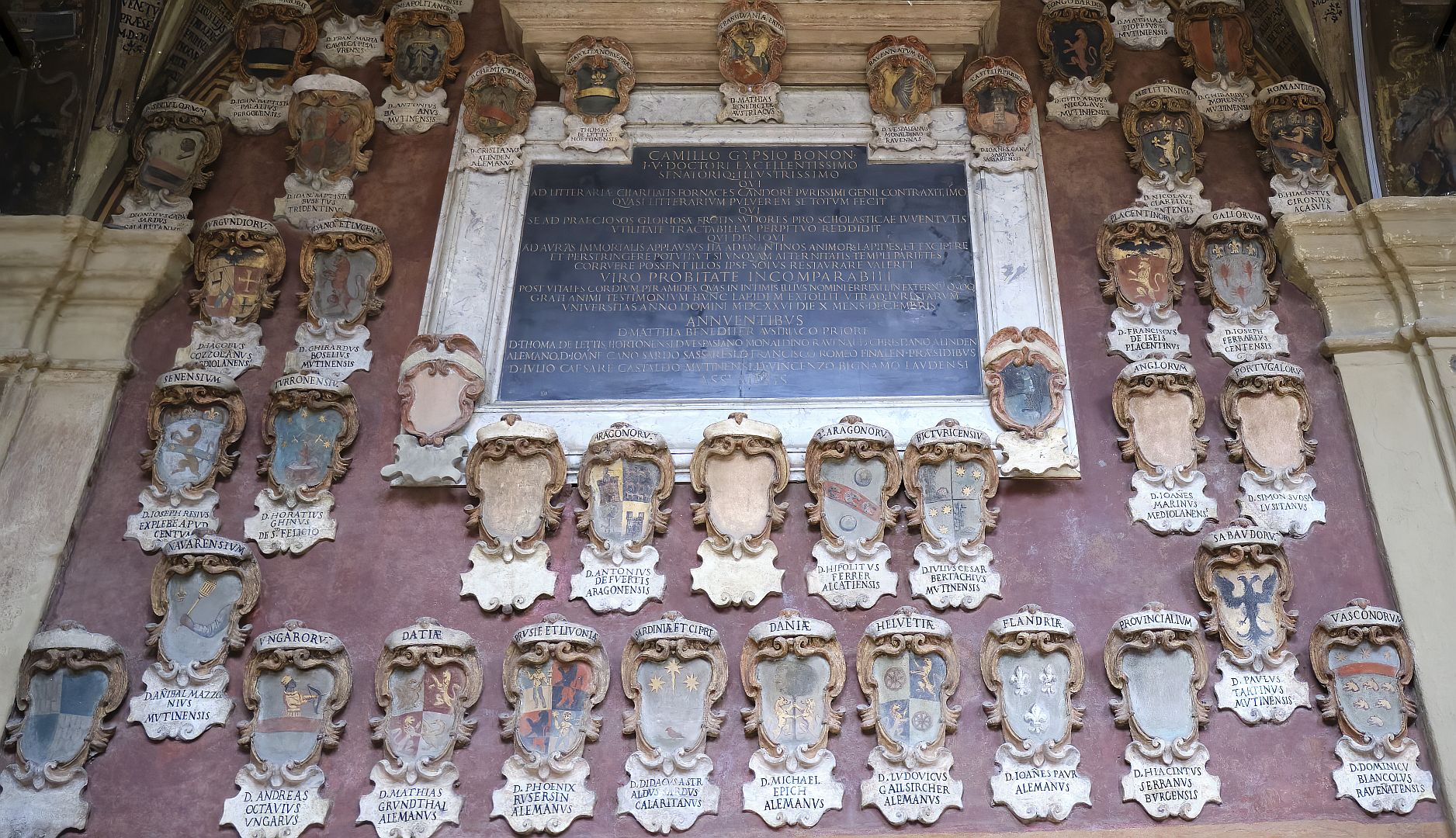
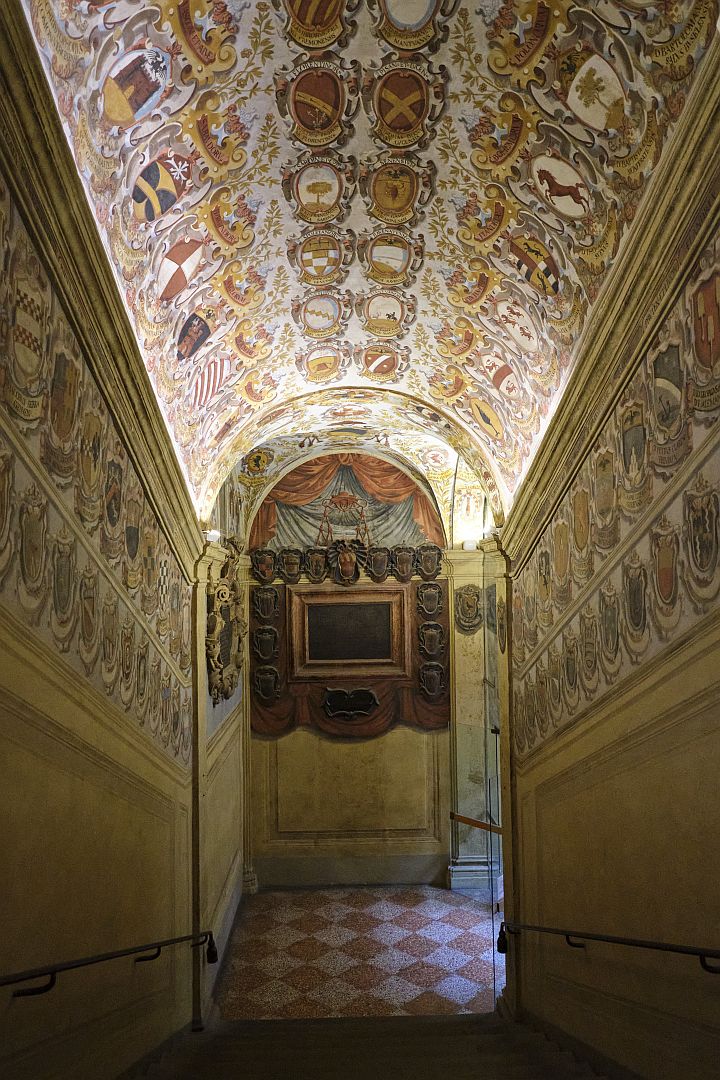
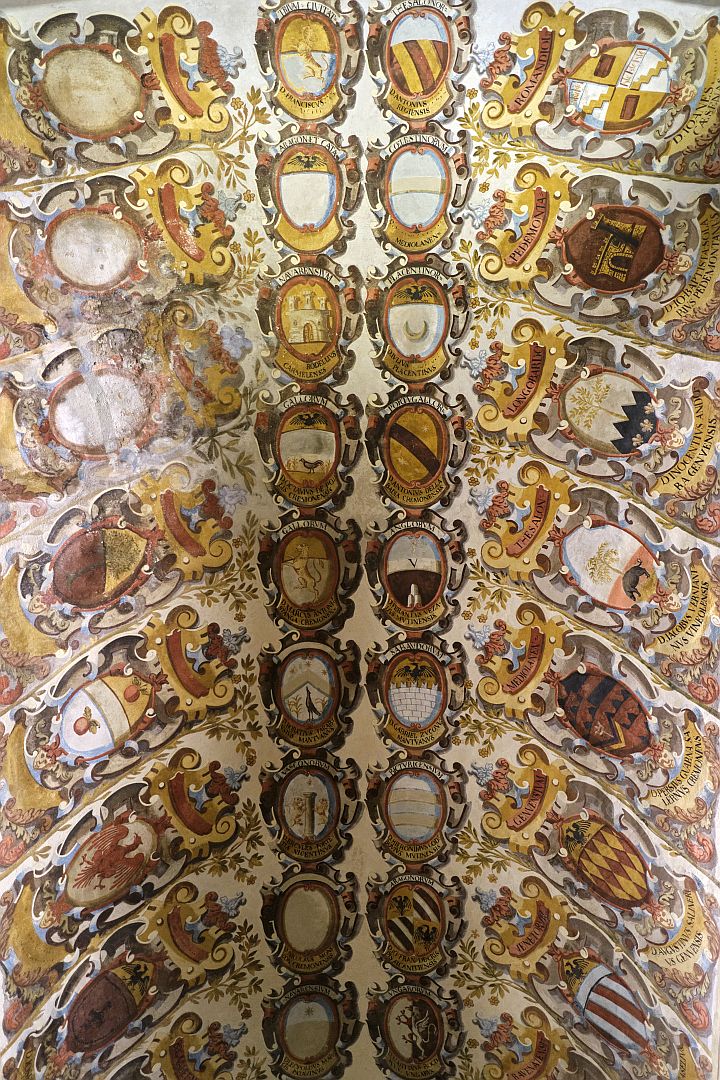
Going through the entrance, you enter the central courtyard, and immediately notice that every surface on the walls and ceilings is covered with coats of arms. Each coat of arms carries, in Latinised form, the name of a country (or duchy, principality or whatever), someone’s name, and a placename. Sometimes the placename is a city, sometimes a country.
Coats of Arms
Just a few of six thousand or so coats of arms in the Archiginnasio. Fujifilm X-Pro 3 digital camera, 16mm lens, cropped (click to enlarge)

What’s going on? Well it seems that the students, who came from all over Italy and Europe, organised themselves into societies based on where they came from, called “nations”, and elected one of their number to represent them. These society presidents had the honour of having their coats of arms fixed to a wall or ceiling, with an inscription about which “nation” they represented, their name, and where they came from. In the picture above, examples include the “nations” of Aragon, Hungary, Switzerland (Helvetiae), Flanders and Portugal. Some are cities like Piacenza (Placentinoria) or Siena (Senesium).

There are a couple of surprises there. Sardinia and Cyprus? That is explained by the fact that the titular crown of Cyprus maintained its own theoretical existence long after the place itself had fallen to the Ottomans, passing from one European royal family to another and ending up with the house of Savoy, which ruled Sardinia. Its representative is described as Sardus Calaritanus, ie. a Sardinian from Cagliari. However Savoy itself (Sabaudorum) being only a duchy, was separately represented.

You can also see that the representatives of the “nations” are not always described as having come from there. So the representatives of England (Anglorum) and Burgundy are described as Mediolanensis which means “from Milan”. And the representatives of Denmark, Switzerland and Flanders are all described as Alemanus which I initially assumed meant “German”, but I then discovered that it could be used to refer to anyone from the Habsburg Holy Roman Empire.

Someone has gone to the trouble of digitising every single one of these, and made them into a searchable database, which you can find here. So if you think you have an ancestor who studied here in the 16th or 17th Centuries, you can search for him here using a Latinised version of his name. Or you can search for everyone from Belgium, for example.
Coats of arms
Lots of coats of arms. Fujifilm X-Pro 3 digital camera, 16mm lens (click to enlarge)
Coats of arms
Even more coats of arms. Fujifilm X-Pro 3 digital camera, 16mm lens (click to enlarge)

An additional wrinkle – which may explain some of the discrepancies between the “nation” and the provenance of the president – is that at this time several of the territories mentioned were by now Protestant, and, during the Thirty Years War, engaged in active hostilities with the Catholic powers. On how this might have affected the students in Bologna, the sources I have consulted are silent. But it is intriguing nonetheless: what stories lie behind these little memorials? How did an Englishman named Joannes Marinus (John the Mariner?) find his way to Bologna via Milan? What was he studying?

The Library and the “Stabat Mater” Room

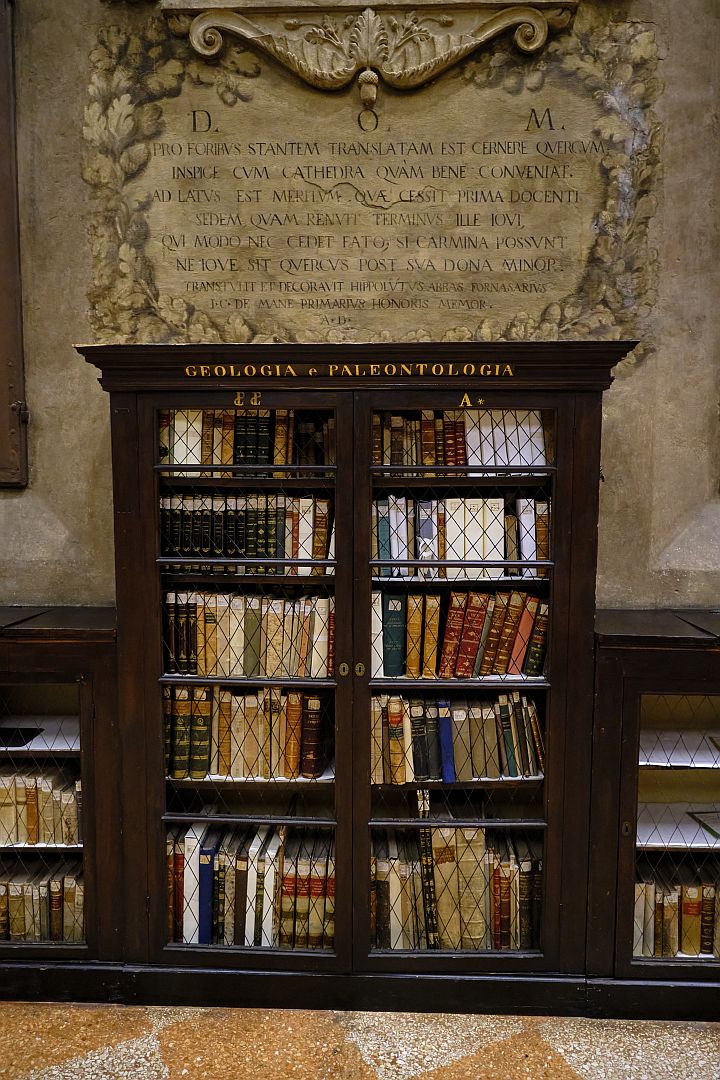
One is hardly surprised to find that a university has a library, but in fact this one only dates from 1801, and moreover the impetus for its foundation was because they needed somewhere to store the books from the religious institutions suppressed during the period of Napoleonic government in Italy.
Library
A bookcase in the library. Fujifilm X-Pro 3 digital camera, 16mm lens (click to enlarge)

Now it is a public library, which any resident of Bologna can use. But as well as borrowing the latest Dan Brown paperback, they can also access five hundred year old editions, which is pretty cool.
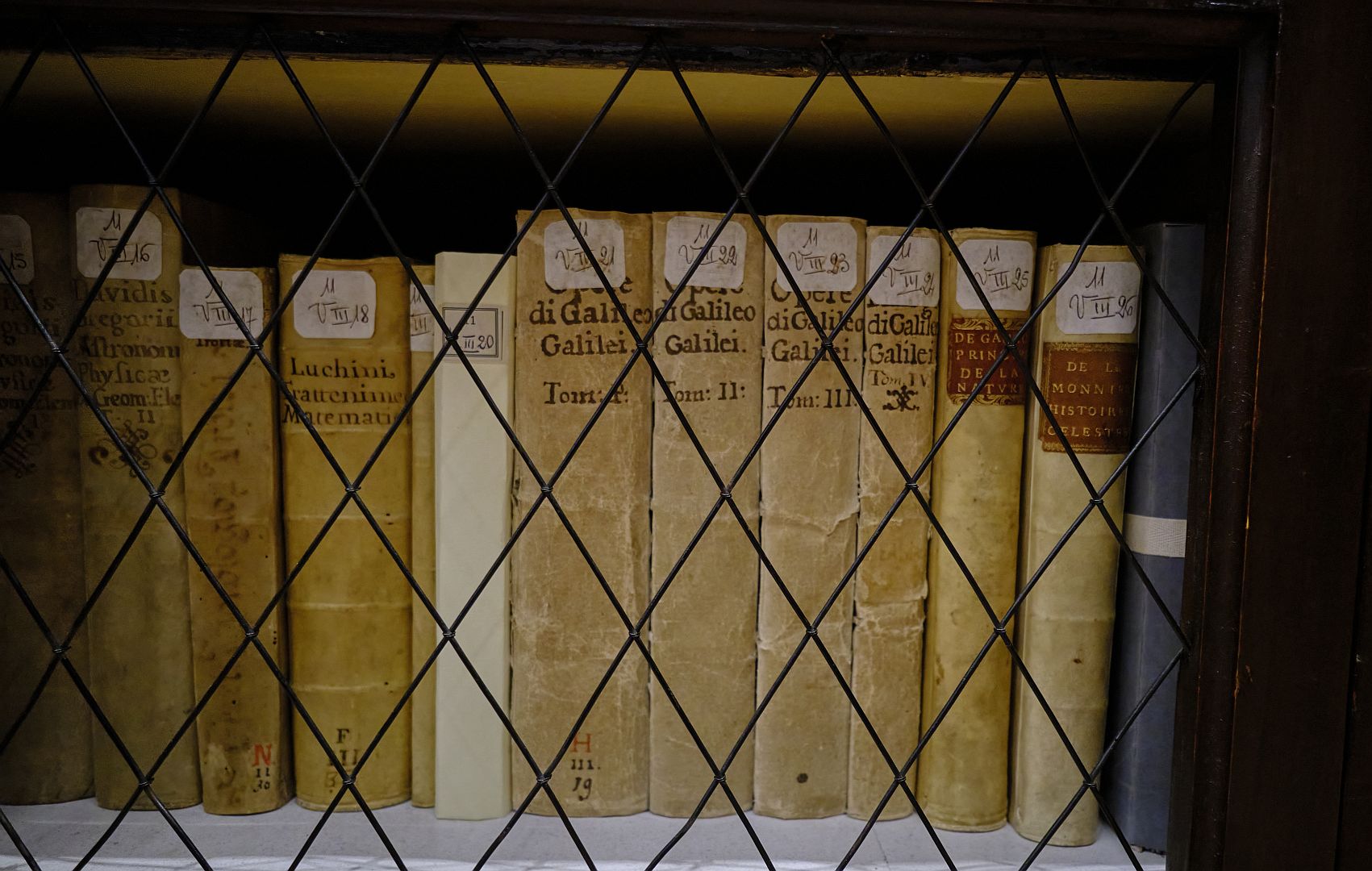
Books in the library including Luchini and Galileo
Books by Luchini and Galileo in the mathematics section. Fujifilm X-Pro 3 digital camera, 16mm lens (click to enlarge)

Part of the library is a large room which today is known as the “Stabat Mater” Room because it was here that Rossini’s setting of Stabat Mater Dolorosa had its first Italian performance in 1842, conducted by Donizetti. The text is a 13th-Century religious poem by the Umbrian Franciscan friar and poet Jacopone da Todi. Interestingly, before he took on his spiritual calling, Jacopone had been a lawyer who took his degree here at Bologna. It would be nice to think that had something to do with the choice of venue, but it probably did not.
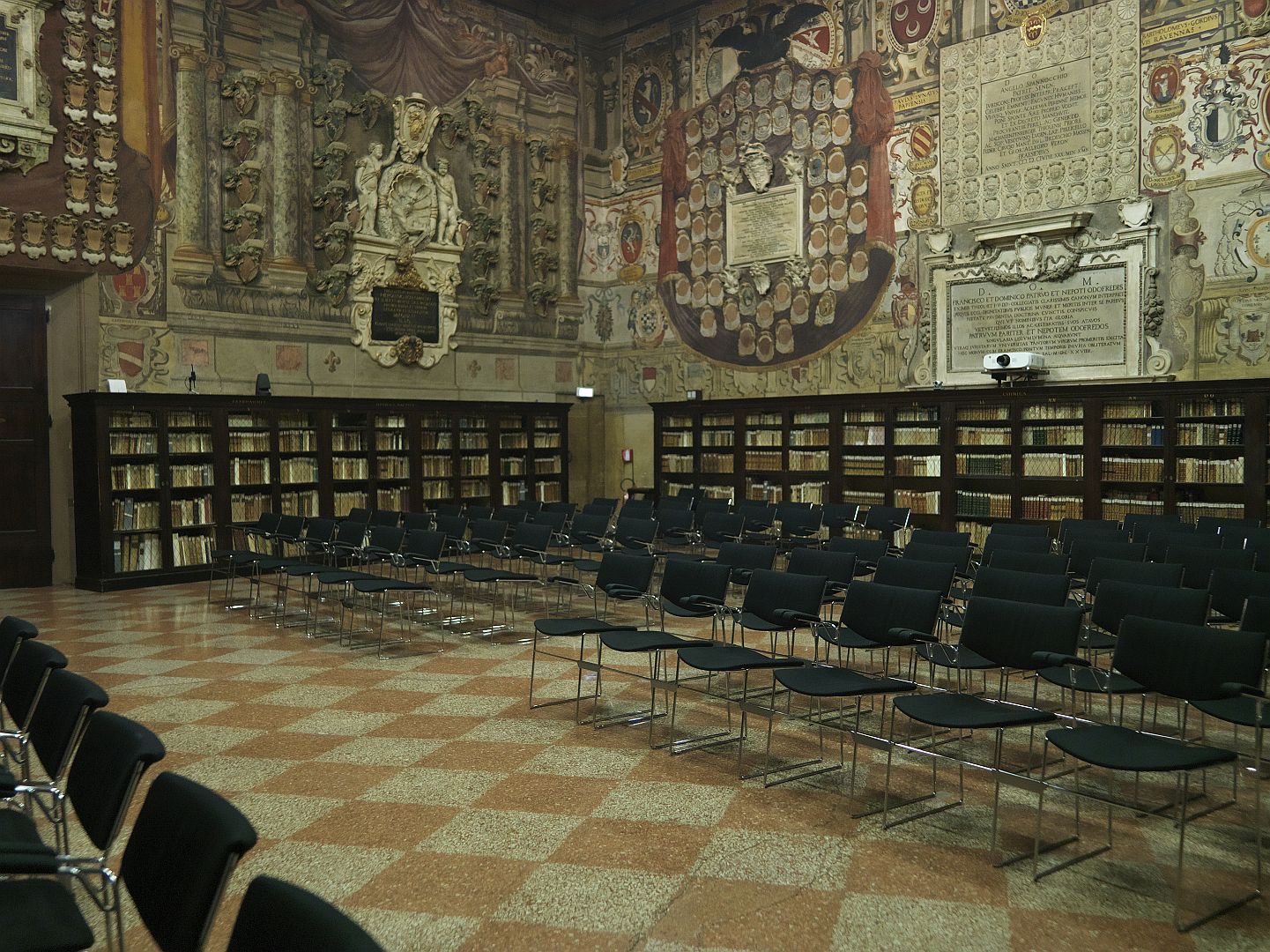
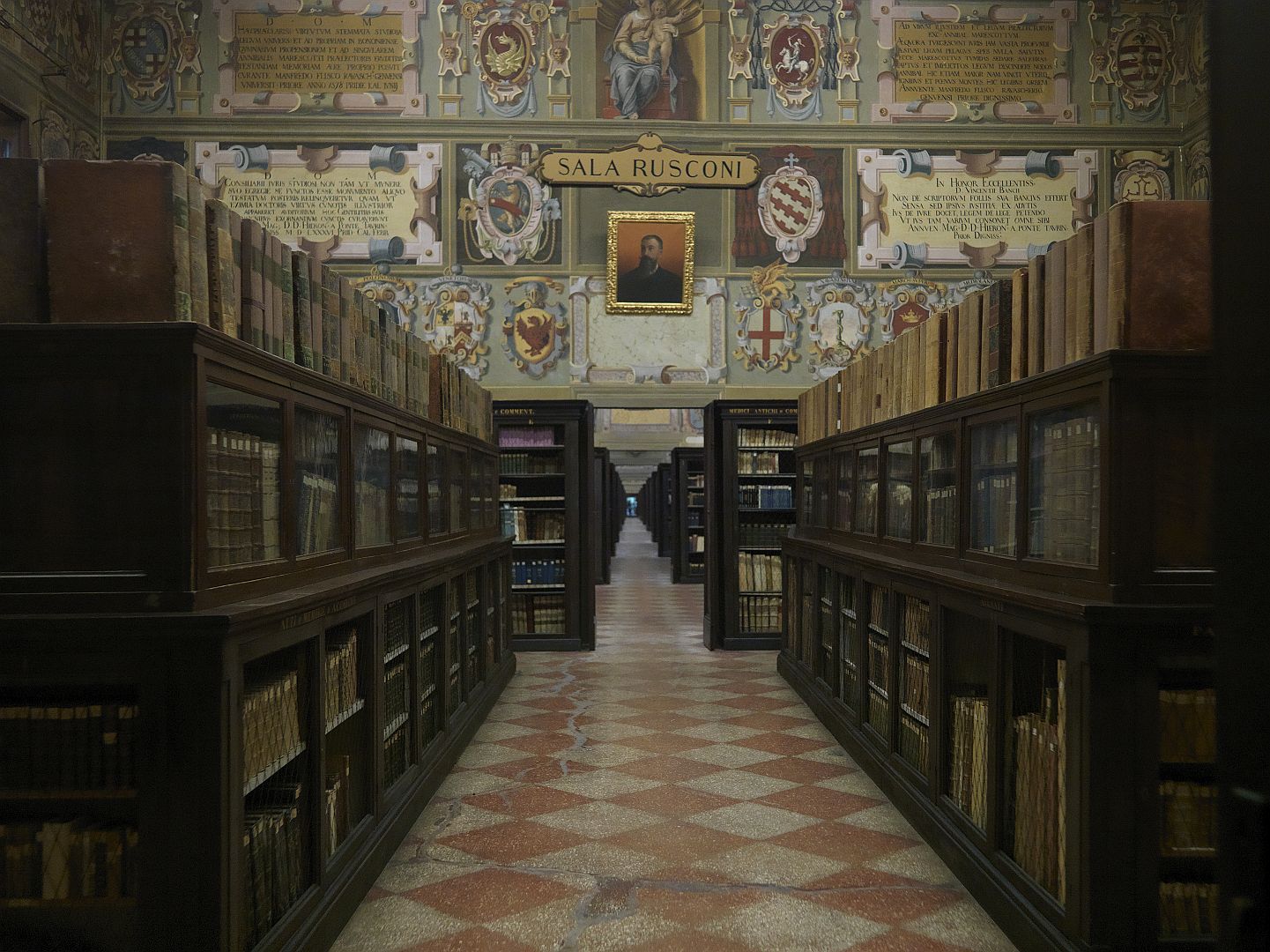
Stabat Mater Room
The “Stabat Mater Room” with a few more coats of arms. Hasselblad 501 C/M camera, Zeiss Distagon CF 60mm lens, CFV-50c digital back (click to enlarge).
The “Rusconi Room” in the University Library. If you look hard, you might be able to make out some more coats of arms. Hasselblad 501 C/M camera, Zeiss Distagon CF 60mm lens, CFV-50c digital back (click to enlarge).

The Anatomy Theatre

One of the “arts” taught at the university was medicine. The Catholic Church had long banned the dissection of cadavers in order to study anatomy, so pioneers like Leonardo da Vinci had to be a bit circumspect about it. However over the course of the 16th Century it became generally recognised that dissection was necessary to the proper understanding of the human body, and universities built special lecture theatres for the purpose. Rembrandt’s famous The Anatomy Lesson of Dr. Tulp, showing such a dissection, dates from 1632 (the Amsterdam Guild of Surgeons, which commissioned the painting, only allowed one public dissection a year, and the corpse had to be that of an executed criminal).

Bologna’s anatomy theatre dates from 1637, but of the original only the ceiling survives – what we see today mostly dates from the 1730s. In the centre of the room is a marble slab for the cadaver, while at the end of the room is a high desk for the lecturer – from which we can deduce that he had an assistant to do the actual messy stuff.

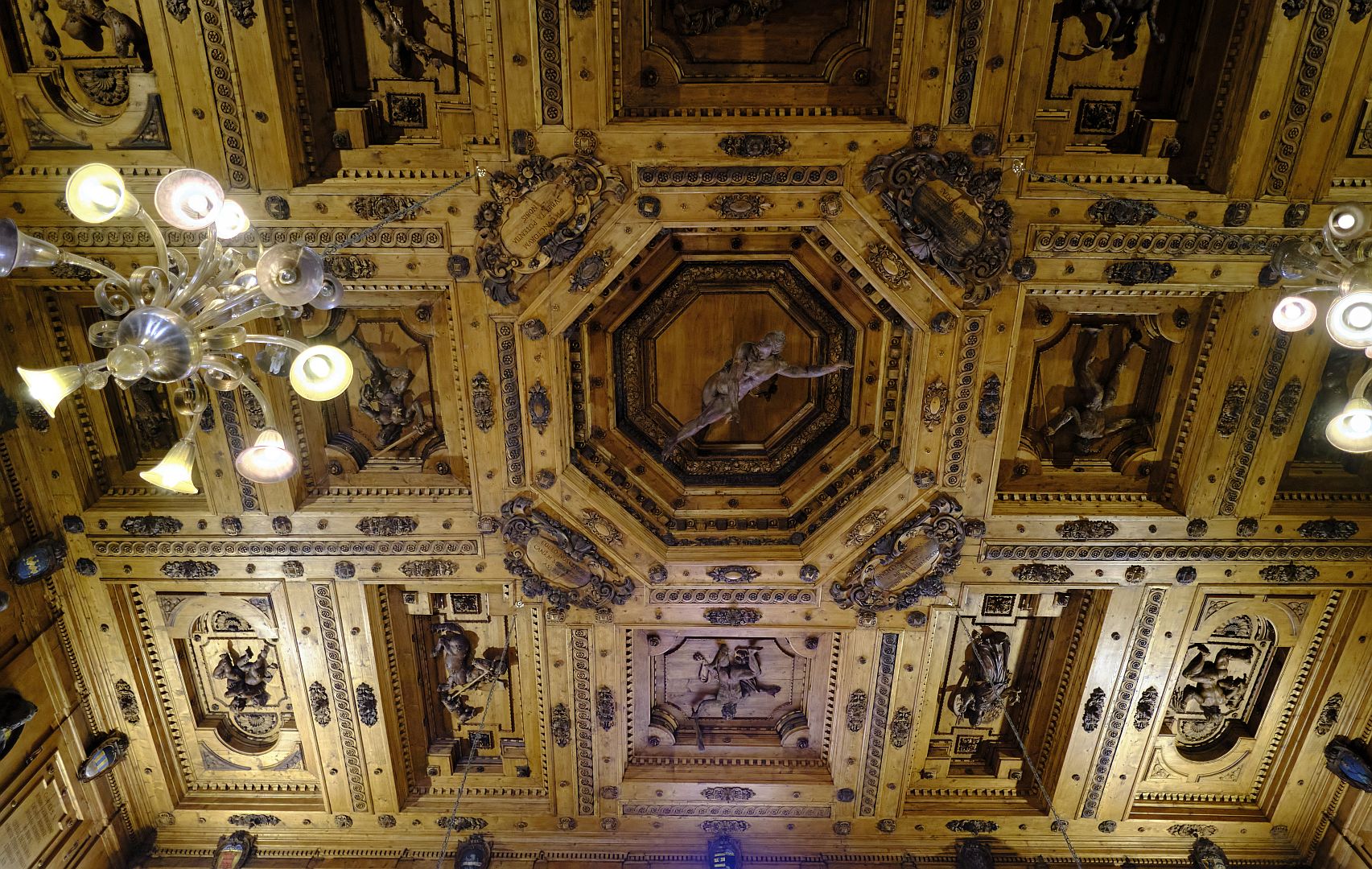
The walls and ceiling are all of elaborately-carved wood. Allegorical and zodiacal themes represent medicine and anatomy, and two rows of statues and busts around the walls represent the great physicians of antiquity (Hippocrates, Galen and so on) and famous doctors and anatomists of the Renaissance.
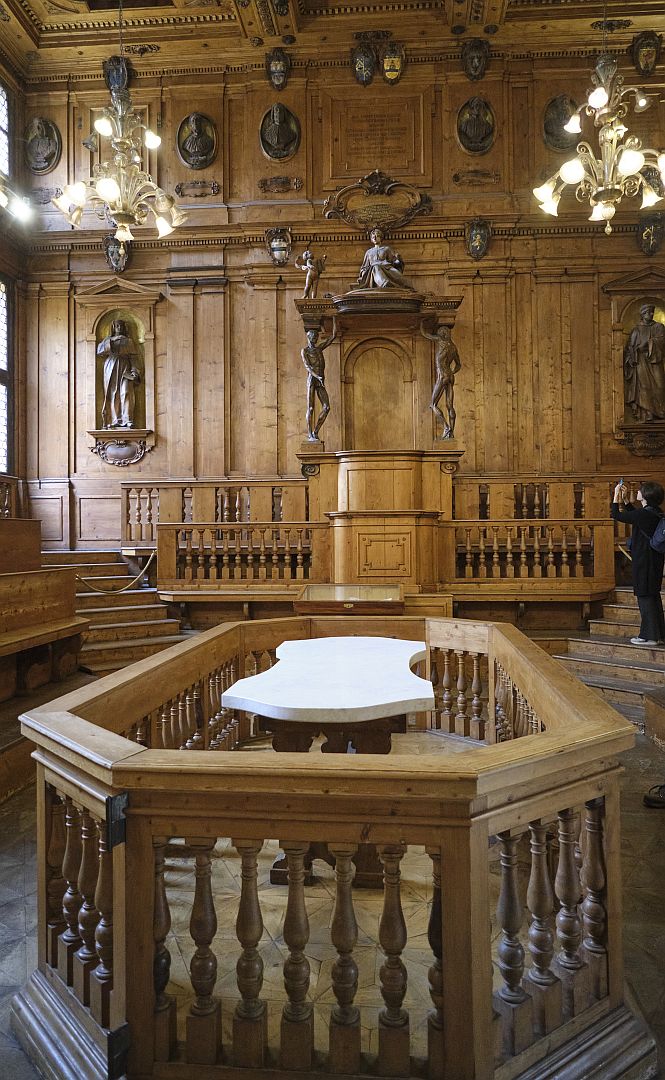
Anatomy theatre
The Anatomy Theatre, with the dissection slab in the foreground, and the lecturer’s desk behind, with statues and busts of famous physicians on the walls. Fujifilm X-Pro 3 digital camera, 16mm lens (click to enlarge).
Anatomy Theatre Ceiling
The ceiling of the Anatomy Theatre. Fujifilm X-Pro 3 digital camera, 16mm lens (click to enlarge).

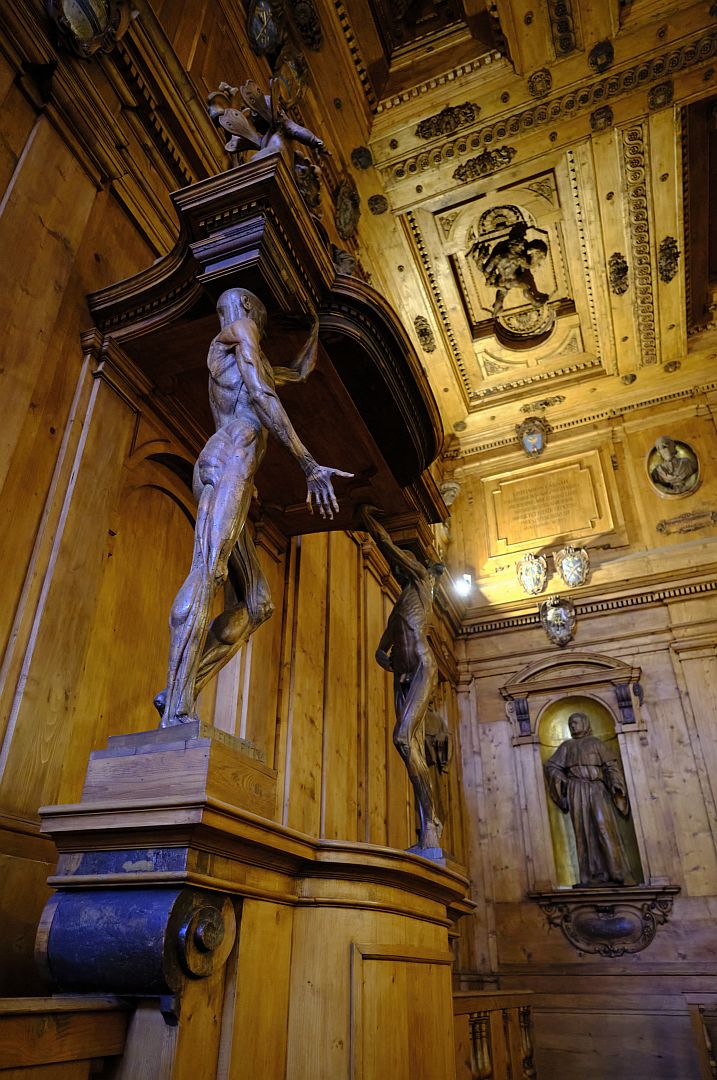
The most memorable statues are the two spellati (skinned ones), either side of the lecturer’s desk, and holding up the wooden canopy. These anatomically accurate (I assume; I’m not an expert) figures show the muscles underneath the skin. Although they are wooden carvings, they are the work of a craftsman who was expert in the preparation of anatomical models made of wax for teaching purposes.
The Spellati or skinned ones
The Spellati or “Skinned Ones”. Fujifilm X-Pro 3 digital camera, 16mm lens (click to enlarge).

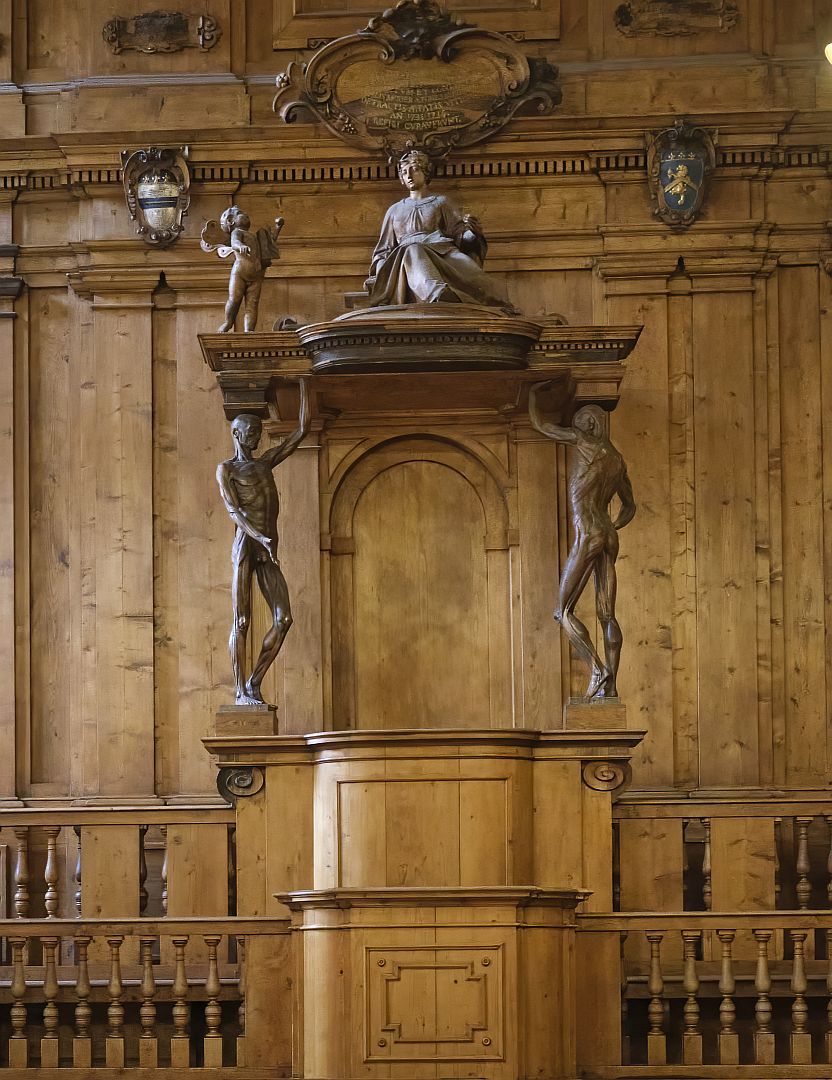
On top of the canopy is a female figure representing the art of anatomy, and in a sort of anatomists’ joke, a cherub is offering her, not a flower as such scenes would normally show, but a human femur. Those anatomists must have been a bundle of laughs.
Lecturer's desk
The lecturer’s desk, with the Spellati on either side and the allegorical figure of anatomy above. Fujifilm X-Pro 3 digital camera, 16mm lens, cropped (click to enlarge).

Disaster struck on 29 January 1944, when Allied bombs destroyed much of the building. Fortunately the statues and carvings survived in good enough condition to be rescued from the wreckage and restored. The wood panelling was replaced.

A final observation: I saw a television documentary in which a respected presenter said that there was a sliding panel in the theatre, concealing a space from which members of the Inquisition could observe lectures and intervene if the lecturer strayed into doctrinally forbidden territory. However I saw no evidence of this in the room itself, and no reference to it in any of the online sources. So appealing as the story might be, I suspect that it might be an urban myth – perhaps nurtured by Bologna’s famous anti-clericalism.
Night Photography in Bologna

Earlier this year we visited Bologna and I published a short post of street photography – people and shops. Recently we went there again and I was able to get in some evening and night photography. Again, these were taken on my Fujifilm X-Pro3 camera which is assuming a similar place in my affections to my old Contax G1 35mm film camera.

Bologna Via Altabella
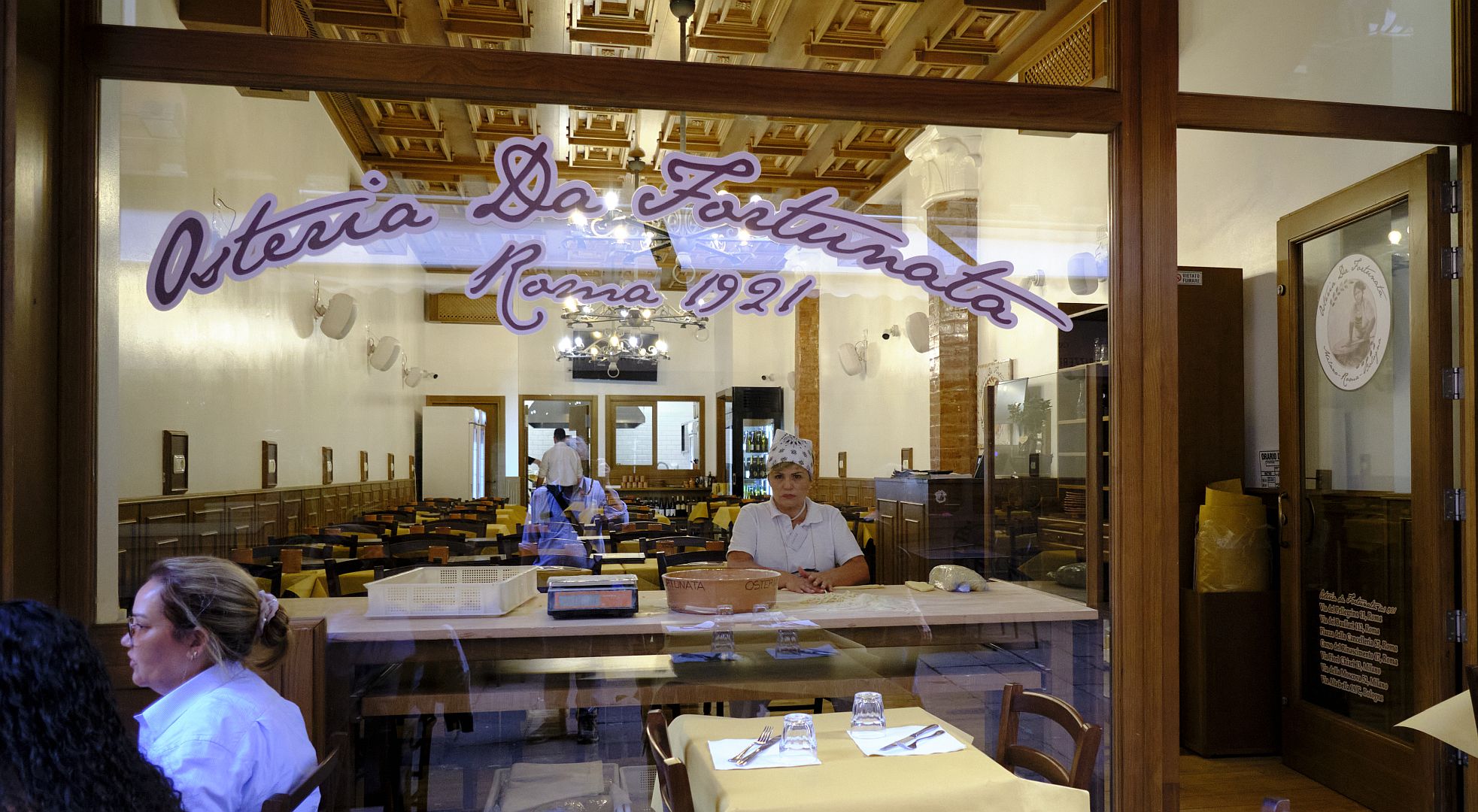
Bologna, Via Altabella. The lady was making pasta in the front window, and although she looks a bit disapproving in this shot, a moment later she rewarded me with a dazzling smile (which I wish I had taken). Fujifilm X-Pro3 camera, Fujifilm XF 16mm lens (click to enlarge).

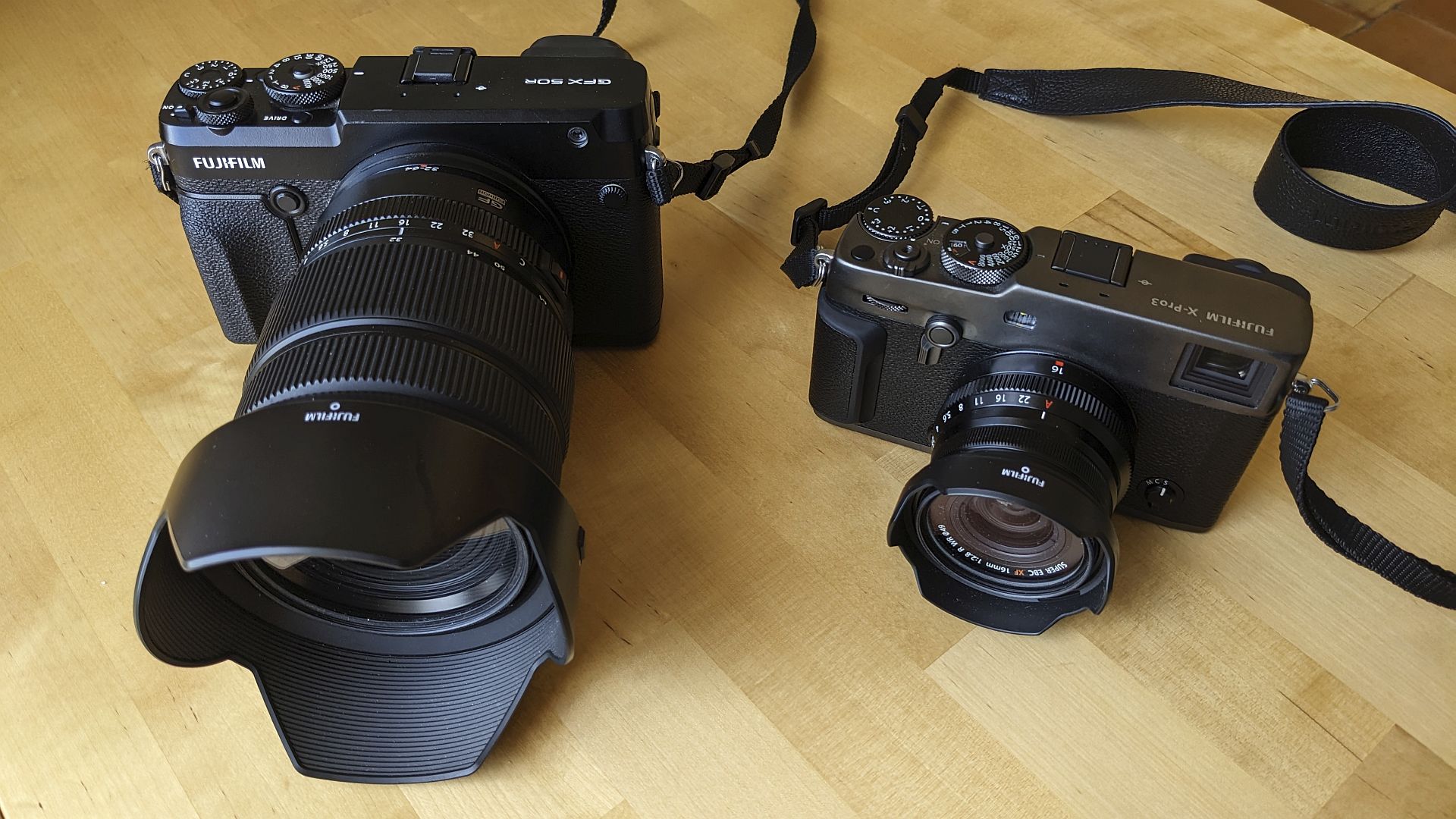
In terms of image quality the X-Pro3 cannot match my medium-format Fujifilm GFX 50R camera with its much larger sensor, but it has its advantages. It is small and unobtrusive compared to the larger camera, and much lighter – where the GFX 50R has brass and steel, the X-Pro3 has magnesium and titanium. And the lenses for larger cameras need more glass, which adds weight. As a result the X-Pro3 with a 16mm lens weighs a bit over 700 grams, while the GFX 50R with its 32-64mm lens weighs in at over 1.7 kilograms.
Fujifilm GFX 50R and X-Pro3
Fujifilm GFX 50R and X-Pro3 comparison (click to enlarge).

Of course night photography has challenges – as the light in the sky fades, shadows become darker and you need to boost the ISO, which makes the resulting images noisier, which is to say more grainy. Modern software can help a lot with noise reduction – I use something called Topaz DeNoise AI.

Bologna Evening
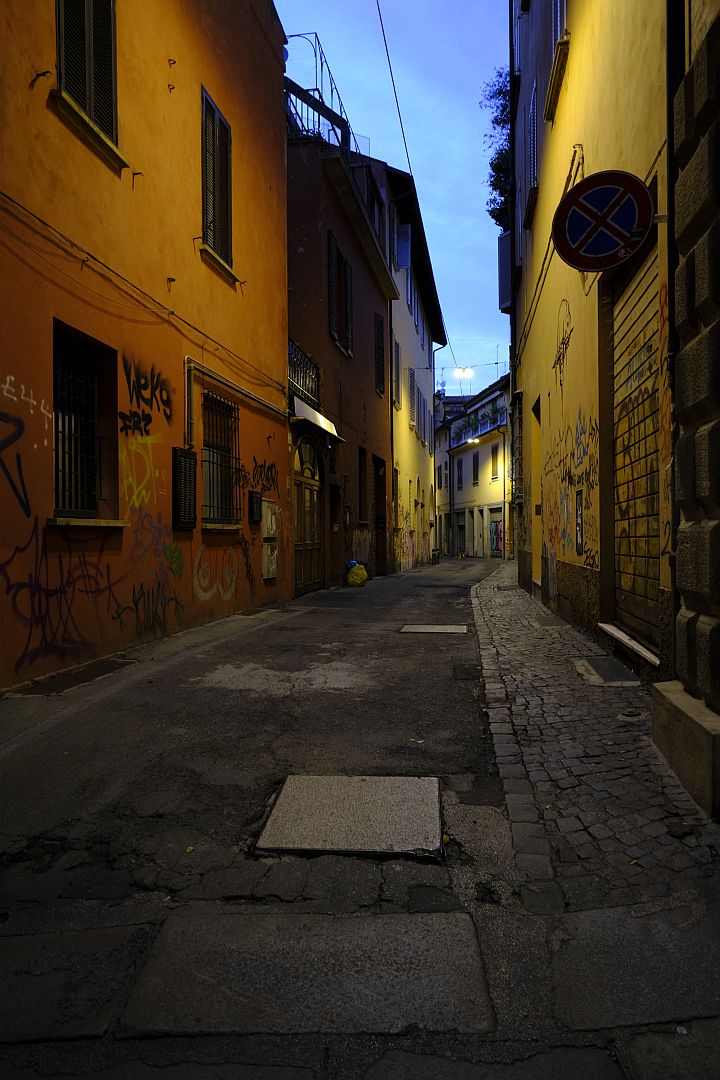
Evening in a back street, Bologna. Fujifilm X-Pro3 camera, Fujifilm XF 16mm lens (click to enlarge).

One of the best times is when the light in the sky is at about the same level as that illuminating the objects you are photographing. This period is quite short, although it lasts a bit longer in summer. Digital post-processing does allow you to extend that period by adjusting highlights and shadows, but if overdone it will look artificial.

Bologna evening
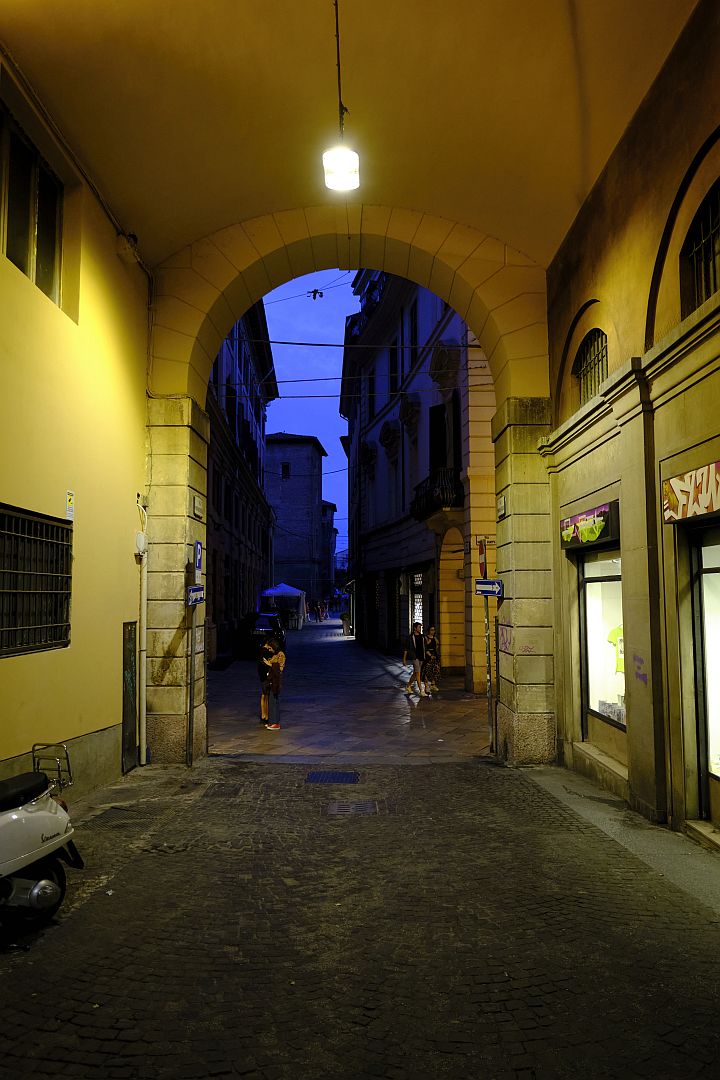
A well-lit archway with blue natural light beyond, Bologna. Fujifilm X-Pro3 camera, Fujifilm XF 16mm lens (click to enlarge).

I was using a wide-angle lens, which has some disadvantages – objects and people appear smaller. But it has some advantages for street photography. The wide angle allows you to point the camera past people rather than at them, while still getting them in the composition.

Bologna evening
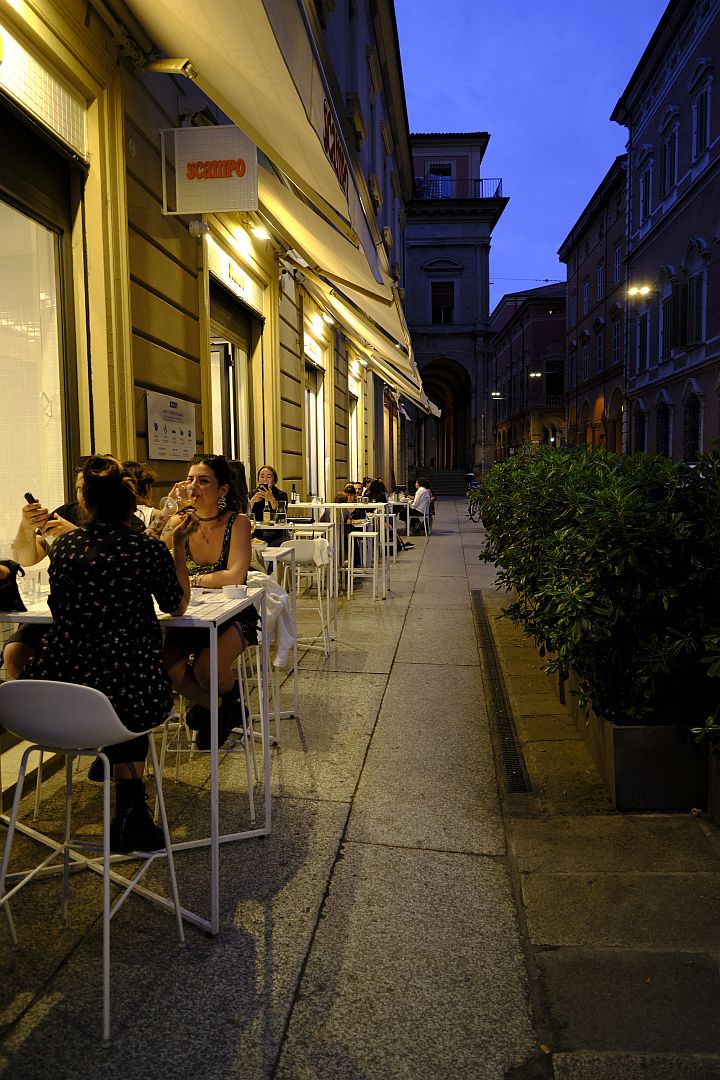
Diners at a street-side trattoria, Bologna. Fujifilm X-Pro3 camera, Fujifilm XF 16mm lens (click to enlarge).

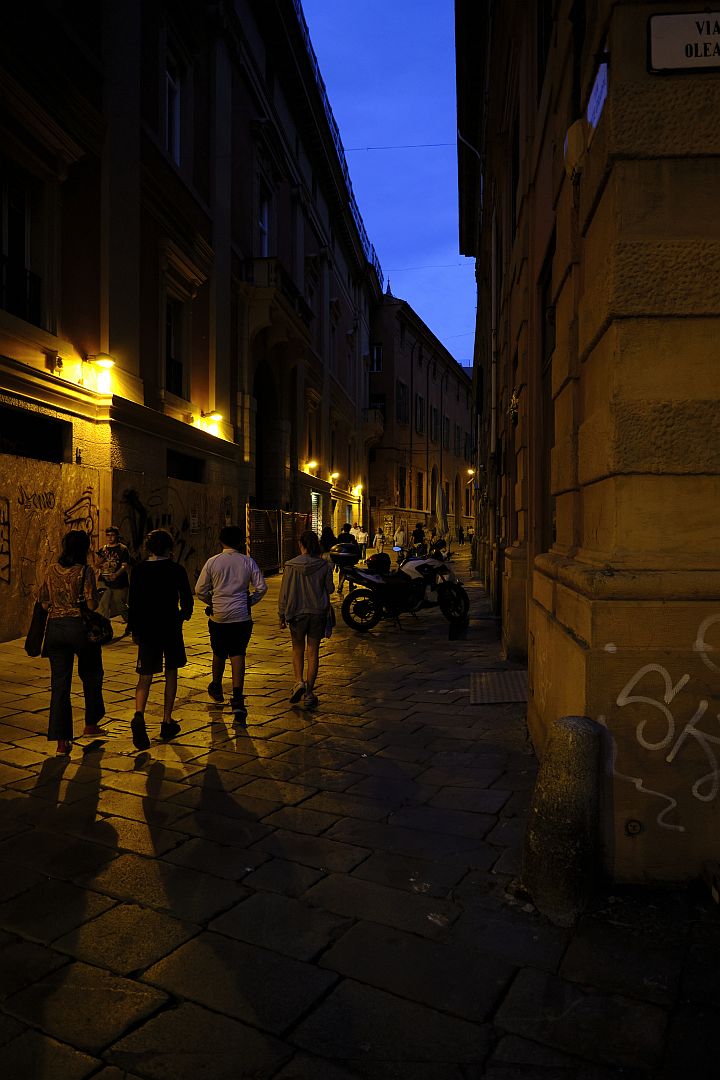
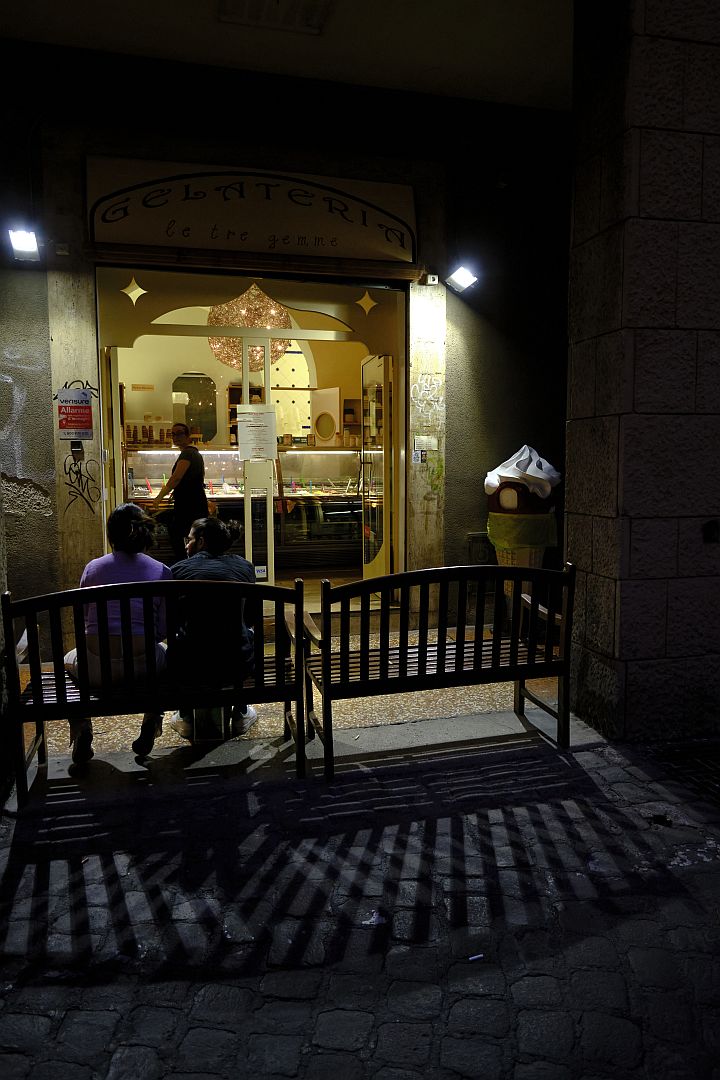
Wide-angle lenses can also give you a lot of foreground in the shot, which is not a good thing if the foreground is boring. On the other hand if you can make the foreground interesting, for example by looking for people casting long shadows, it can add to the mood, or even become one of the subjects of the composition.

Bologna evening
Making the shadows part of the composition, Bologna. Fujifilm X-Pro3 camera, Fujifilm XF 16mm lens (click to enlarge).
Bologna night photography
In this case, the shadows cast by the backs of the seats are what first caught my eye. Gelateria, Bologna. Fujifilm X-Pro3 camera, Fujifilm XF 16mm lens (click to enlarge).

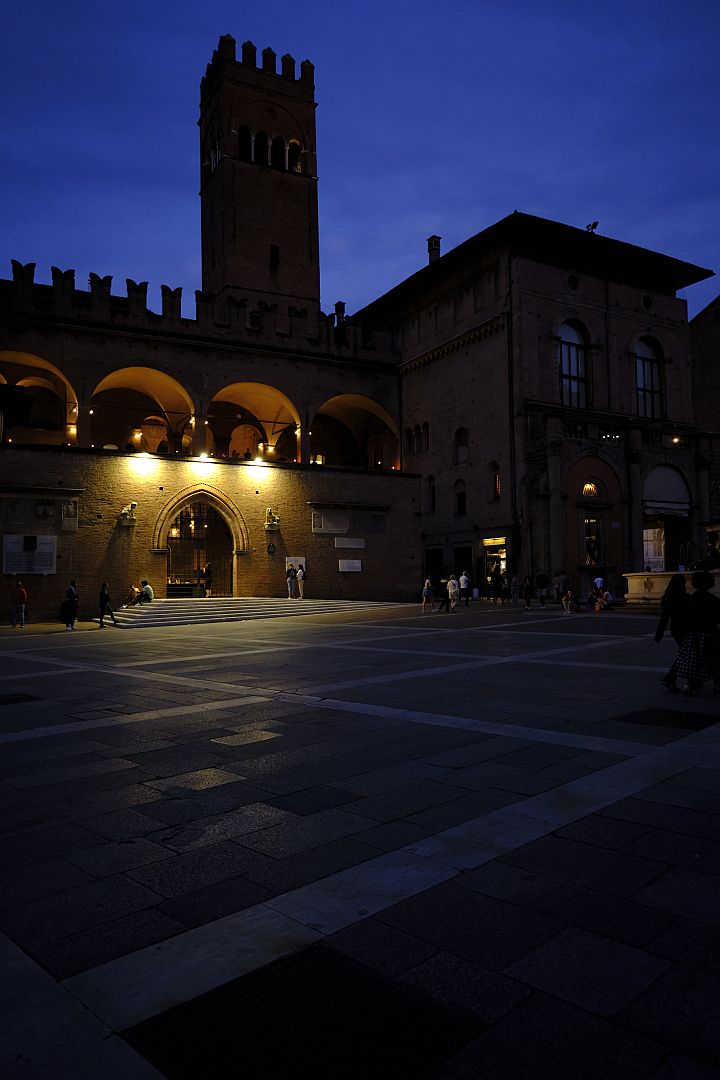
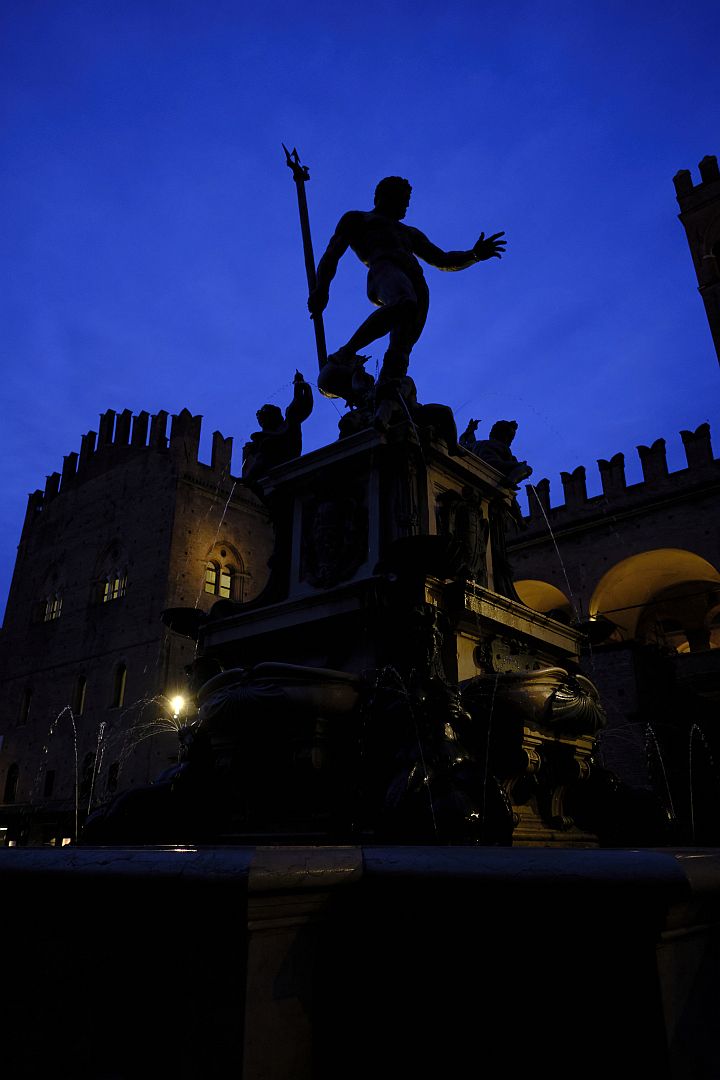
By the time we got to the main piazza, the sky was getting a lot darker, but was still bright enough to create silhouettes. Silhouettes in night photography can be overrated, but when they are instantly recognisable like the Statue of Neptune, they can be worth it.

Bologna evening
Piazza Grande, Bologna. Fujifilm X-Pro3 camera, Fujifilm XF 16mm lens (click to enlarge).
Statue of Neptune, Bologna
Statue of Neptune, Bologna. The shape of his trident was borrowed by the Maserati brothers as a badge for their cars. Fujifilm X-Pro3 camera, Fujifilm XF 16mm lens (click to enlarge).

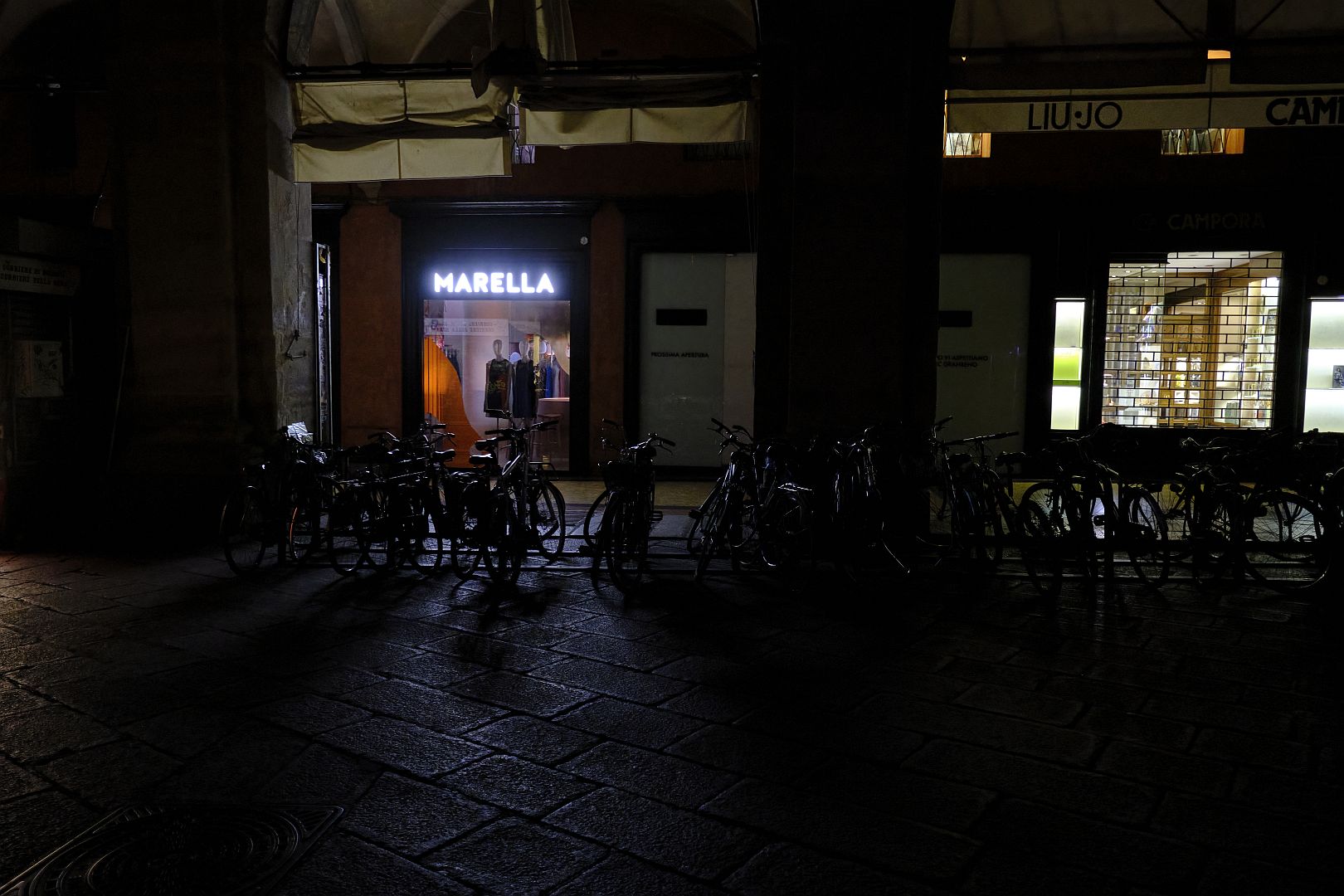
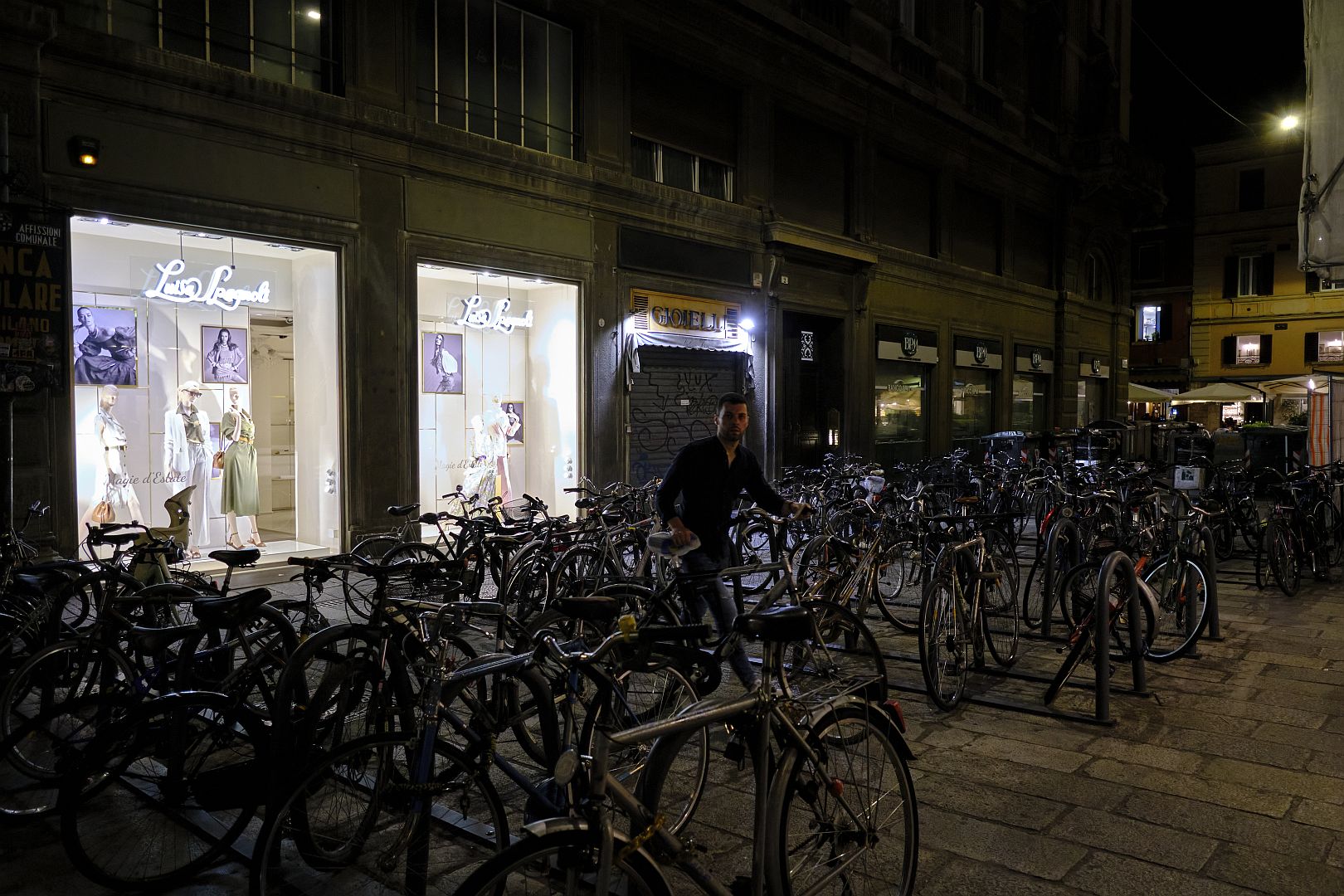
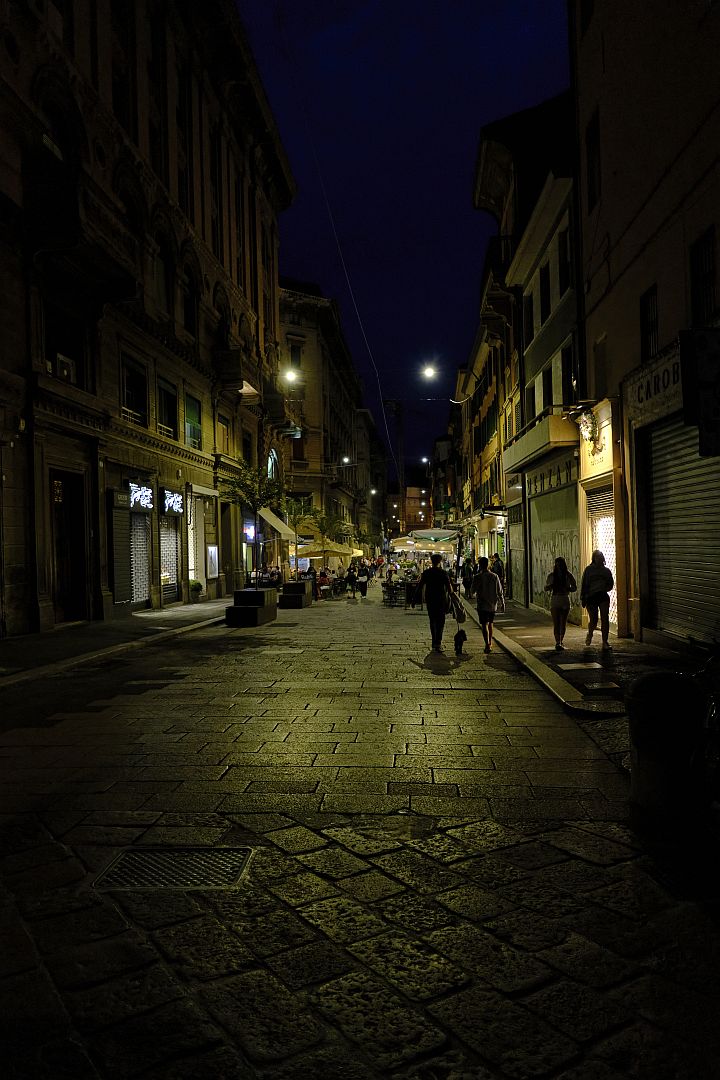
Eventually it got to the point where the only source of light was street lights and shop windows.

Bologna night photography
Night in Bologna. Fujifilm X-Pro3 camera, Fujifilm XF 16mm lens (click to enlarge).
Bologna night photography
Night in Bologna. Fujifilm X-Pro3 camera, Fujifilm XF 16mm lens (click to enlarge).

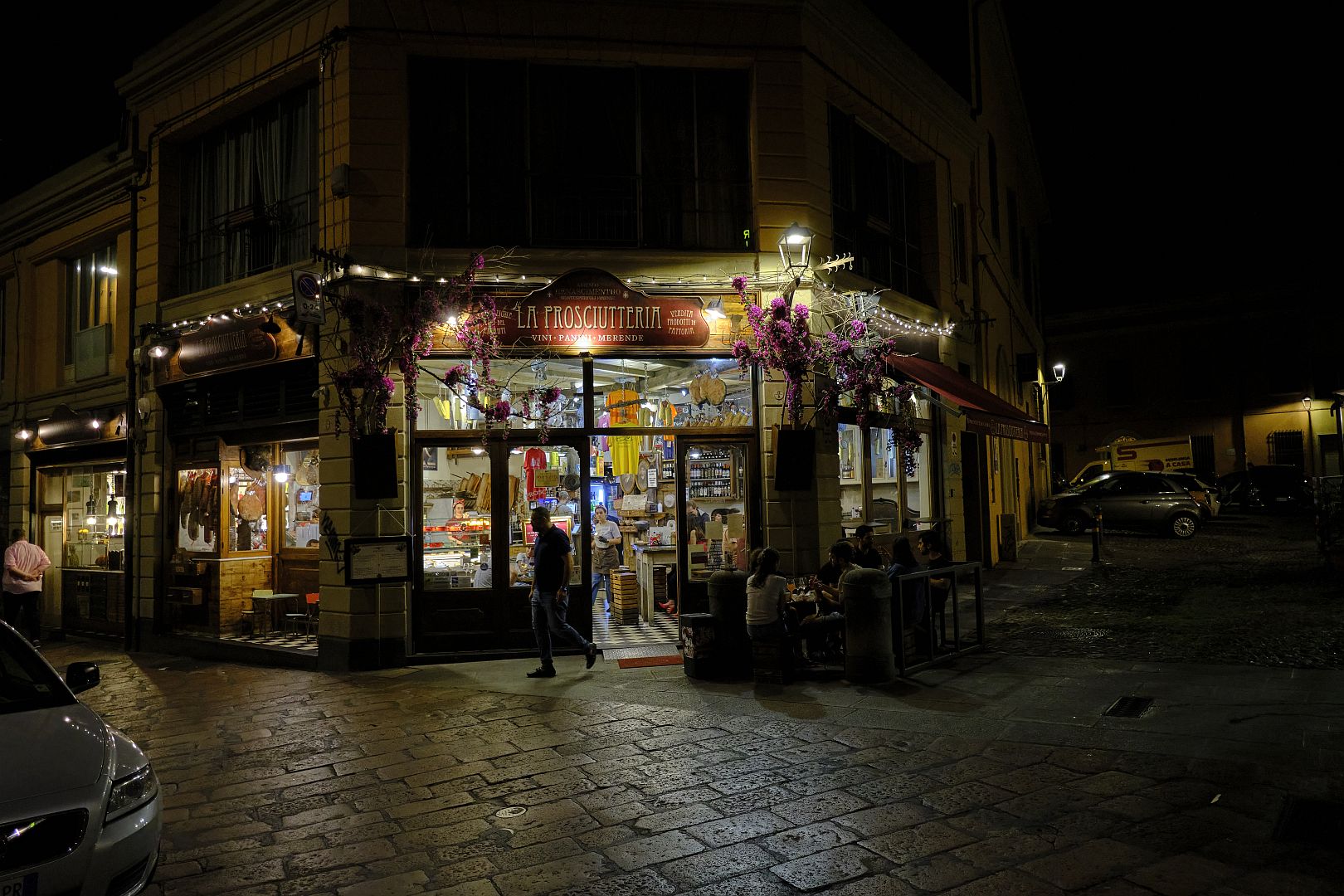
Not long ago, most of the shop interiors would have been lit by fluorescent tubes. The light produced by these would come out on film and digital sensors as a ghastly blue-green. And incandescent light bulbs came out as very yellow, so when both sources were present, it was almost impossible to balance them without some advanced post-processing techniques. These days people mostly light their shops with LEDs, which produce light that looks a lot more natural to a camera. A win for night photography as well as for the environment.

Bologna night photography
In the days when this shop was lit by fluorescent lights, the interior would have been a strange green colour in a photograph. Via Oberdan, Bologna. Fujifilm X-Pro3 camera, Fujifilm XF 16mm lens (click to enlarge).

Lighting coming from odd directions can help the street photographer to pick out a subject and try and tell a story. As someone who mostly did landscape photography for many years I will admit that I am still coming to grips with this, but it is fun when it works out.

Bologna night photography
Bologna evening. People head from a deserted street towards a distant scene of activity. Fujifilm X-Pro3 camera, Fujifilm XF 16mm lens (click to enlarge).
Bologna night photography
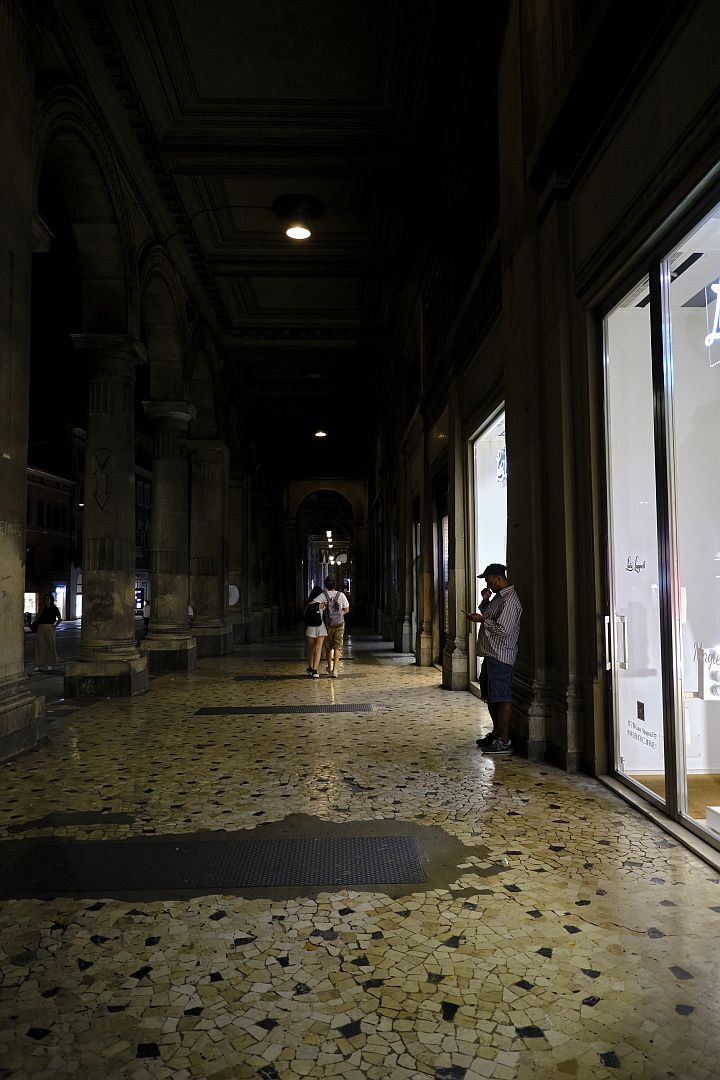
Bologna. A couple walk off together while a man looks at his phone. Fujifilm X-Pro3 camera, Fujifilm XF 16mm lens (click to enlarge).
Bologna night photography
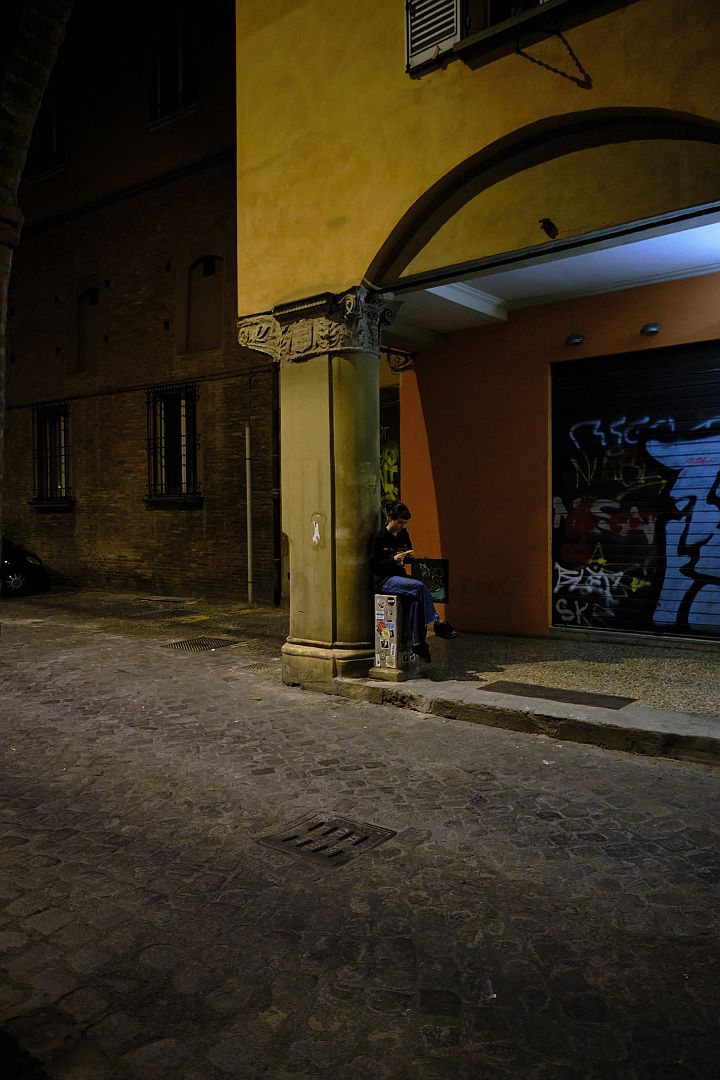
Bologna. A staff member from a gelateria rolls herself a cigarette while on a break. Fujifilm X-Pro3 camera, Fujifilm XF 16mm lens (click to enlarge).

Street Photography in Bologna

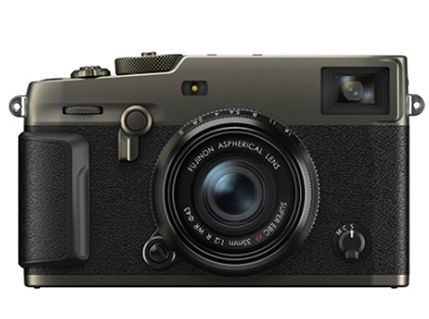
Bologna is one of the best places in Italy for street photography, of the candid sort but also of some beautifully presented shopfronts and window displays. We recently spent a couple of days in Bologna with friends, and here is a short photo essay. All these were taken on my new Fujifilm X-Pro3 which is a small, discreet rangefinder-style digital camera.

Fujifilm X-Pro3 (source: Fujifilm.com)

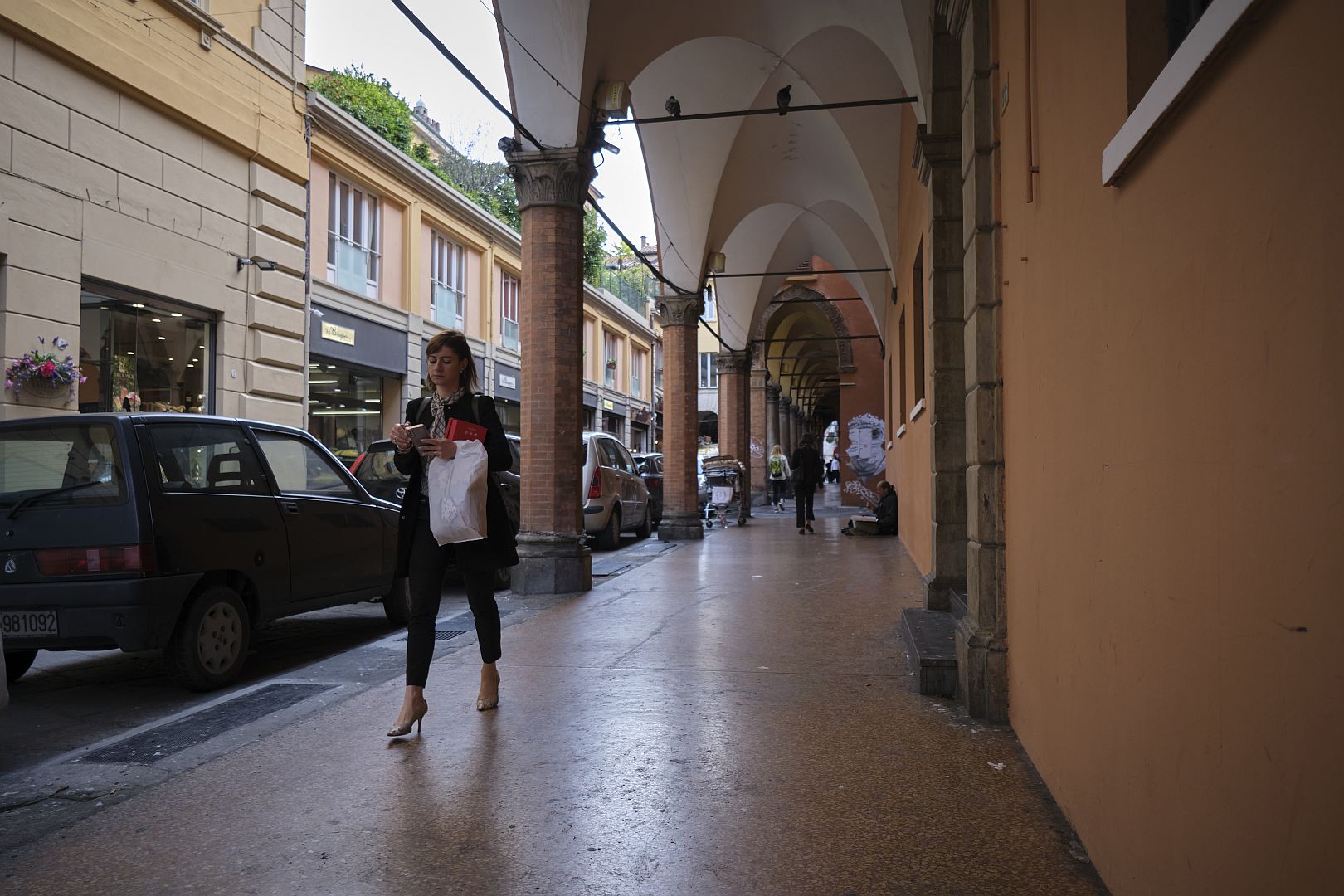
The historic centre of Bologna is a good place for street photography, for a few reasons. One is that there are enough tourists that the guy with the camera doesn’t stand out, but enough locals that your picture is not going to be full of tourists.

Bologna Via Oberdan
Bologna Via Oberdan. Fujifilm X-Pro3 camera, Fujifilm XF 16mm lens (click to enlarge).
Bologna Via Oberdan
Bologna, Via Oberdan. Fujifilm X-Pro3 camera, Fujifilm XF 16mm lens (click to enlarge).
Bologna Via Oberdan
Bologna, Via Oberdan. Fujifilm X-Pro3 camera, Fujifilm XF 16mm lens (click to enlarge).

Another is that even when a shopkeeper does see you taking a photograph, he or she is probably used to it. A third is that the elegant shopfronts and food displays in the market quarter deserve to be photographed – when the proprietor has spent that much trouble making it look nice, it is a fitting compliment to take a picture of it.

Bologna Cheese Shop
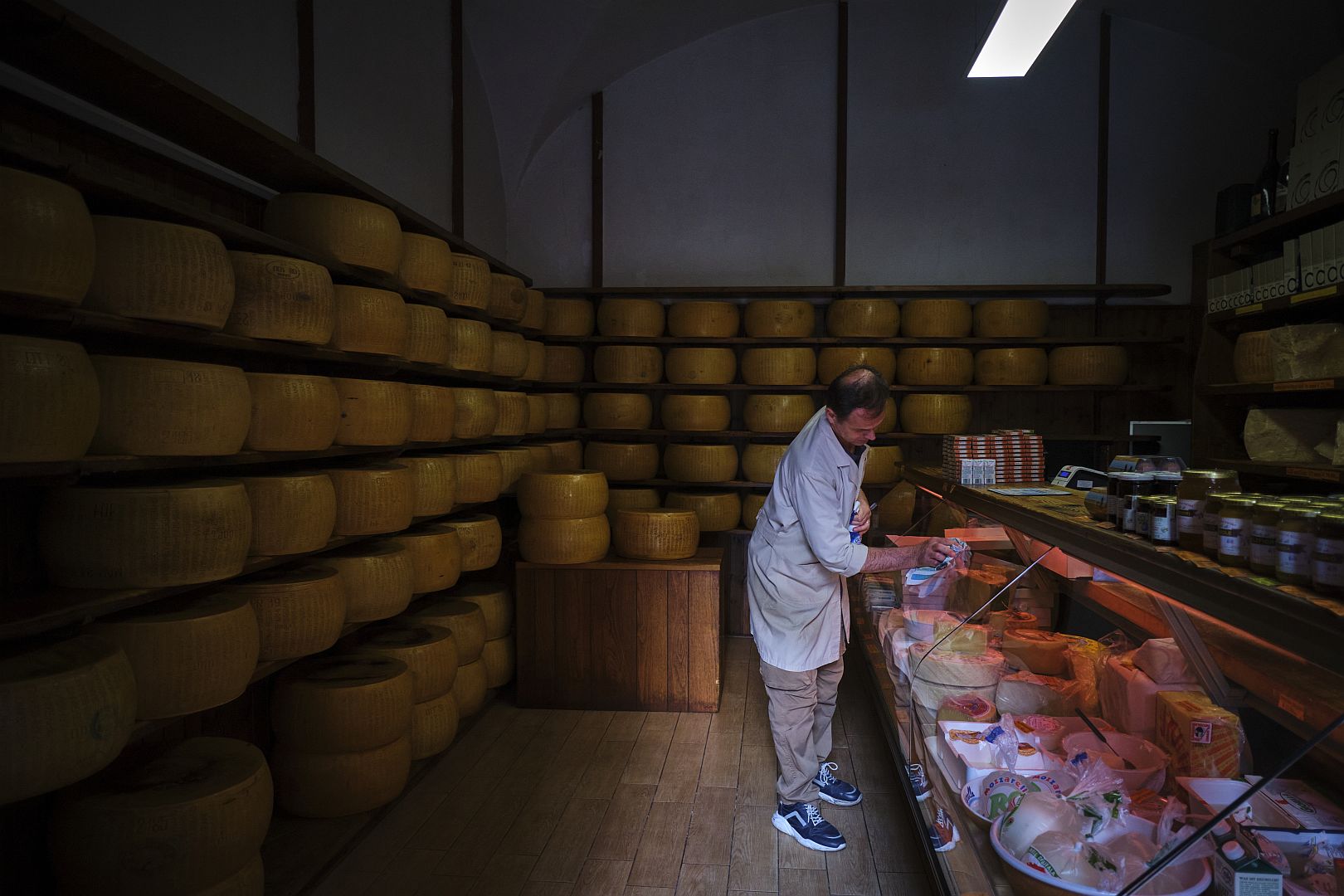
Bologna, cheese shop. Fujifilm X-Pro3 camera, Fujifilm XF 16mm lens (click to enlarge).

In any case, in shops I often ask first. “Posso?” (may I?) I ask, pointing at the camera. No-one has ever said no, but it makes me feel more comfortable knowing that I have been given permission. In the picture above, the man in the cheese shop said “certo” (of course) and carried on cleaning his counter.

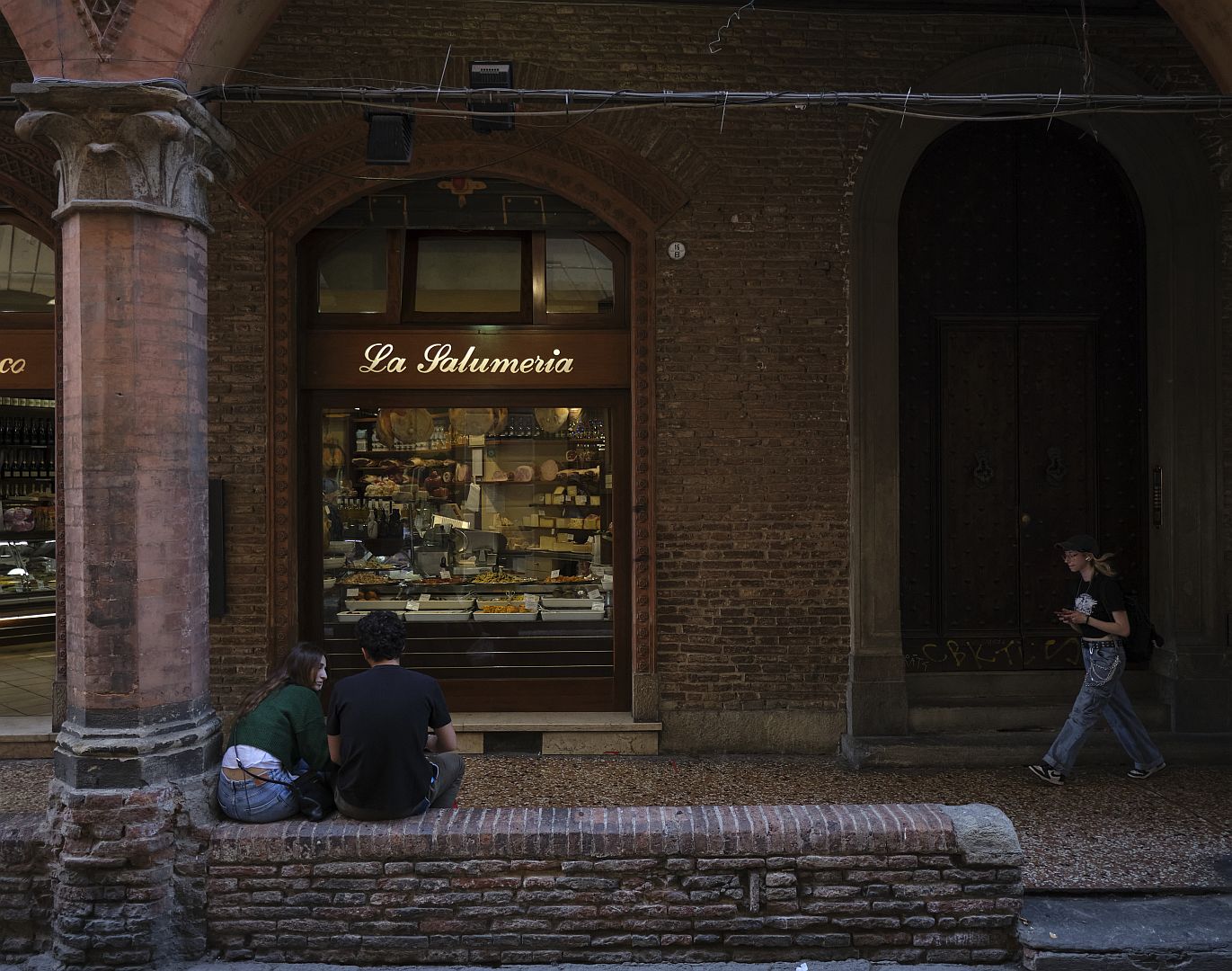
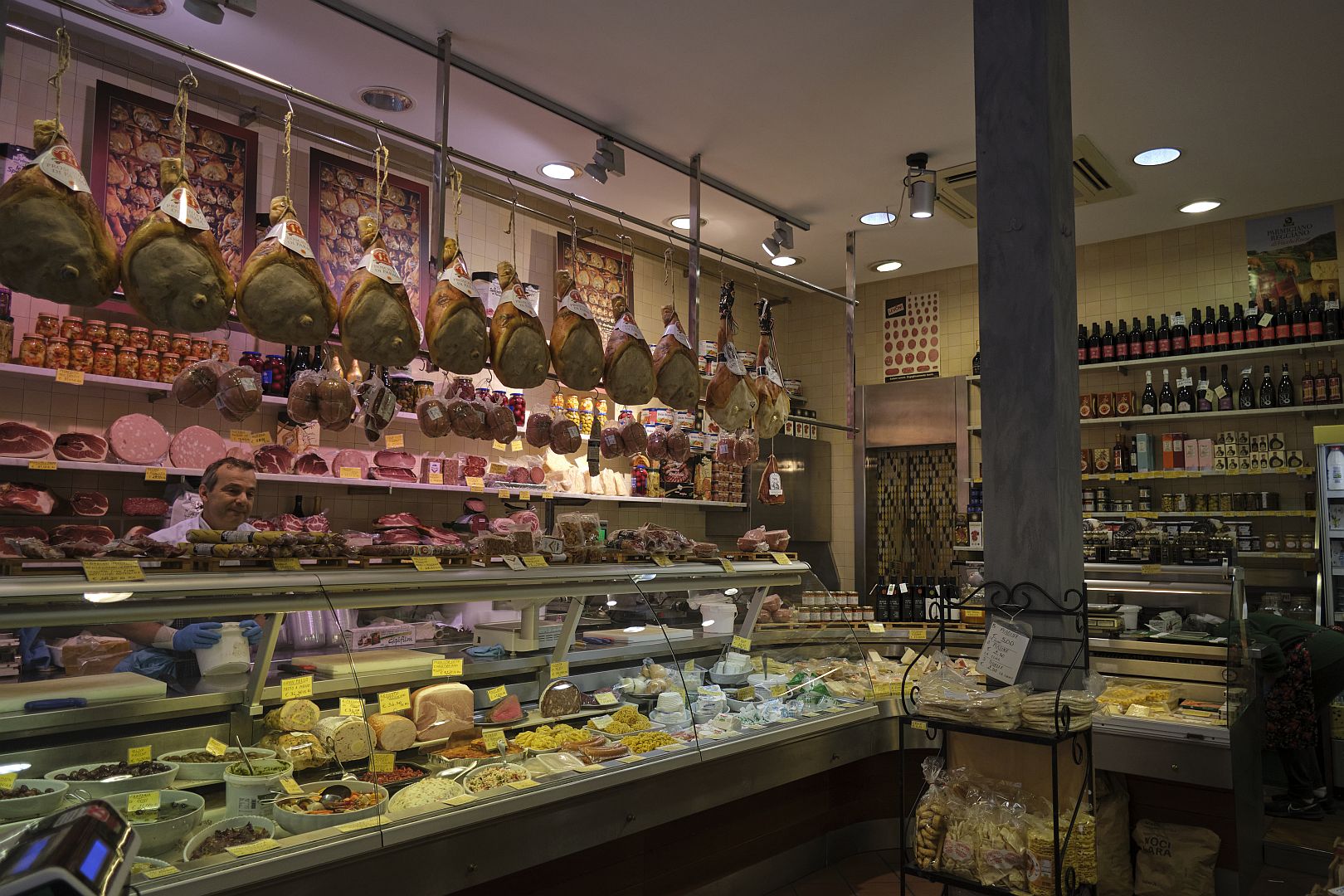
Bologna Salumeria
Bologna, salumeria. Fujifilm X-Pro3 camera, Fujifilm XF 16mm lens (click to enlarge).

If I haven’t asked, and get busted, I will touch my cap and nod thanks, which often seems to suffice.

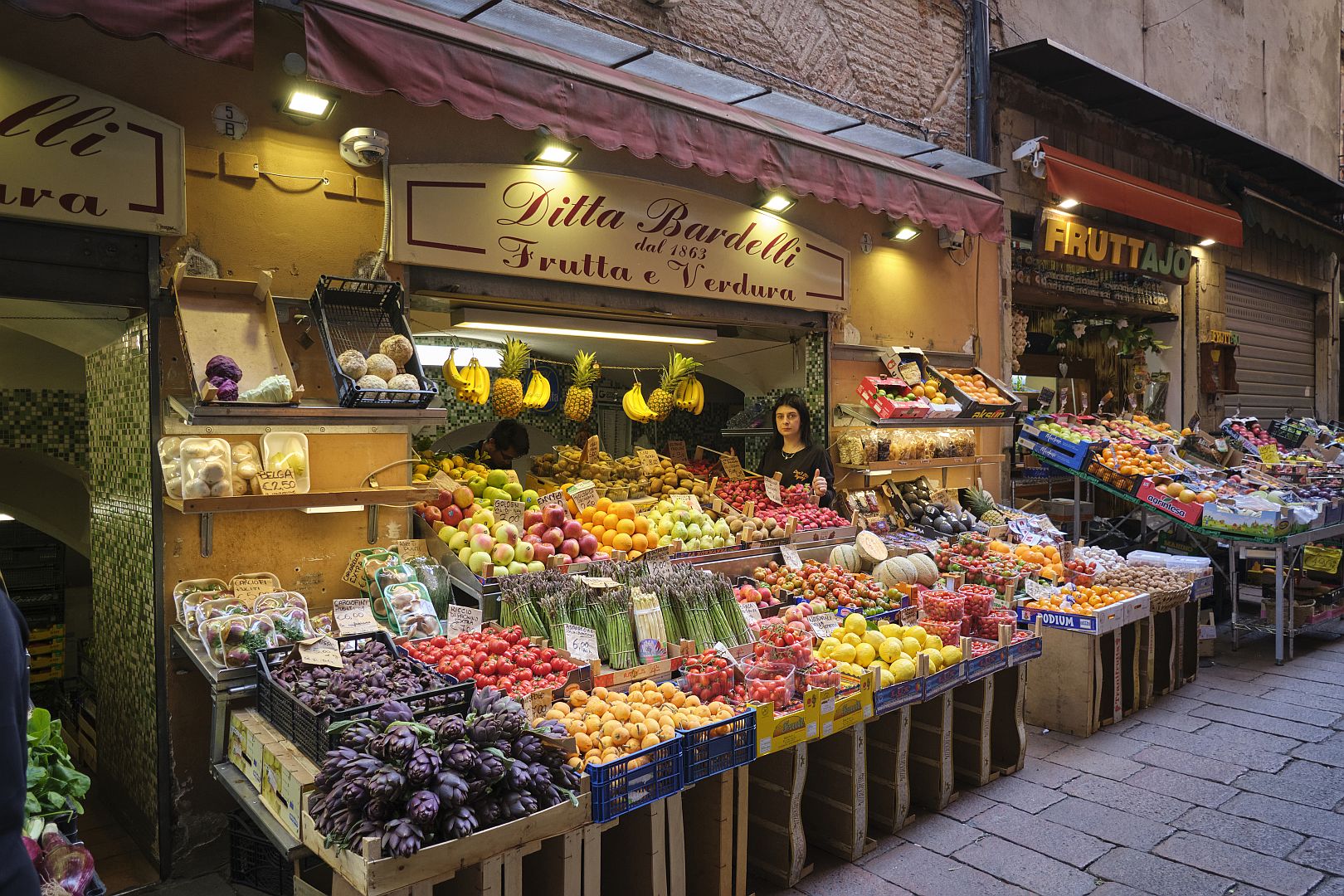
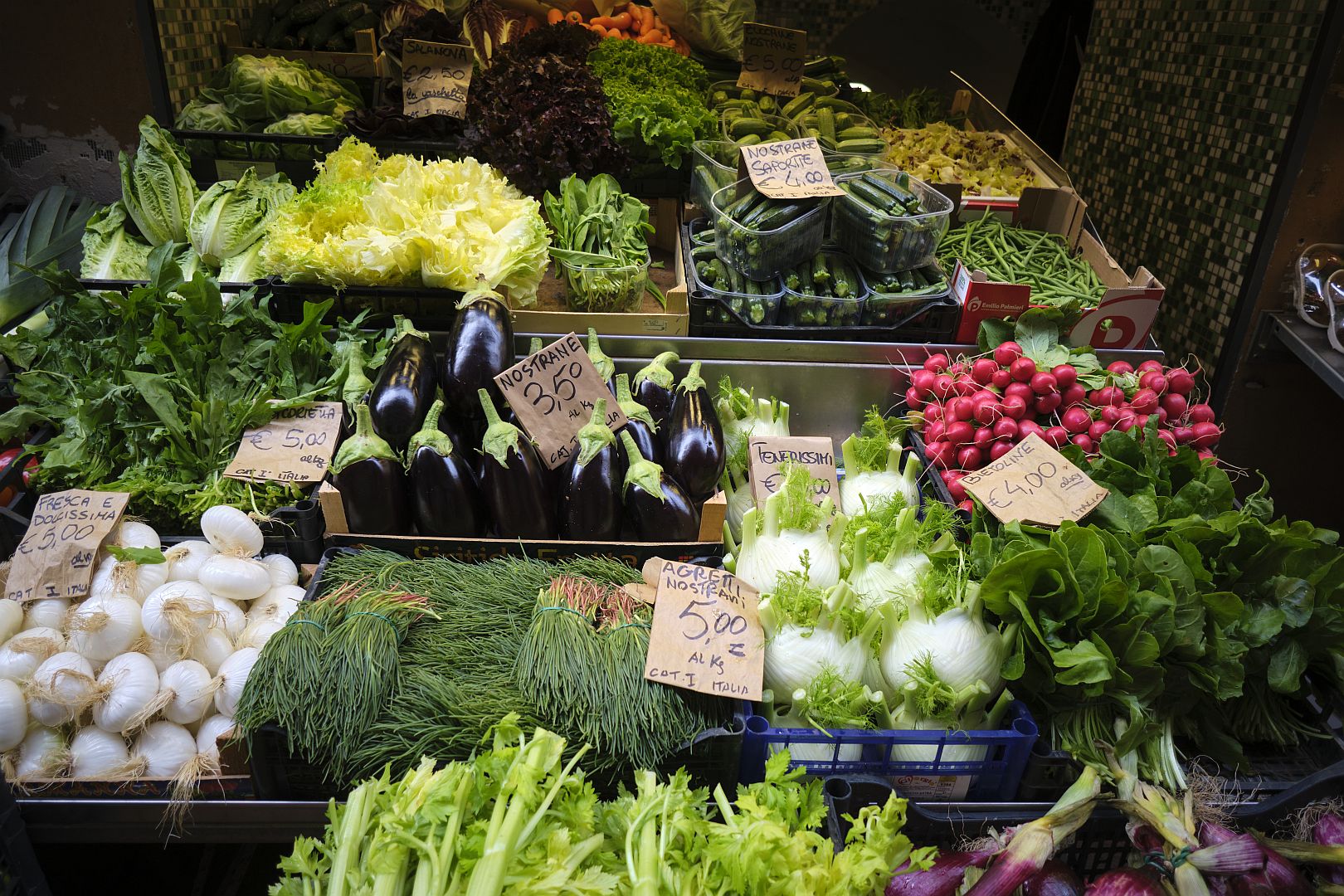
Bologna Greengrocer
Greengrocer’s shop, Bologna. Fujifilm X-Pro3 camera, Fujifilm XF 16mm lens (click to enlarge).
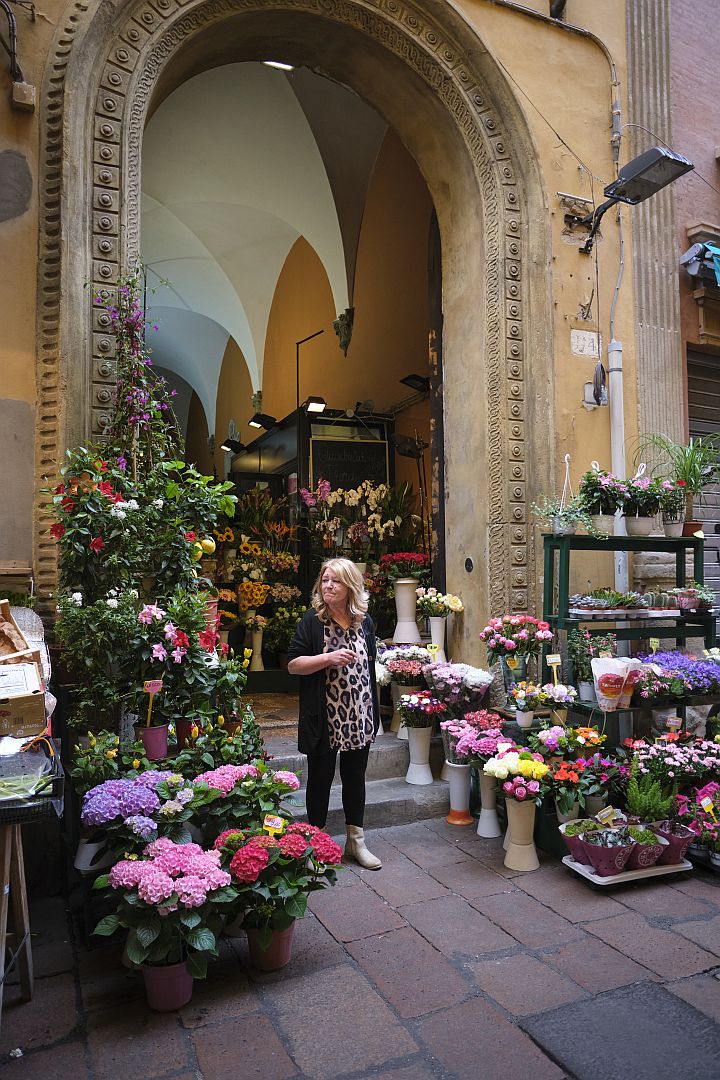
Bologna florist
Florist, Bologna. Fujifilm X-Pro3 camera, Fujifilm XF 16mm lens (click to enlarge)

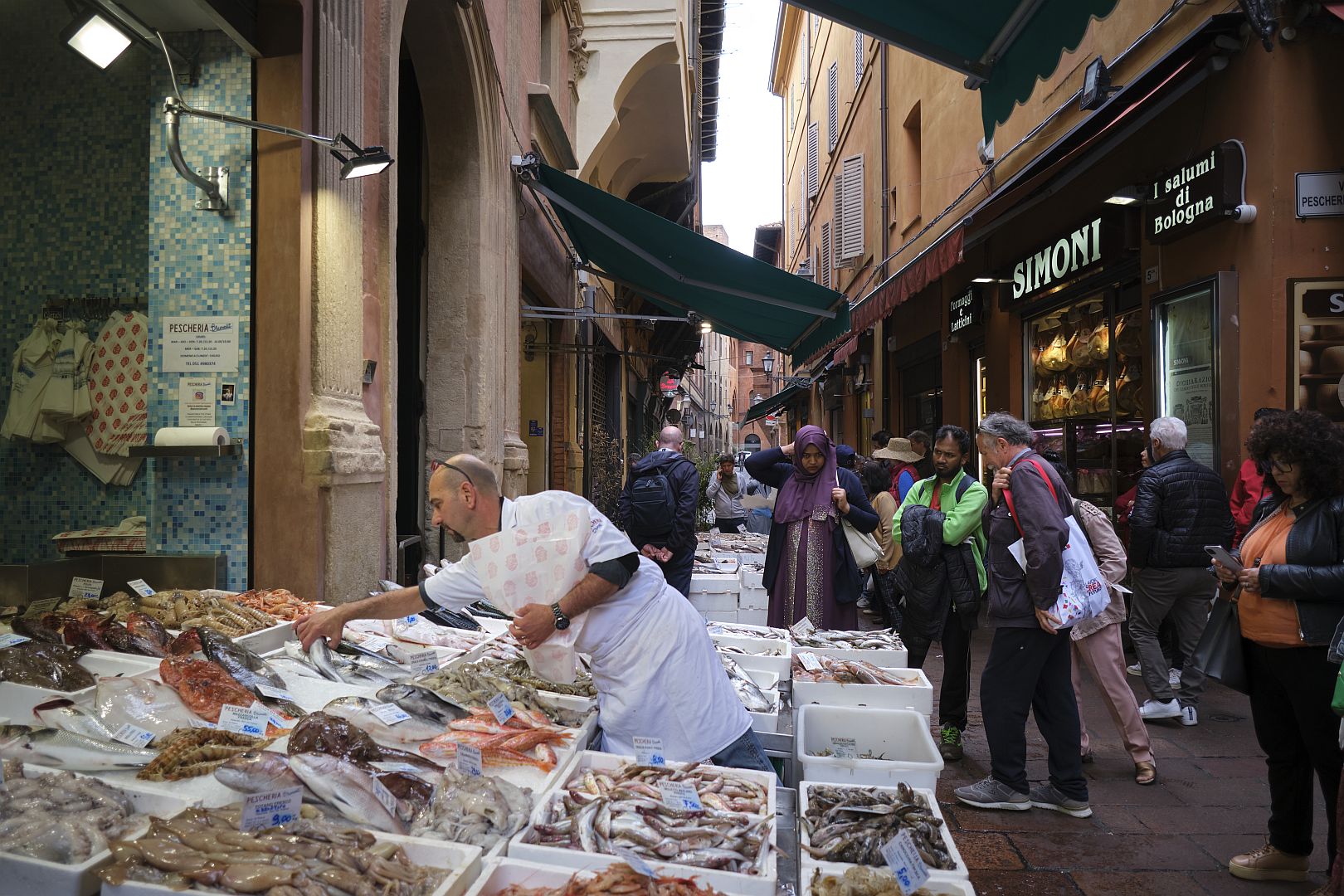
Immediately to the east of the Piazza Maggiore in Bologna is a small area of narrow streets and many shops, mainly butchers, fishmongers, greengrocers, wine merchants and the like. This is the historic market area, and the best time to go there is in the morning, when all the produce is fresh, and in any case some shops like the fishmongers close for the day at lunchtime.

Bologna Fishmongers
Bologna fishmonger. Fujifilm X-Pro3 camera, Fujifilm XF 16mm lens (click to enlarge).
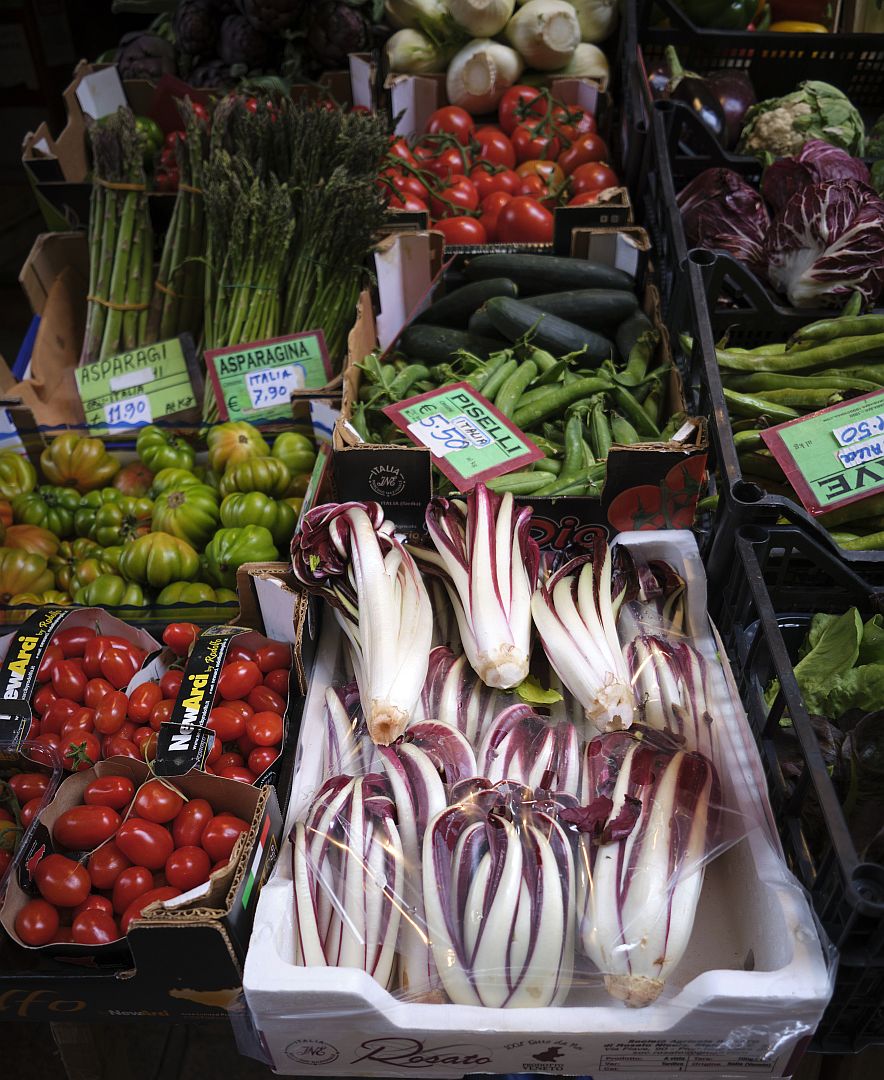
Bologna greengrocer
Fresh vegetables. Fujifilm X-Pro3 camera, Fujifilm XF 16mm lens (click to enlarge)

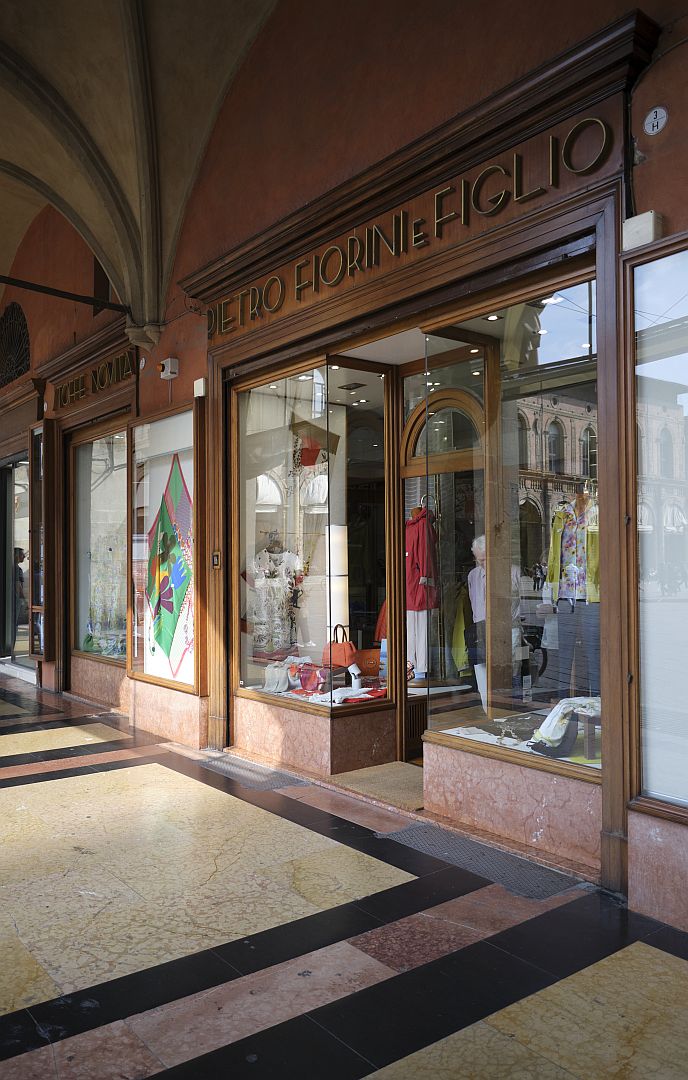
Bologna is home to the world’s oldest university (founded in 1088) and it has the energy and edginess that one associates with student towns. But it is also a prosperous place – productive agriculture and high-tech industry clearly bring in a lot of wealth, and have done for a while. In the centre the shopfronts can therefore be very elegant – sometimes retaining their original antique signage when the actual shop has been taken over by something more modern.

Bologna shopfront
Bologna shopfront near the Piazza Maggiore. Fujifilm X-Pro3 camera, Fujifilm XF 16mm lens (click to enlarge).
Bologna Shopfront
Bologna, shopfront near the Piazza Maggiore. Fujifilm X-Pro3 camera, Fujifilm XF 16mm lens (click to enlarge).

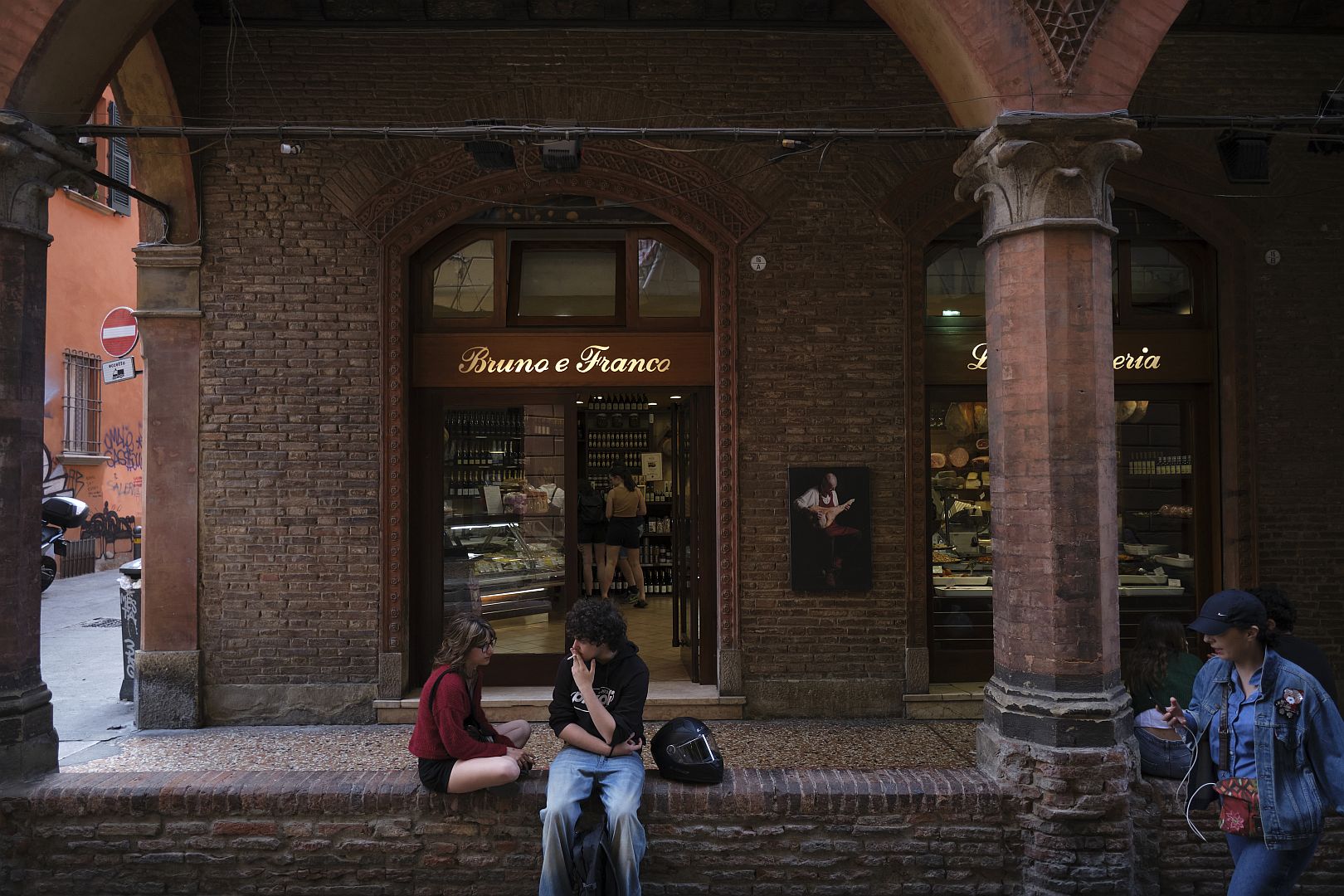
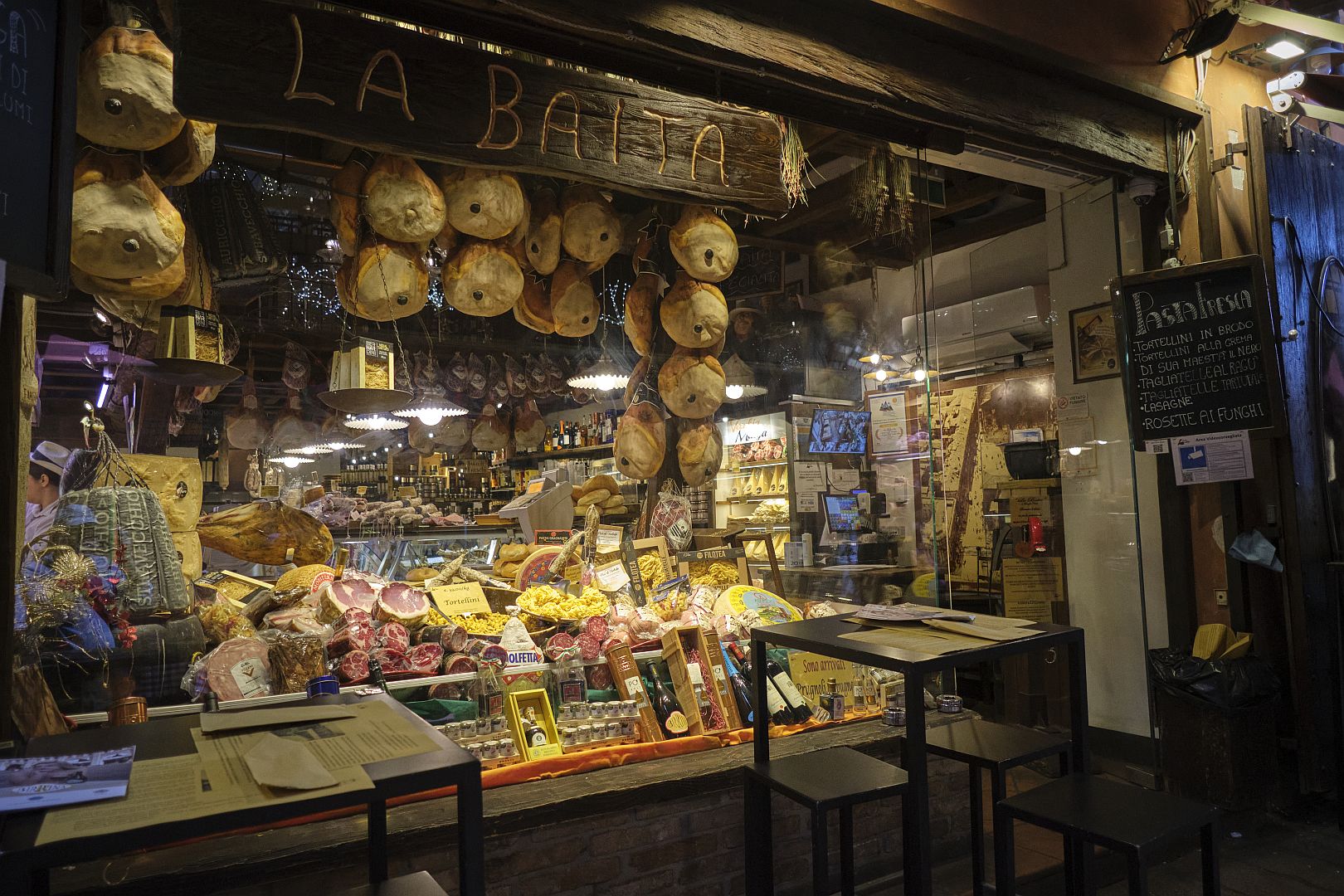
But one of the special things about Bologna is that the Bolognese take food very, very seriously indeed, even by Italian standards. The food shops are therefore temples to gastronomy, places of wonder, delight and not inconsiderable expense.

Bologna La Baita
Bologna, salumeria. Fujifilm X-Pro3 camera, Fujifilm XF 16mm lens (click to enlarge).
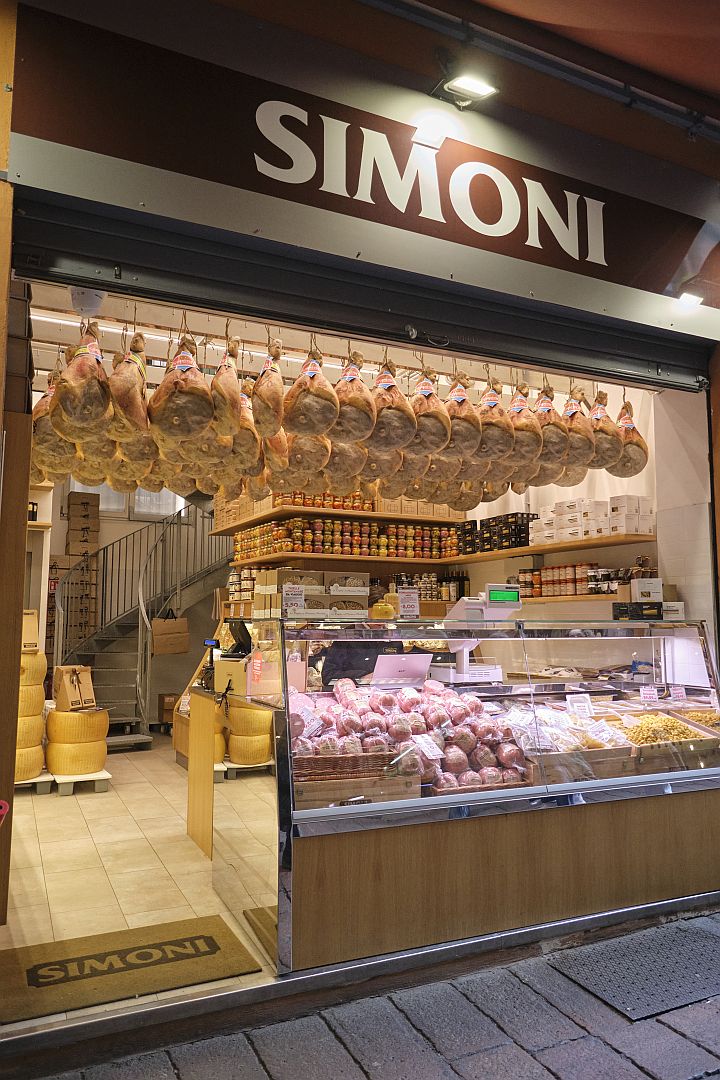
Bologna Simoni
Bologna, salumeria Simoni. Fujifilm X-Pro3 camera, Fujifilm XF 16mm lens (click to enlarge).
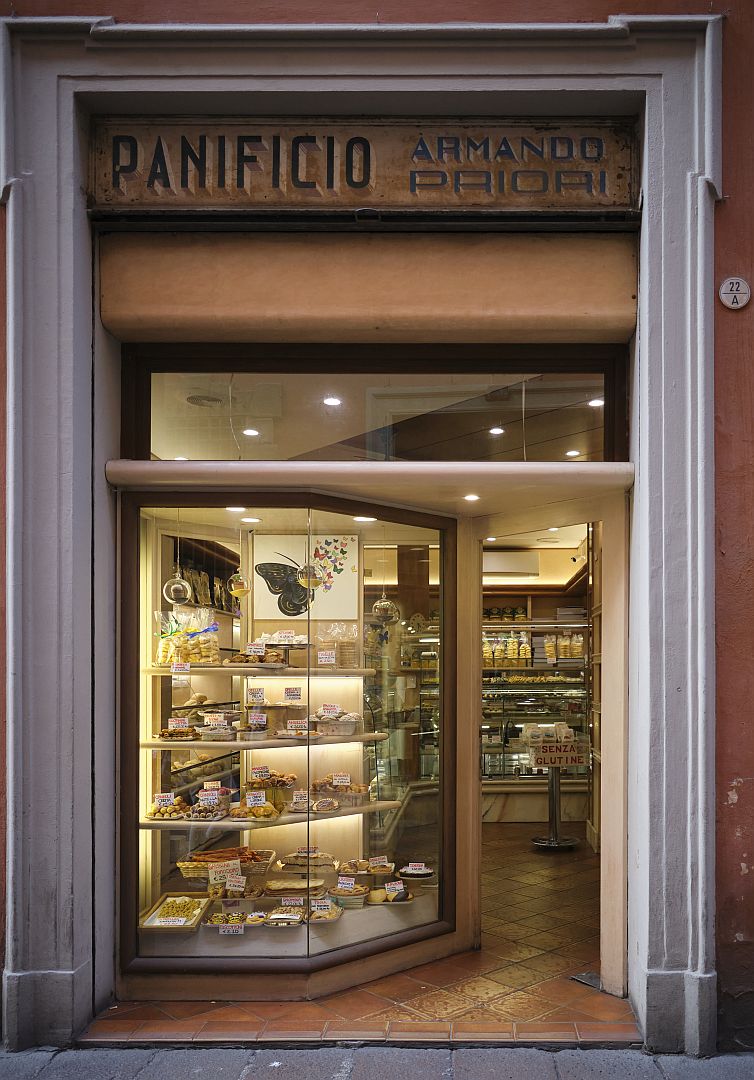
Bologna Paneficio Priori
Bologna, Paneficio Armando Priori. Fujifilm X-Pro3 camera, Fujifilm XF 16mm lens (click to enlarge).
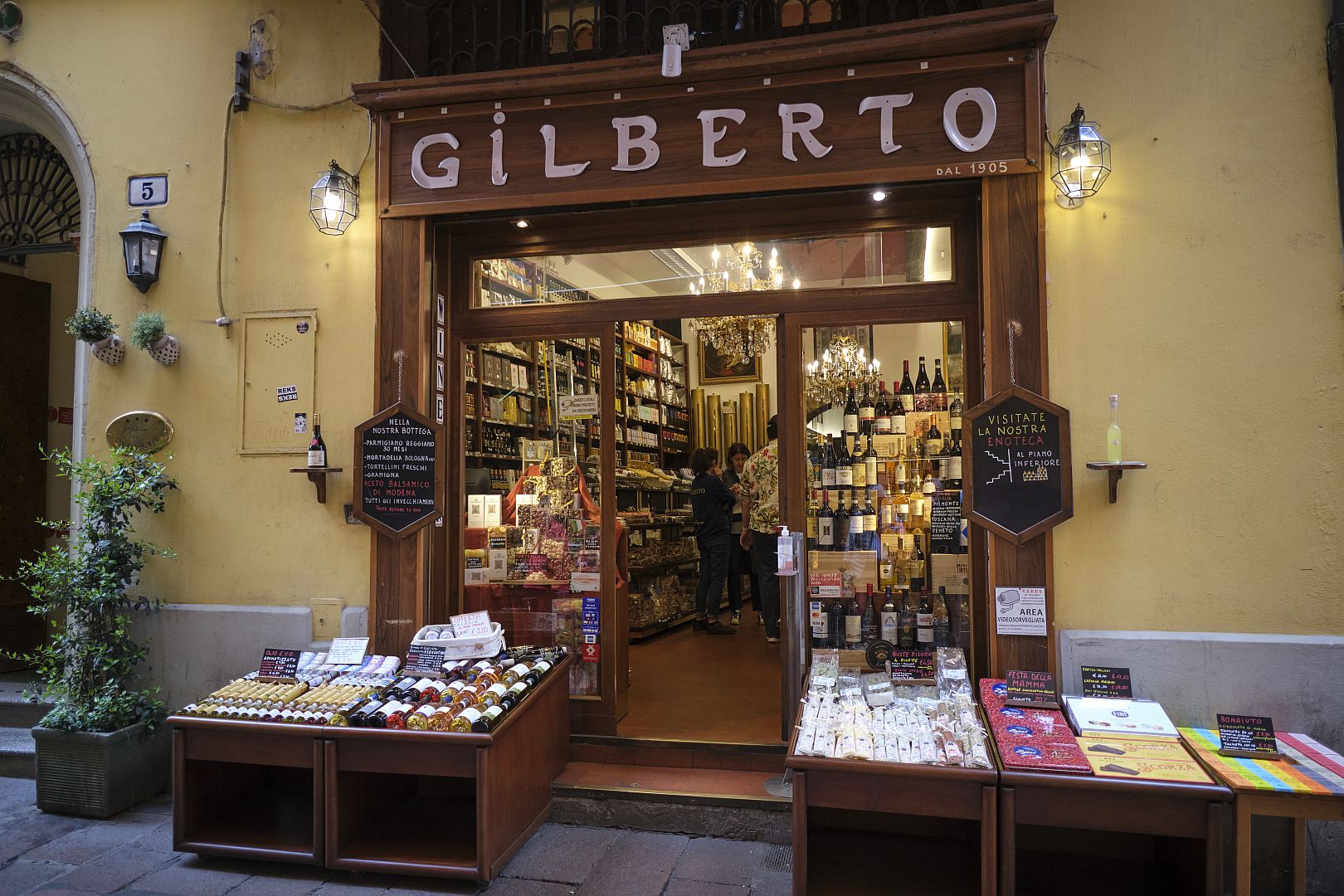
Bologna Gilberto
Bologna, Enoteca Gilberto. Fujifilm X-Pro3 camera, Fujifilm XF 16mm lens (click to enlarge).

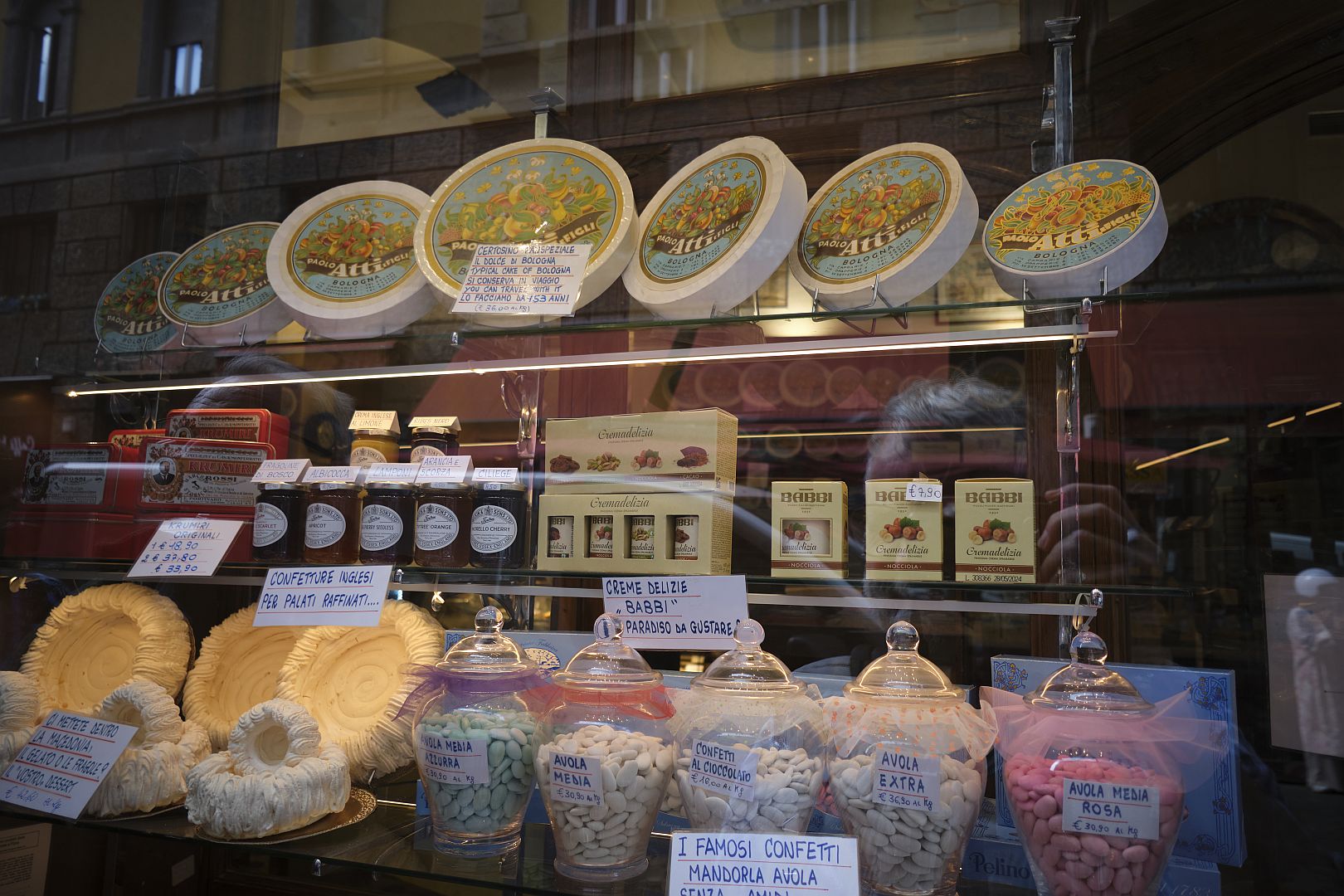
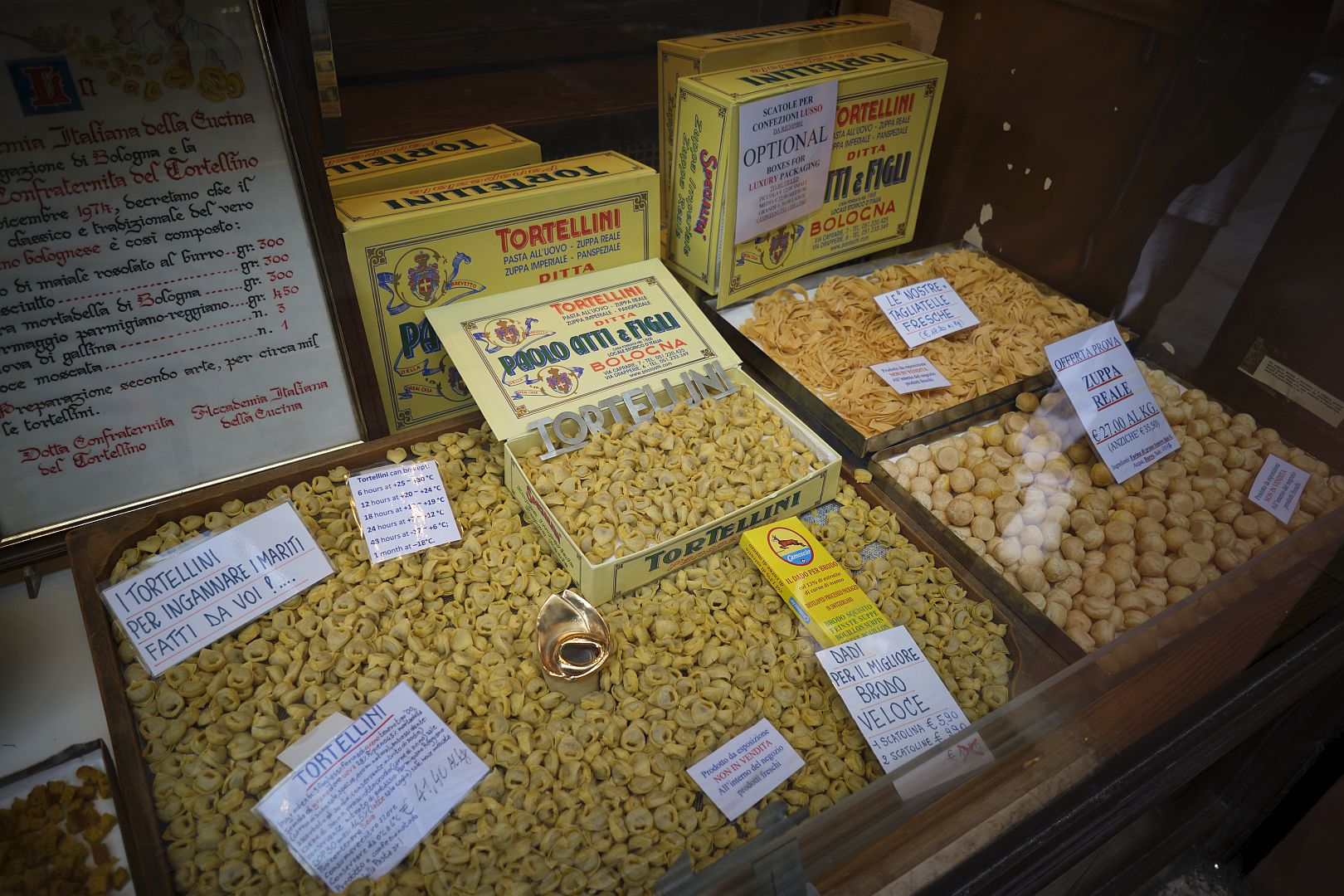
One of the classiest shops in this area is “Atti & Figli”. You can walk away from there somewhat lighter in the pocket, but clutching a couple of hundred grams of tortellini in very elegant packaging and the feeling that somehow you have temporarily been admitted to an exclusive club.

Bologna Atti
Bologna, Atti & Figli. Note the exquisite packaging, and the “English jams for refined palates”. Fujifilm X-Pro3 camera, Fujifilm XF 16mm lens (click to enlarge).
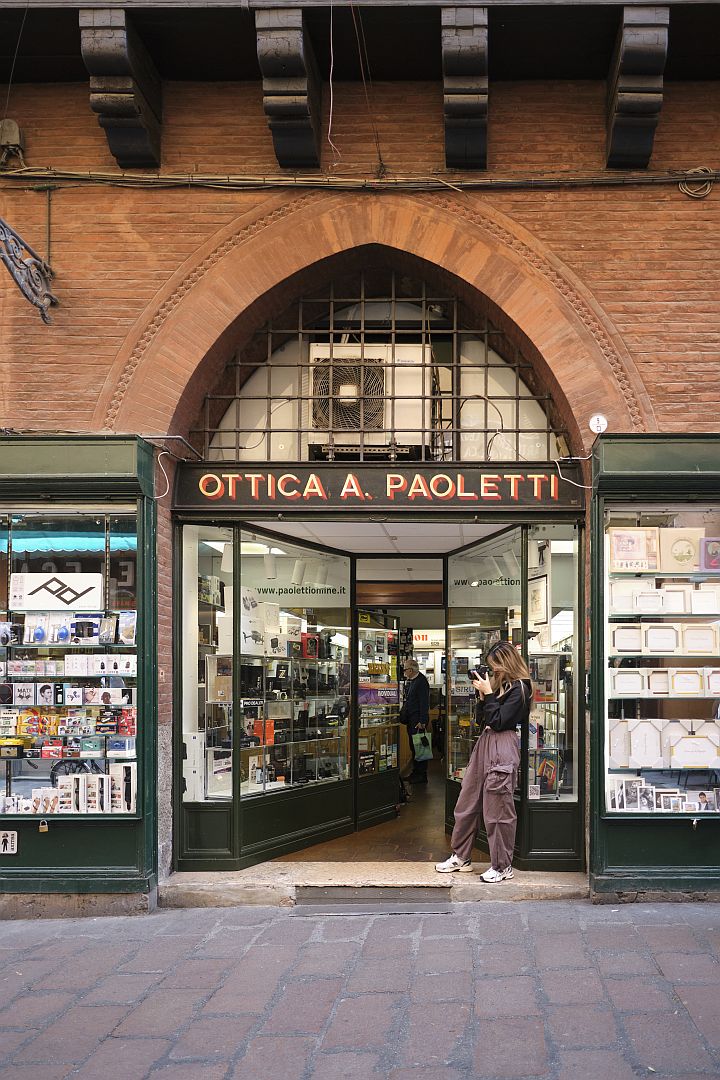
Bologna Ottica Paoletti
Even the camera shops look elegant in Bologna. Fujifilm X-Pro3 camera, Fujifilm XF 16mm lens (click to enlarge).
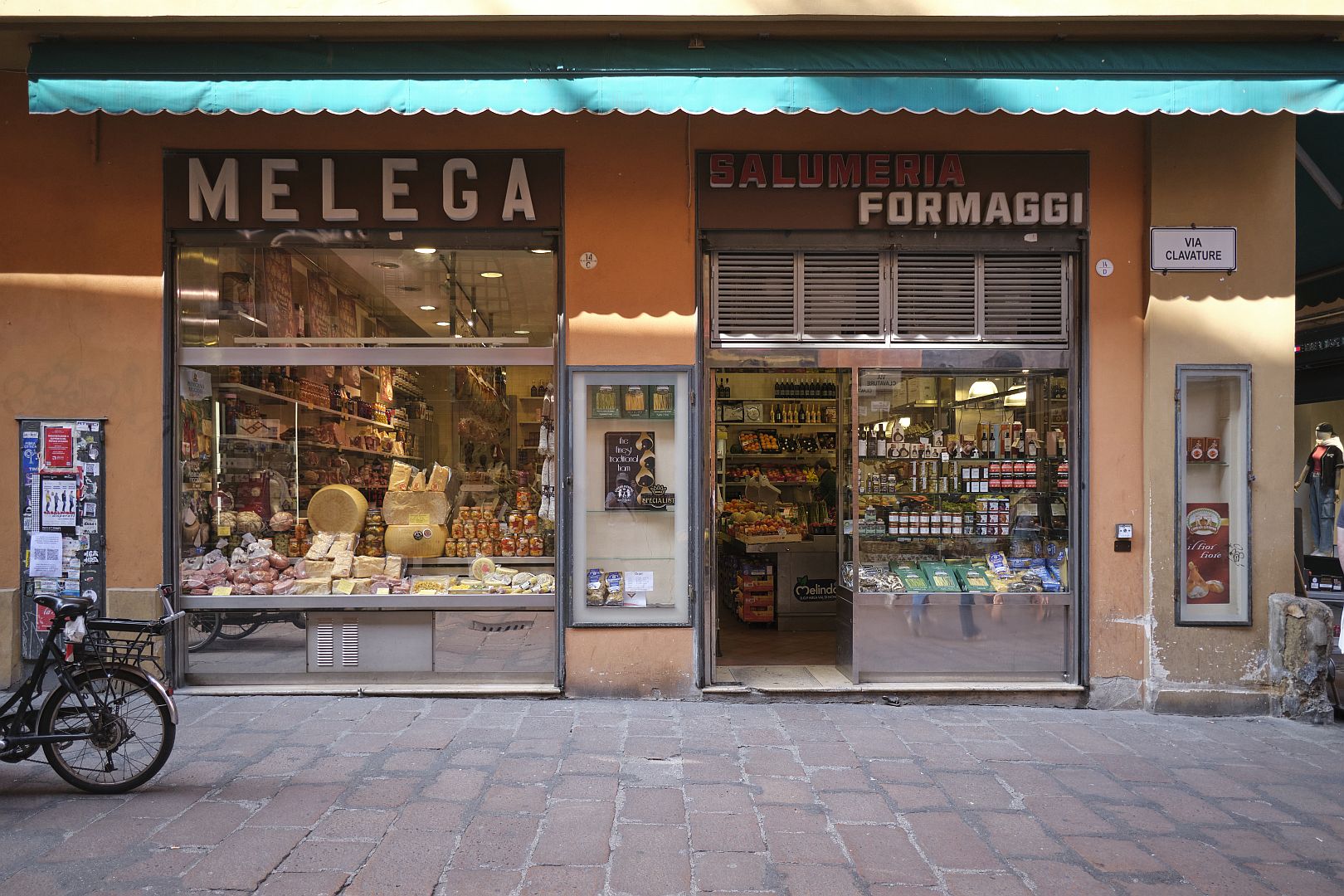
Bologna Melega
Bologna, Via Clavature. Fujifilm X-Pro3 camera, Fujifilm XF 16mm lens (click to enlarge).
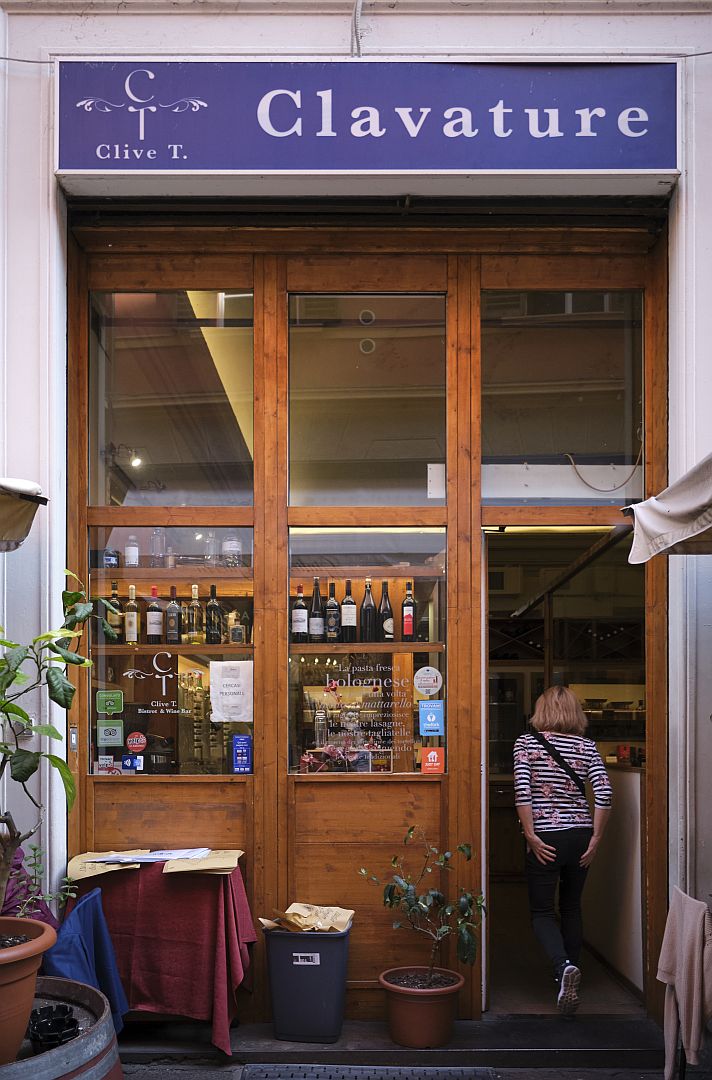
Bologna Via Clavature
Bologna, Via Clavature. Fujifilm X-Pro3 camera, Fujifilm XF 16mm lens (click to enlarge).
Bologna Via Pescherie Vecchie
Bologna, Via Pescherie Vecchie. Fujifilm X-Pro3 camera, Fujifilm XF 16mm lens (click to enlarge).
Bologna Atti
One of the signs says “the tortellini for fooling husbands that you made it yourselves”. Fujifilm X-Pro3 camera, Fujifilm XF 16mm lens (click to enlarge).
Bologna Vicolo Ranocchi
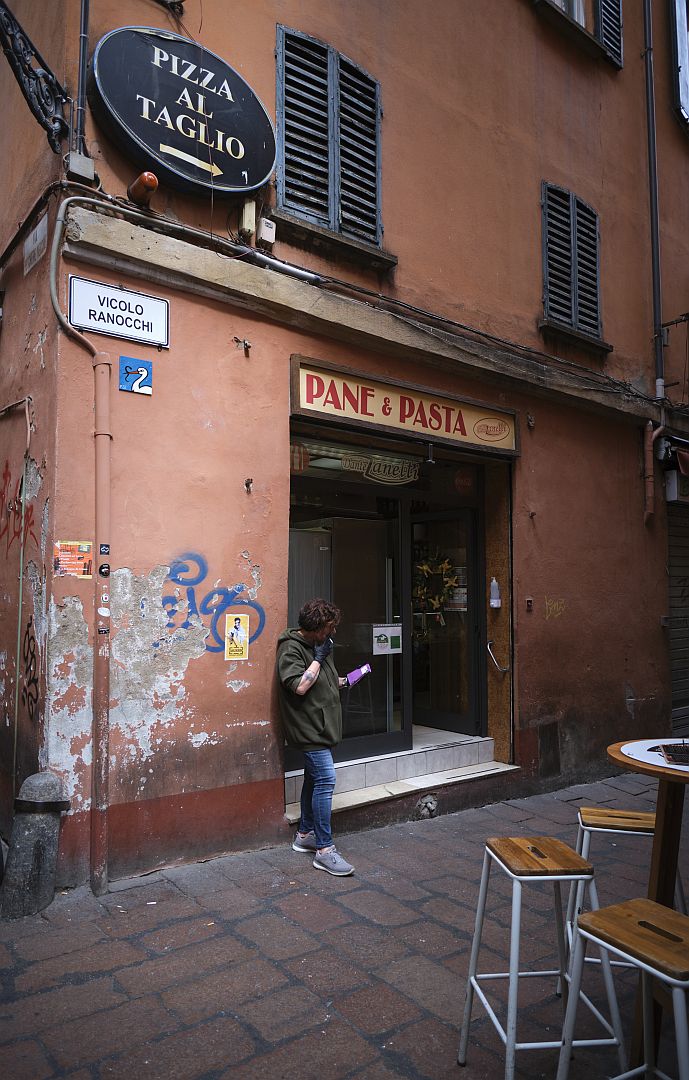
Bologna, Vicolo Ranocchi. Fujifilm X-Pro3 camera, Fujifilm XF 16mm lens (click to enlarge).

A note on the photography – black and white conversion

I was very pleased with the photograph above of the man in the cheese shop – the simplicity of the scene and the rich colours required little in the way of post-processing. But nonetheless I was interested to see if I could make it more dramatic by converting it to back and white. Most cameras (and smartphones) have a monochrome option, and sometimes this does little more than convert each pixel in the red, green and blue channels to the same intensity in greyscale.

But have you ever seen a black and white photograph and wondered why it seems more dramatic than its colour equivalent would have been?

The answer may be that the colours have not been given equal priority in conversion to greyscale. This was something that the old film photographers understood well; when I was a child learning to take black and white pictures, my father showed me how to attach a yellow filter in sunny weather. This had the effect of blocking much of the blue light, and darkening skies while leaving clouds white, making it much more dramatic.

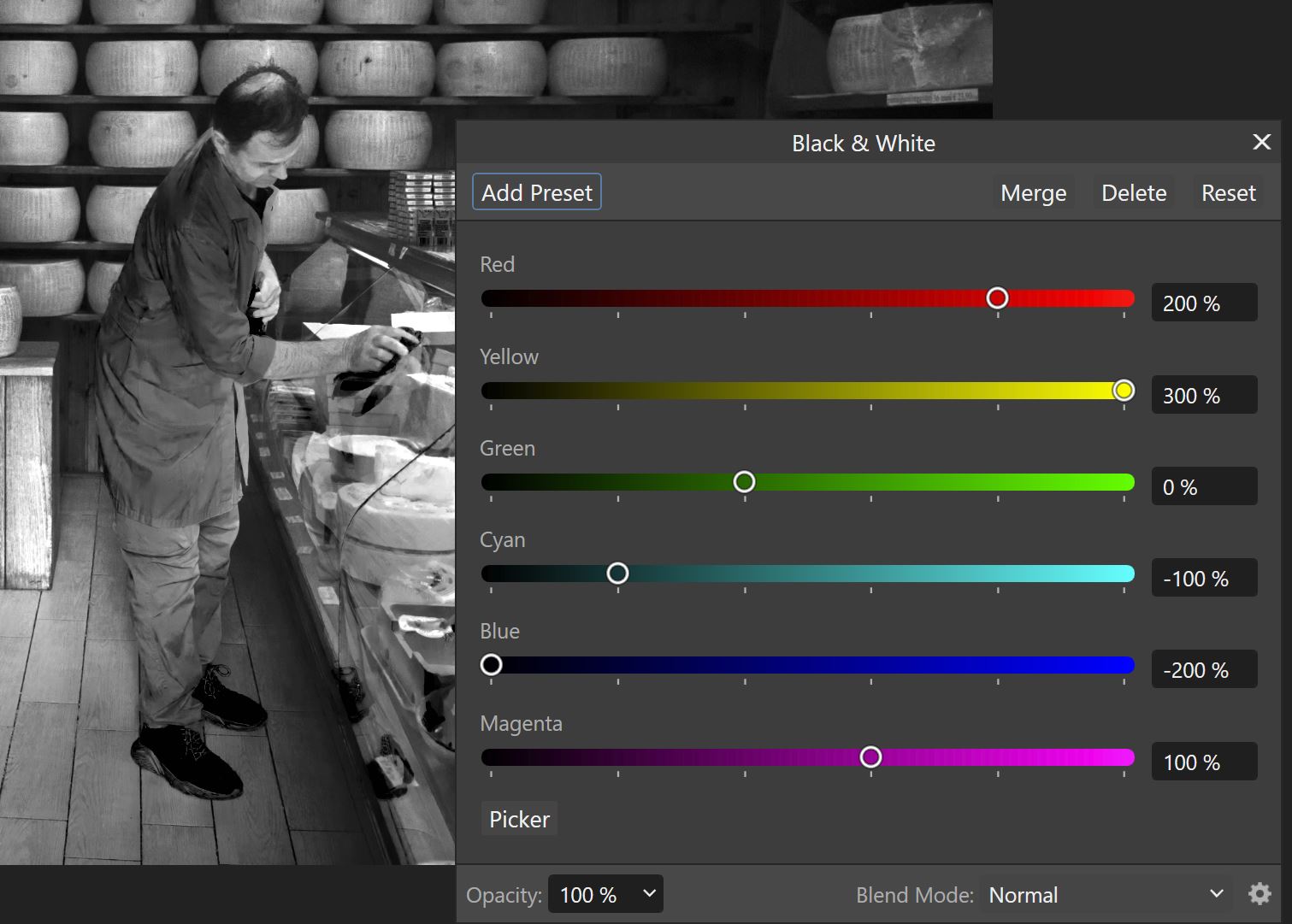
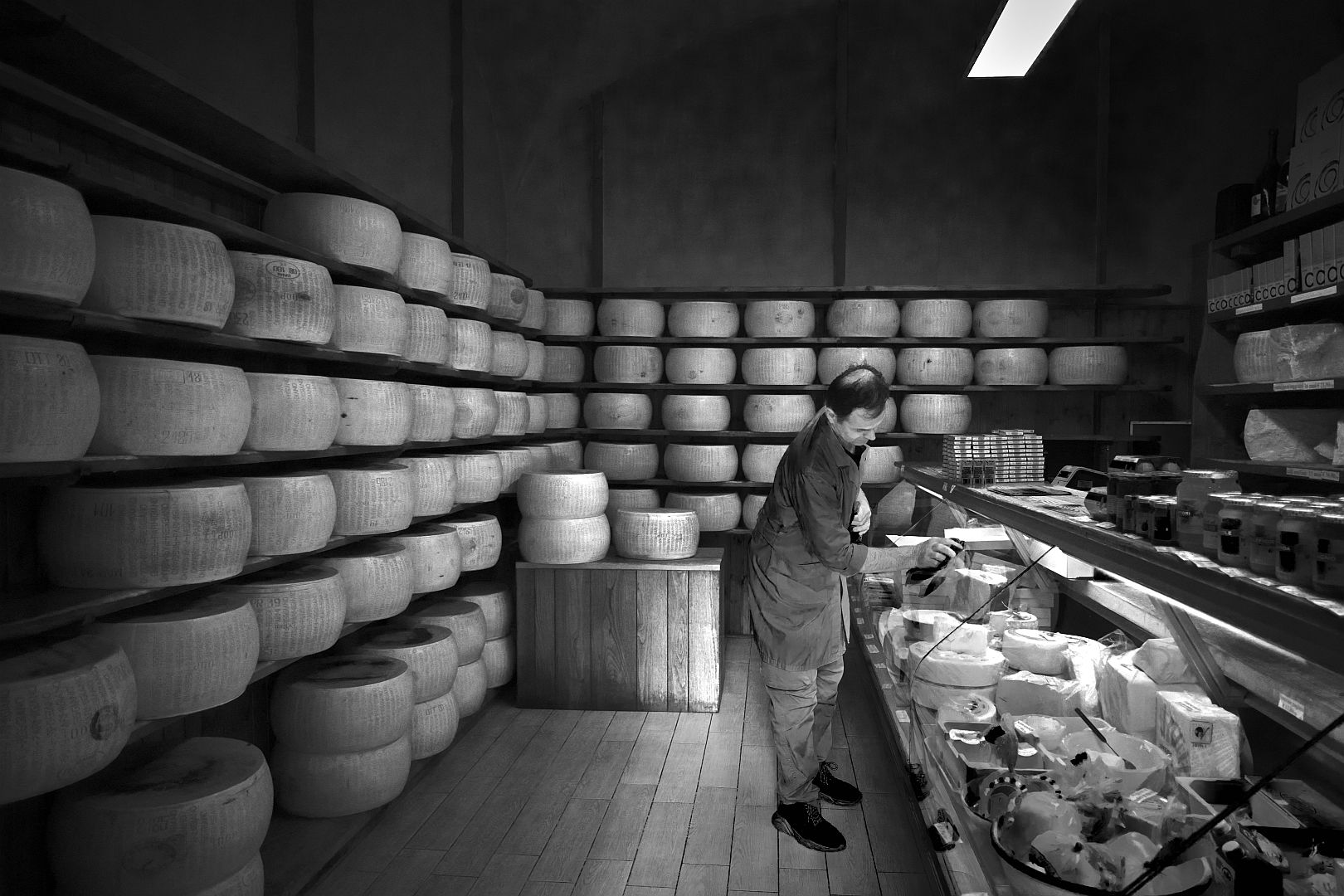
You can do the same with a digital photograph. In the image below, I boosted the red and yellow while reducing the blue, using Affinity Photo 2 software. This made the orange colours of the cheeses seem to glow, while reducing white and blue – see how the man’s white coat has become dark. Is it an “accurate” photograph? Not in some ways, but that’s not always the point.

Cheese shop B&W
Man in a cheese shop: monochrome conversion with reds and yellows enhanced and blues suppressed. Fujifilm X-Pro3 camera, Fujifilm XF 16mm lens (click to enlarge).
Screen grab from Affinity Photo 2 software, showing relative proportions of colours converted to greyscale (click to enlarge).

Note: we made a second visit to Bologna a couple of months later. On that occasion I took quite a few evening shots, which you can see here.