Roman Todi 2 – Architecture and Engineering

My earlier post on Roman Todi discussed the process by which this independent Umbrian city beside the Tiber, on the boundary with Etruscan territory, came under Roman rule. I will now look at some Roman architecture and civil engineering, remains of which can still be seen in Todi today.

Gates, Tombs and Temples

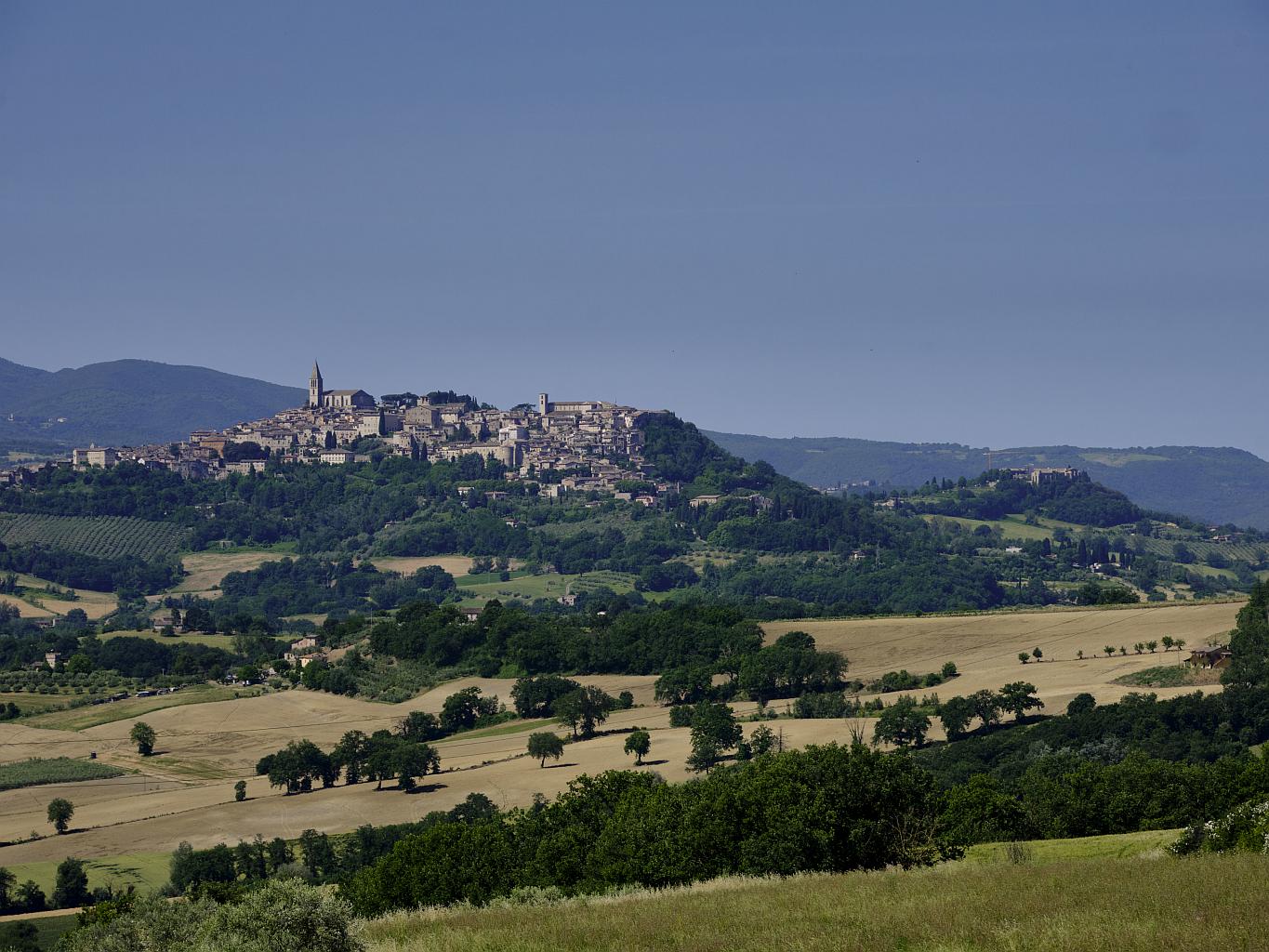
Let us start by assuming that we are approaching Roman Todi from the south, along the Via Amerina. I wrote about the Via Amerina in this article, but here again is a view south from Todi. Note that the road that goes up the hill is a later medieval road – the Roman-era road runs along the floor of the valley to the right, beside the little river Arnata.
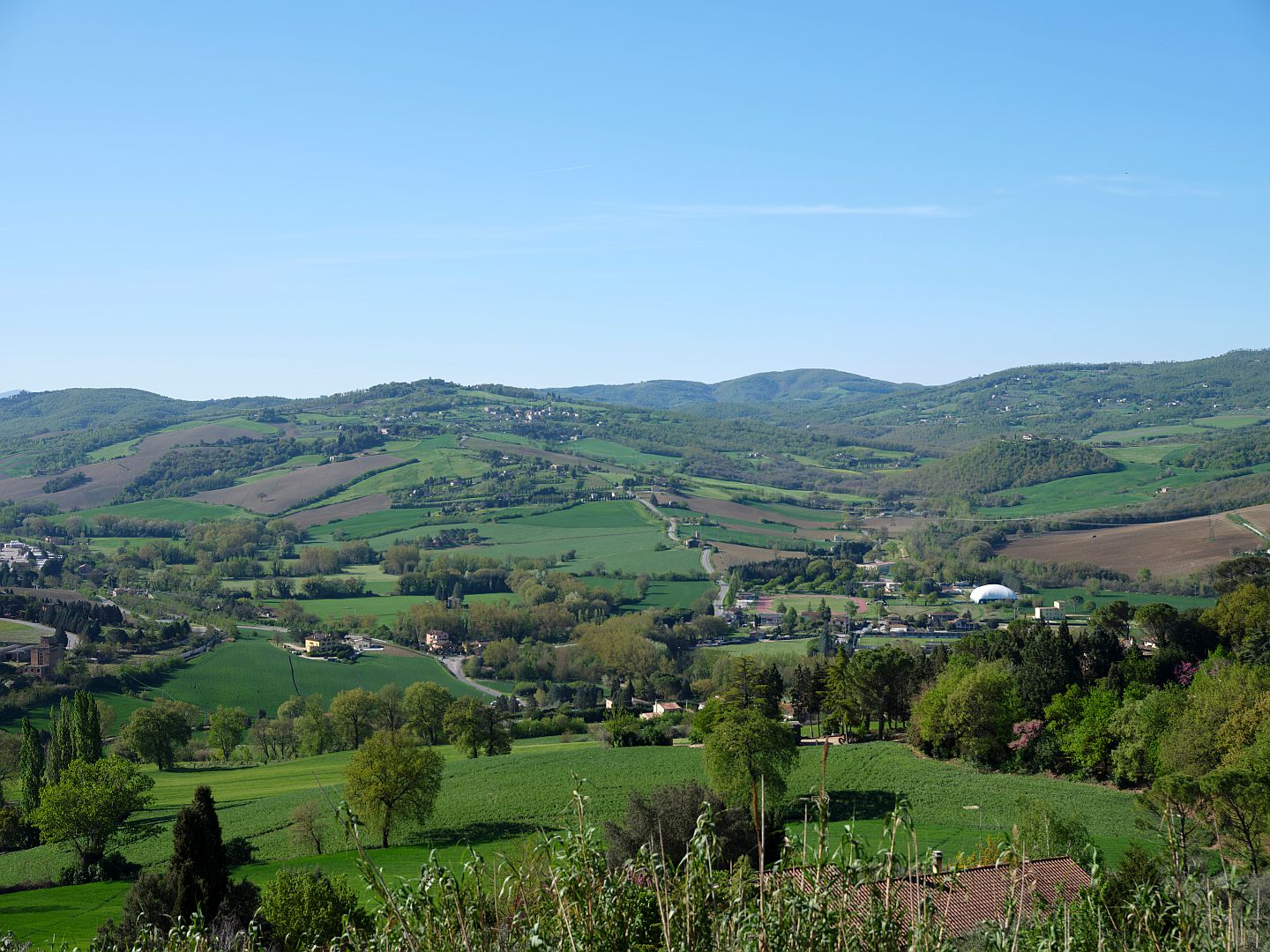
View south from Todi – the Via Amerina runs in the valley to the right. Fujifilm GFX-50R medium format digital camera, 32-64mm lens (click to enlarge).

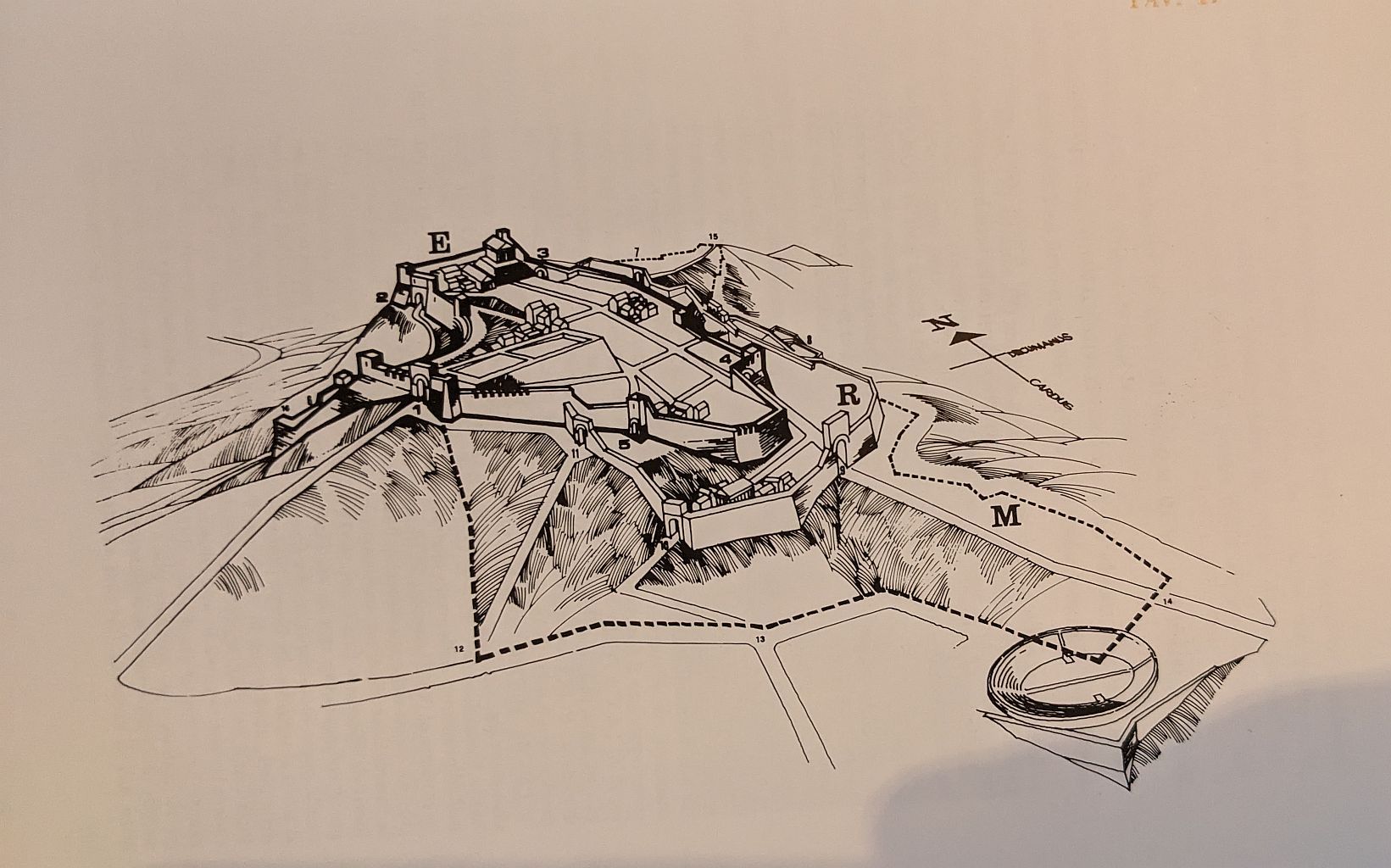
The picture below is an illustration in Todi e I Suoi Castelli by Franco Mancini, published in 1960 but still in print (the illustration is attributed to one G. Tenneroni). It shows an elevated view of Todi from the south, and I will be referring to it in this article. The photograph above was taken from roughly the position marked by the figure 5 in the drawing, with the Via Amerina the road that comes up towards the town at the bottom.
Todi elevation
Illustration of Todi from the south, from “Todi e I Suoi Castelli” by Franco Mancini, 1960 (click to enlarge).

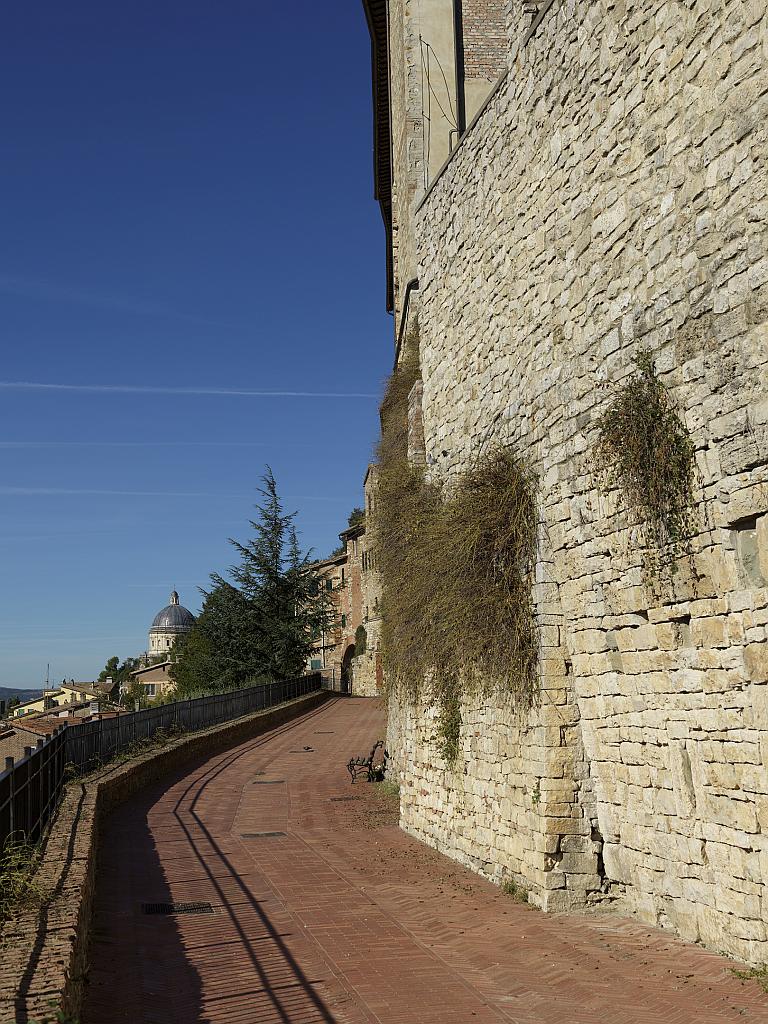
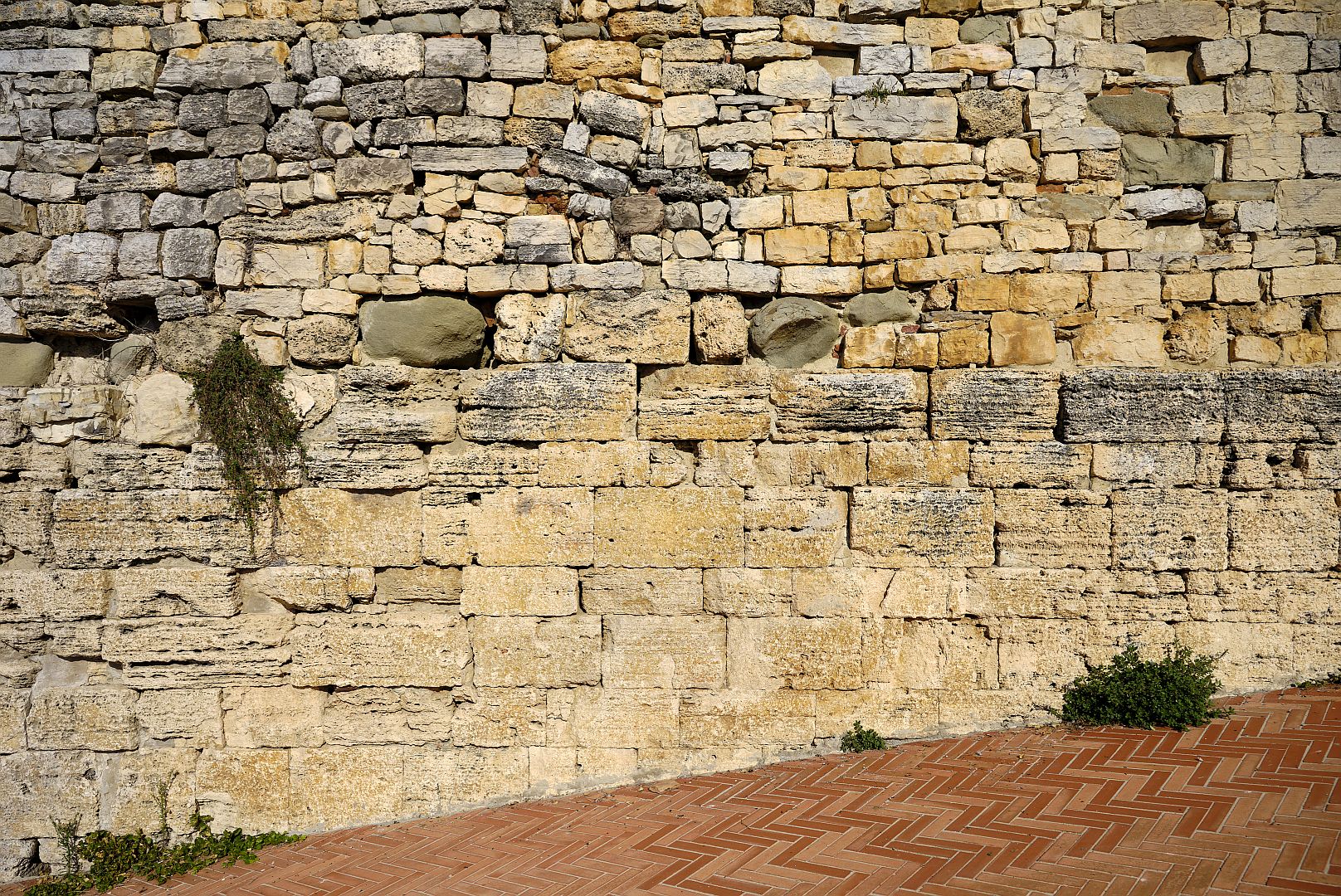
The map labels the three circles of the city walls as E for Etruscan (obviously in 1960 people still referred to the pre-Roman Umbrian period in Todi as Etruscan), R for Roman, and a dotted line marked M for Medieval. Frustratingly, it is hard to find agreement on when the “Roman” walls were built. Some date them to the time when Todi first became part of the Roman world in the 2nd Century BC, others to after Todi became a colonia in the 1st Century BC. The first ever source I encountered called them tardo-Romano, that is from the late Roman period when they would have been needed for defence against the invading Goths, in the 6th Century AD. Even if the walls were already in existence then, a hasty program of repairs seems plausible.
Second circle of walls
The second circle of walls, ie the Roman walls, with the dome of the Renaissance church of Consolazione in the distance. Hasselblad 501 C/M camera, Zeiss Distagon CF 60mm lens, CFV-50c digital back (click to enlarge).
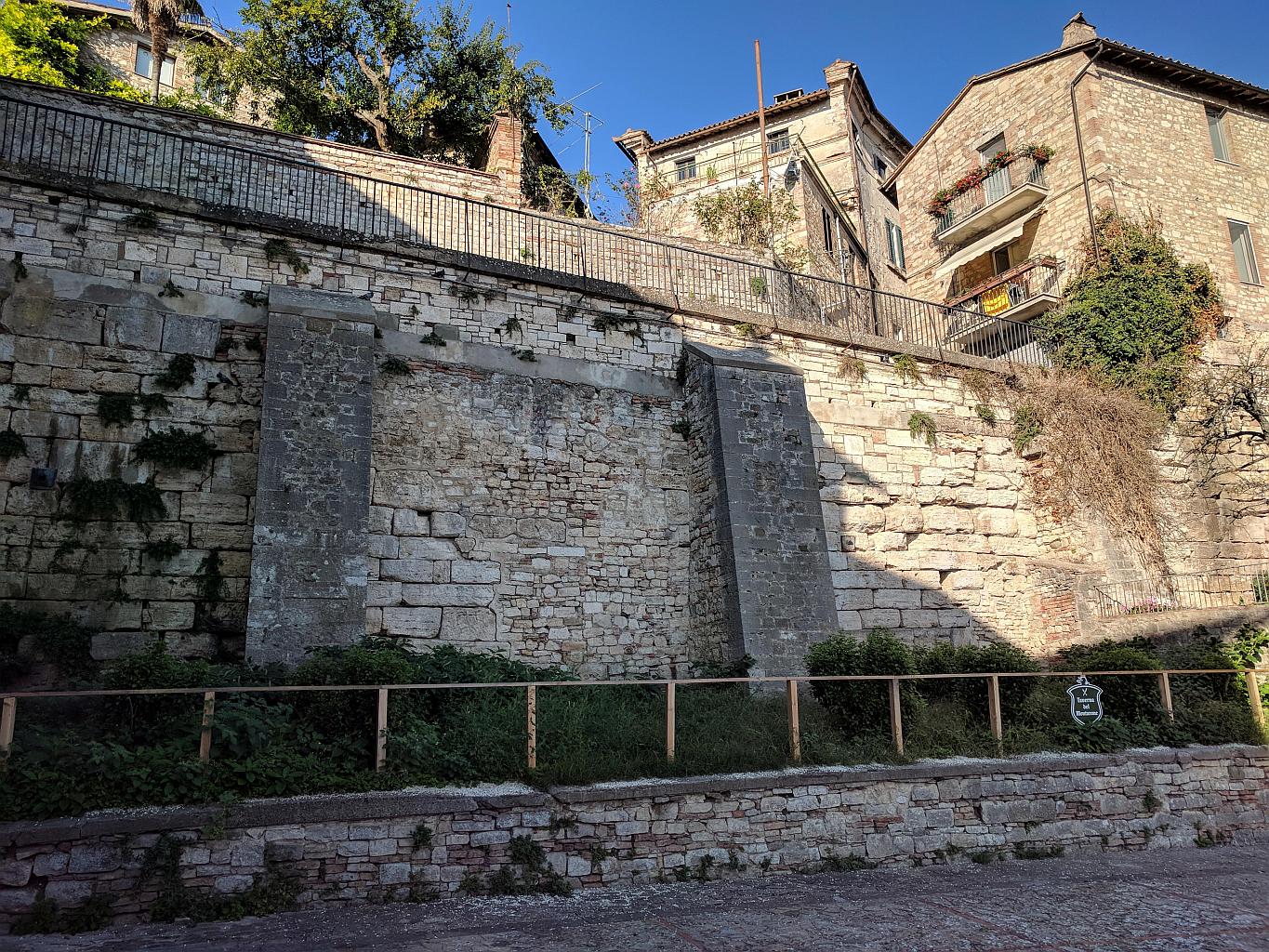
Via del Mezzomuro
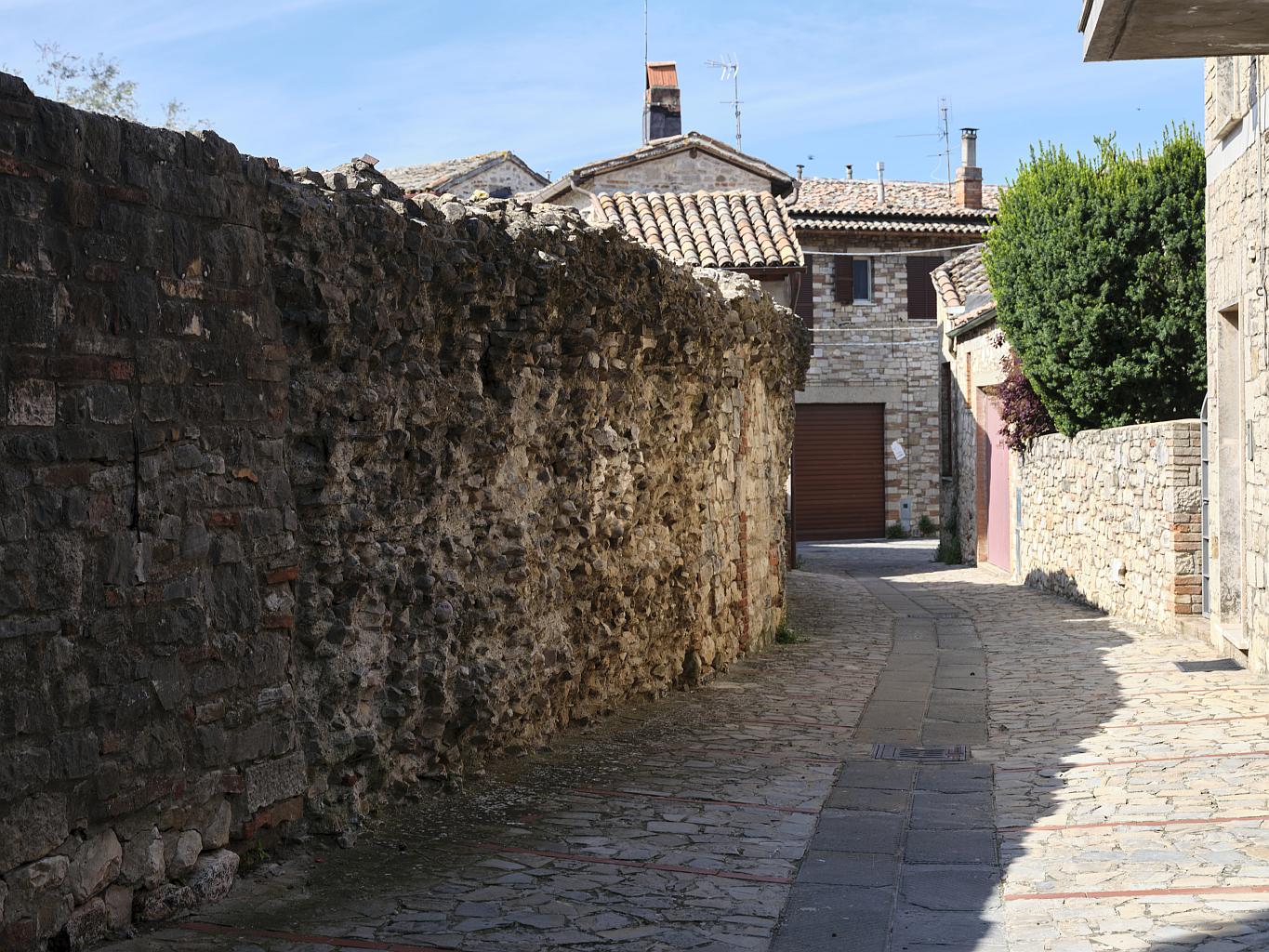
Part of the second circle of walls, on the aptly-named “Via di Mezzo Muro”. The contrast between the lower (presumably original Roman) stonework and upper (late-Roman or medieval extensions or repairs?) is very marked. Fujifilm GFX-50R medium format digital camera, 32-64mm lens (click to enlarge).

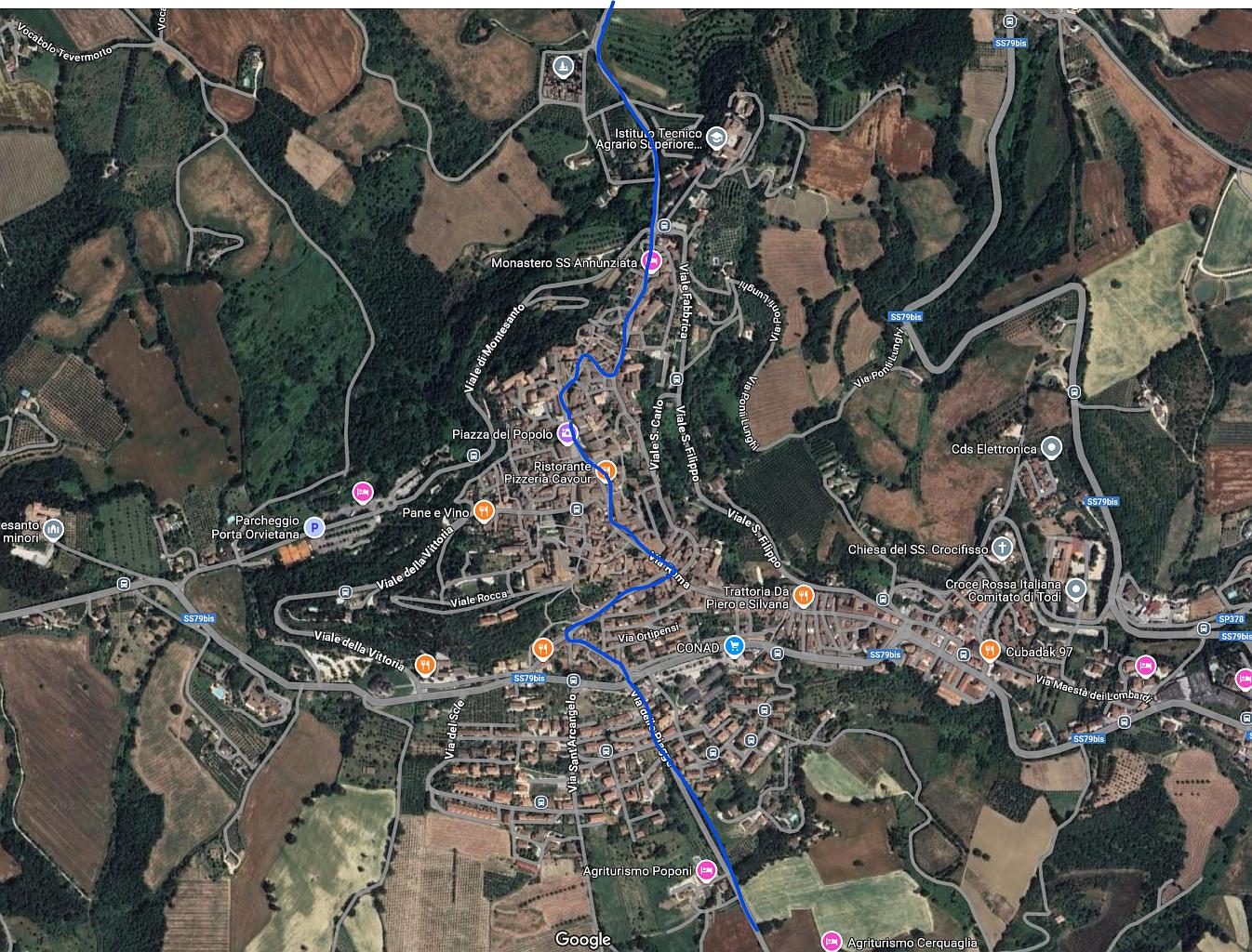
The route of the Via Amerina through the town is unchanged from antiquity. Here is a picture taken from Google Maps, on which I have marked its route.
Via Amerina
The route of the ancient Via Amerina through the modern town of Todi (source – Google Maps, click to enlarge).

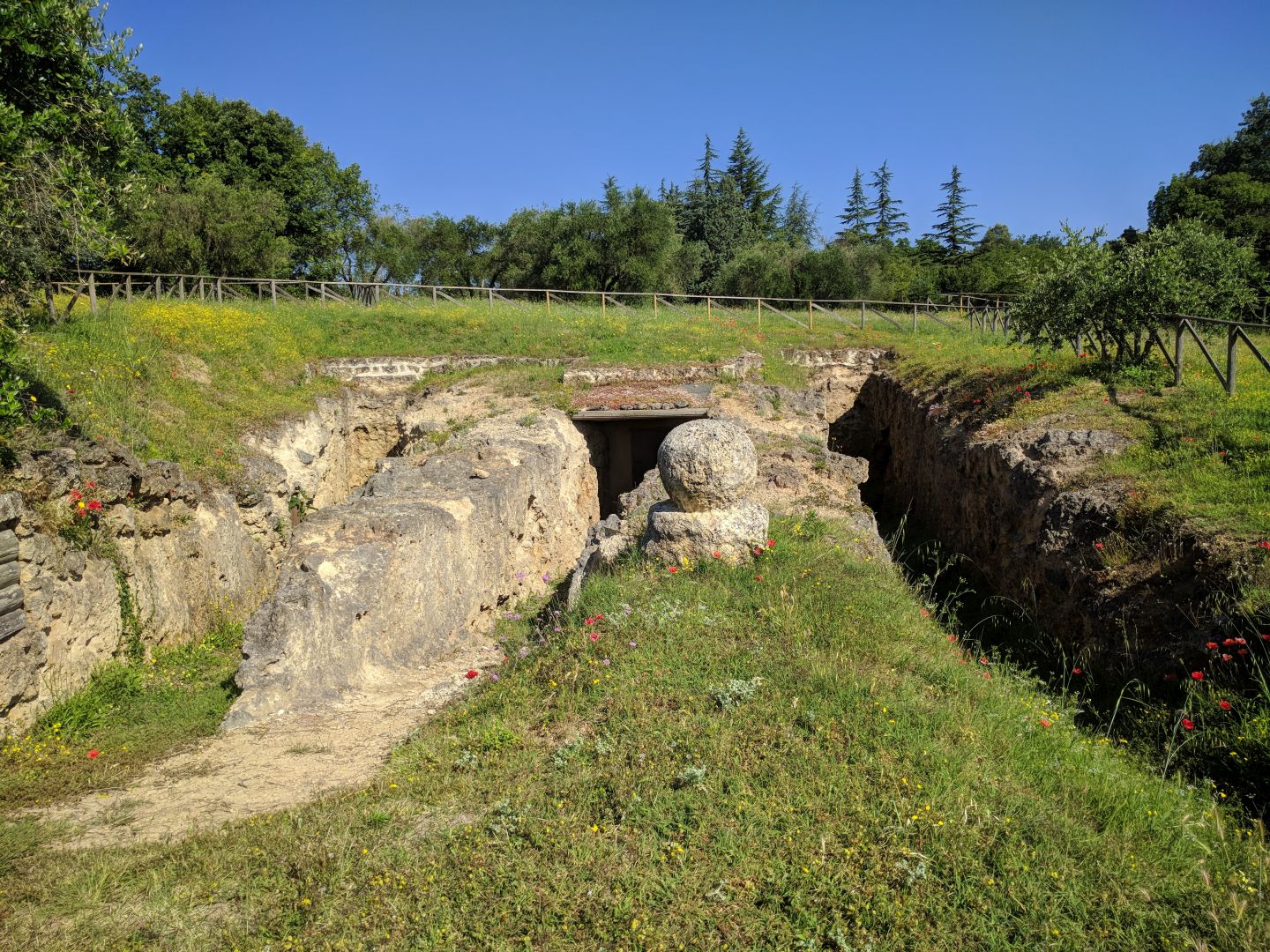
It is a long straight climb from the valley floor up to the town. As we saw in the first post in this series – Ancient Todi – Before the Romans, the southern slope of Todi’s hill was the site of a pre-Roman necropolis. In my mind’s eye I see this as a bit like the Etruscan necropolis we visited at Sarteano in 2018, where the tomb entrances take the form of long passages cut into the hillsides, giving the dead a nice view, as it were. If the pre-Roman tombs in Todi were like this, the passages would presumably have been clearly visible on either side as we ascended the hill.
Sarteano tombs
Entrances to Etruscan tombs in the necropolis of Sarteano. Perhaps the tombs on Todi’s southern slopes look a bit like this. Nokia 6.1 phone camera (click to enlarge).

It is likely that the area continued to be used for tombs, as the Romans also had the sensible rule that forbade burials inside city limits,. But their tombs looked different. Going by what we have seen on the Via Appia outside Rome, at Pompeii and close to Todi at Carsulae, they built monumental tombs above the ground. During the Republican and early Imperial periods, these were usually to hold the ashes of the deceased rather than the body, with inhumation becoming common later under the influence of eastern religions, including Christianity.
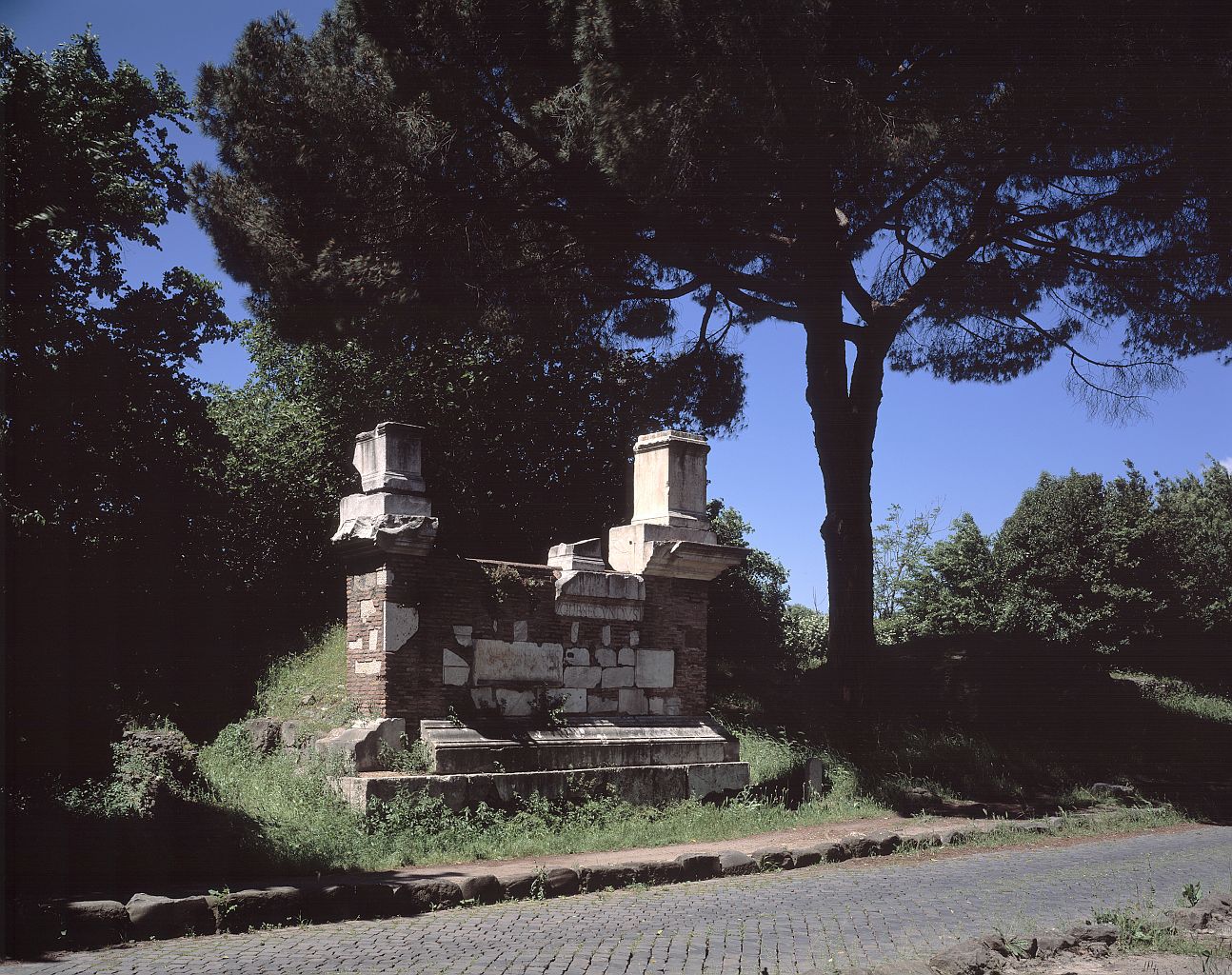
Monumental tomb on the Appian Way outside Rome. The Roman-era tombs that lined the roads outside Todi may well have looked like this. Horseman 45FA large format camera, Fuji Fujinon-W 125mm lens, 4×5-inch film back, Fujichrome Velvia 50 sheet film, scanned on an Imacon Flextight II film scanner (click to enlarge).
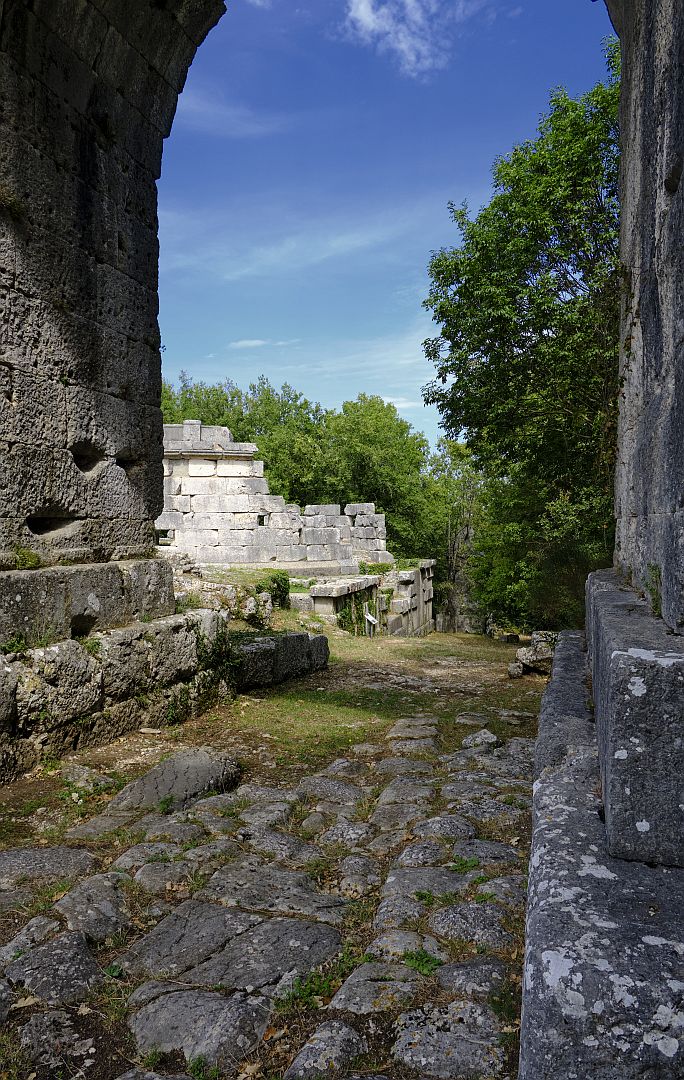
Carsulae
Carsulae – looking out of the town gate along the Via Flaminia with a monumental tomb visible just outside. Again, the Roman tombs outside the Todi city walls may have been similar. Fujifilm X-Pro 3 digital camera, 16mm lens (click to enlarge).

The remains of funerary monuments have also been found along the Via Amerina on the northern side of Todi, near the present Porta Perugina on the road towards Perugia. There are no standing remains of Roman above-ground tombs around Todi of which I am aware, but several fragments have come to light over the years and are preserved in the Civic Museum or the Lapidarium (of which more later).
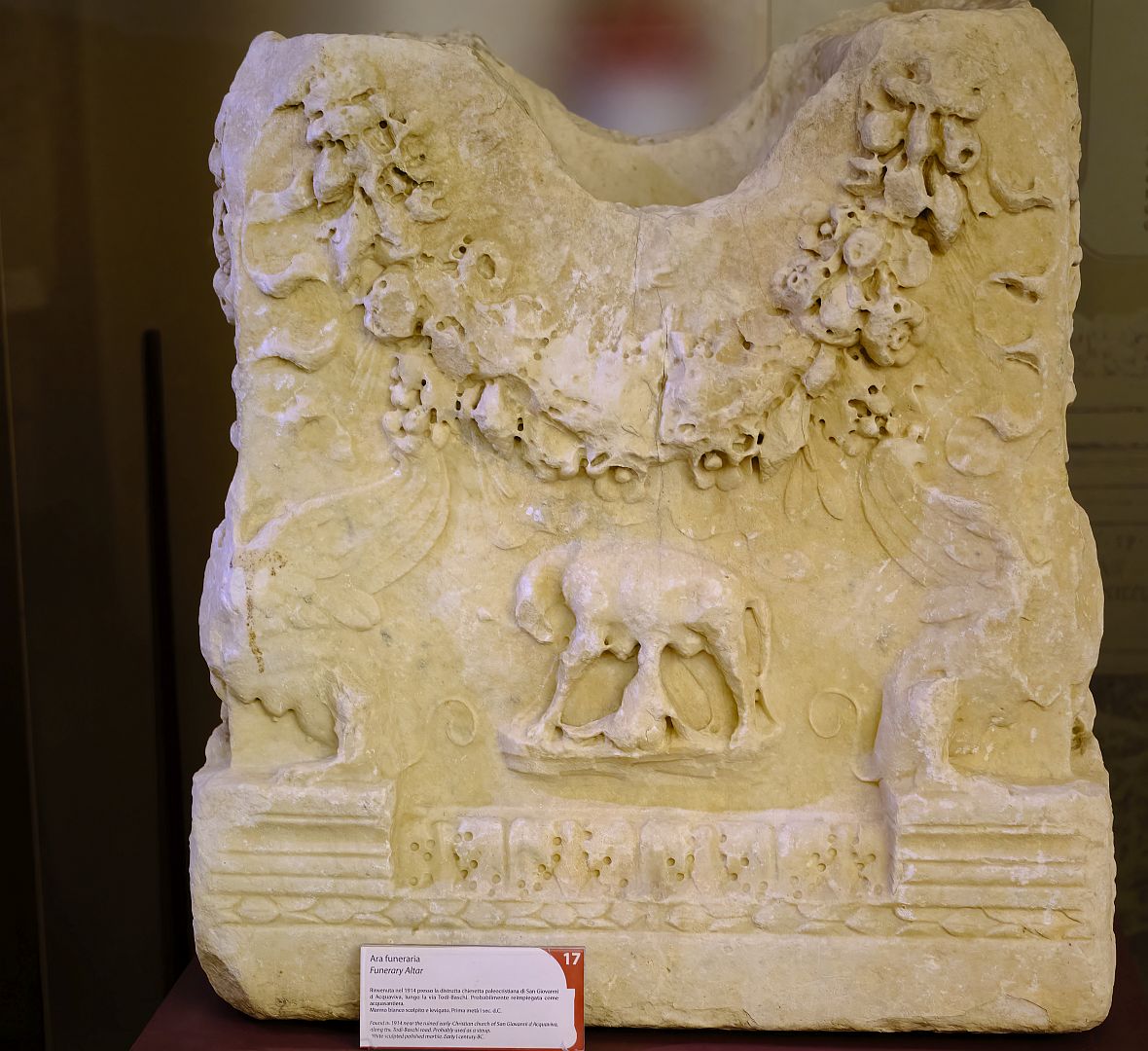
Funerary Altar
A Roman funerary altar from the 1st Century AD, from near Todi. It was found in the ruins of an early Christian church in which it had been used as a stoup, probably explaining its survival. Lapidarium Museum, Todi. Fujifilm X-Pro 3 digital camera, 35mm lens (click to enlarge).
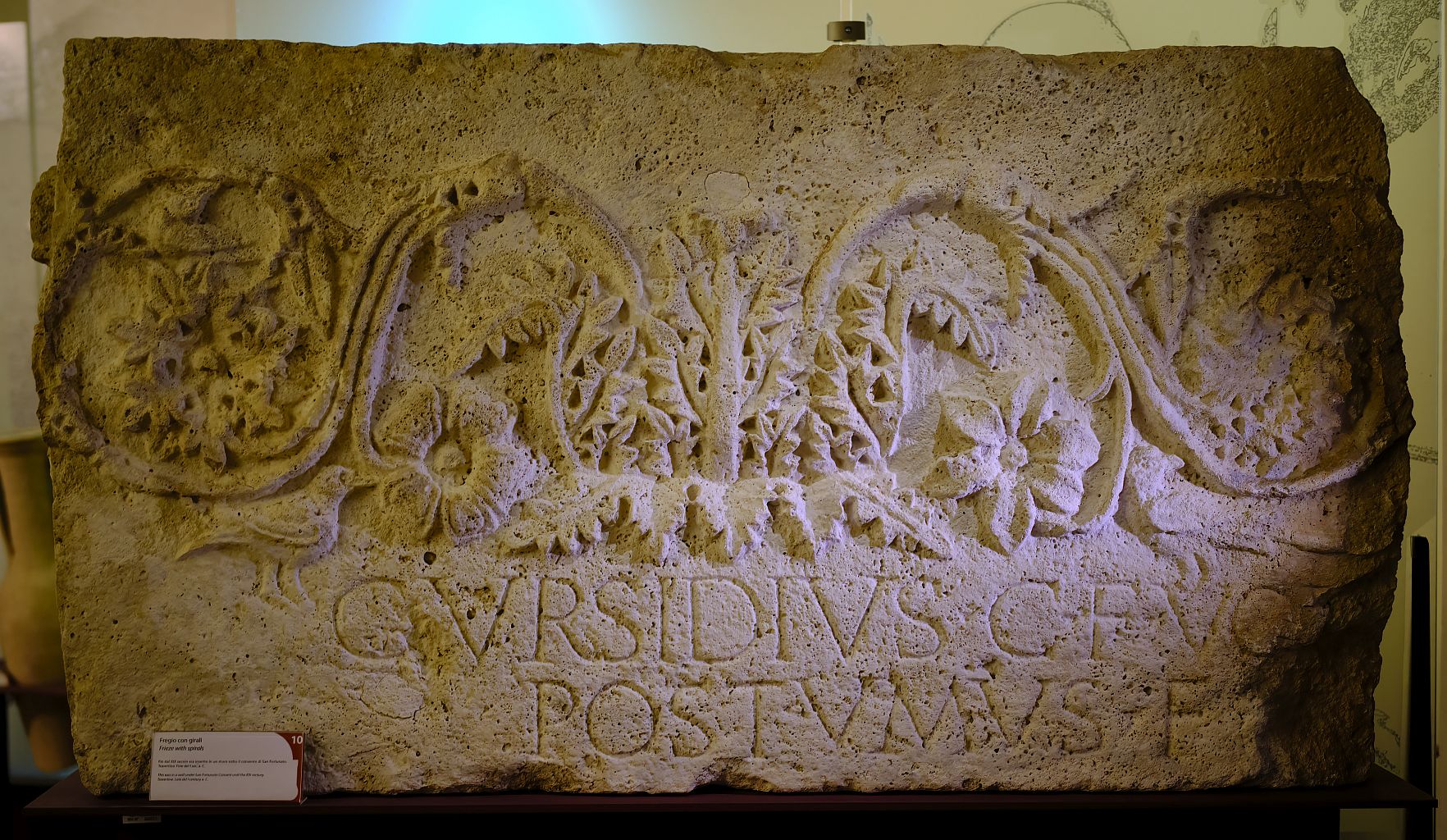
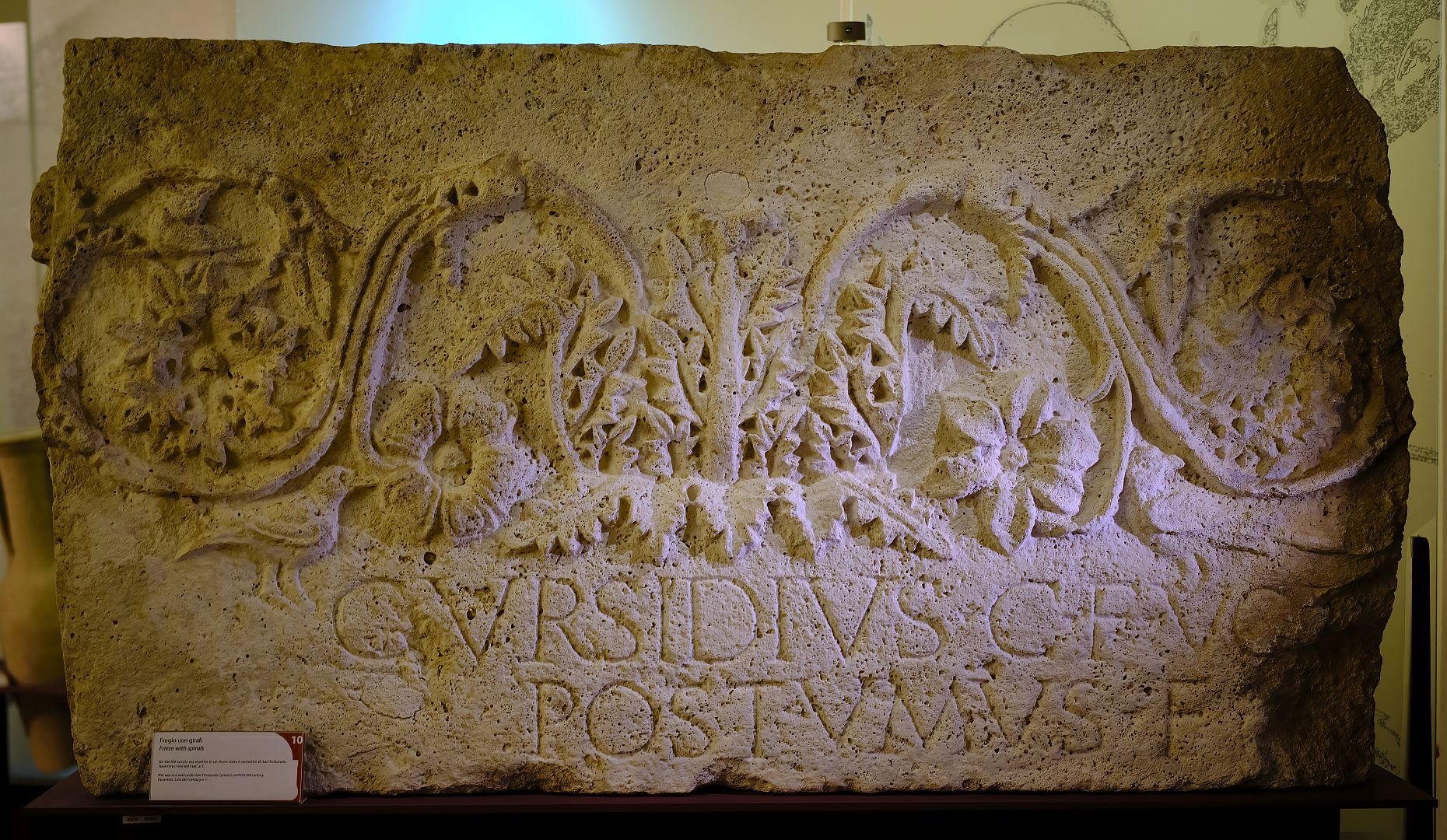
Frieze with spirals
Frieze with birds and floral motif, with memorial inscription, late 1st Century BC. This survived by being re-used as part of a wall under the San Fortunato Convent until the 19th Century. Lapidarium Museum, Todi. Fujifilm X-Pro 3 digital camera, 35mm lens (click to enlarge).

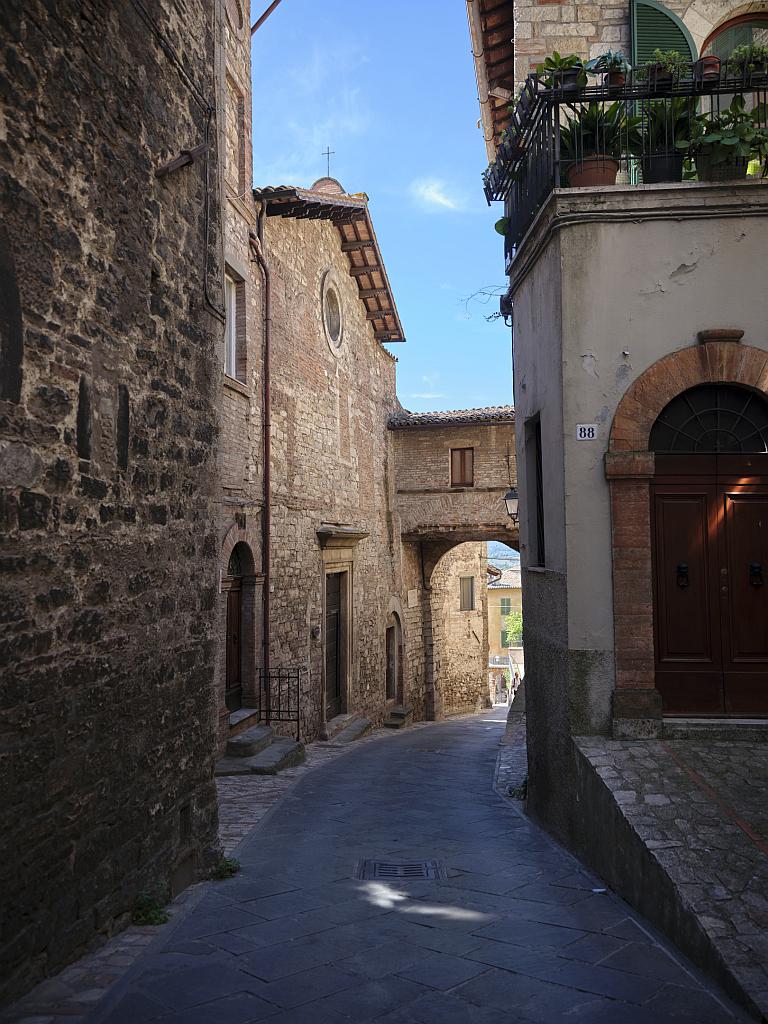
Let us continue our imaginary approach to Todi. We would enter the town through the Porta Aurea, in the second circle of walls. The gate still exists, although like all of Todi’s gates, the upper parts are medieval or later, reflecting the need to keep them in good defensive repair.
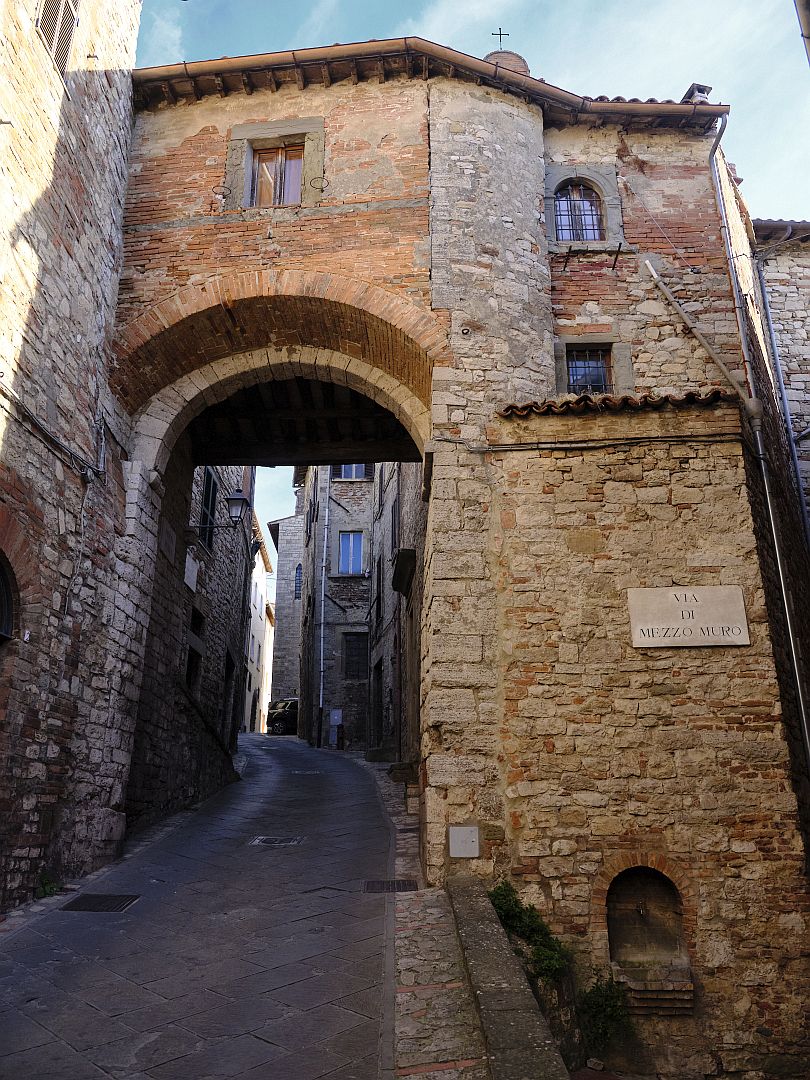
Porta Aurea
The Porta Aurea, just as you enter the Roman walls. The plaque on the inside dates it to the 2nd Century BC and the 13th Century AD. Some of the large, even, unmortared stone blocks on the right of the gate look Roman – everything else looks like a later repair or reconstruction. Fujifilm GFX-50R medium format digital camera, 32-64mm lens (click to enlarge).
Porta AUrea
The Porta Aurea, looking back from inside the walls, looking very medieval. Fujifilm GFX-50R medium format digital camera, 32-64mm lens (click to enlarge).

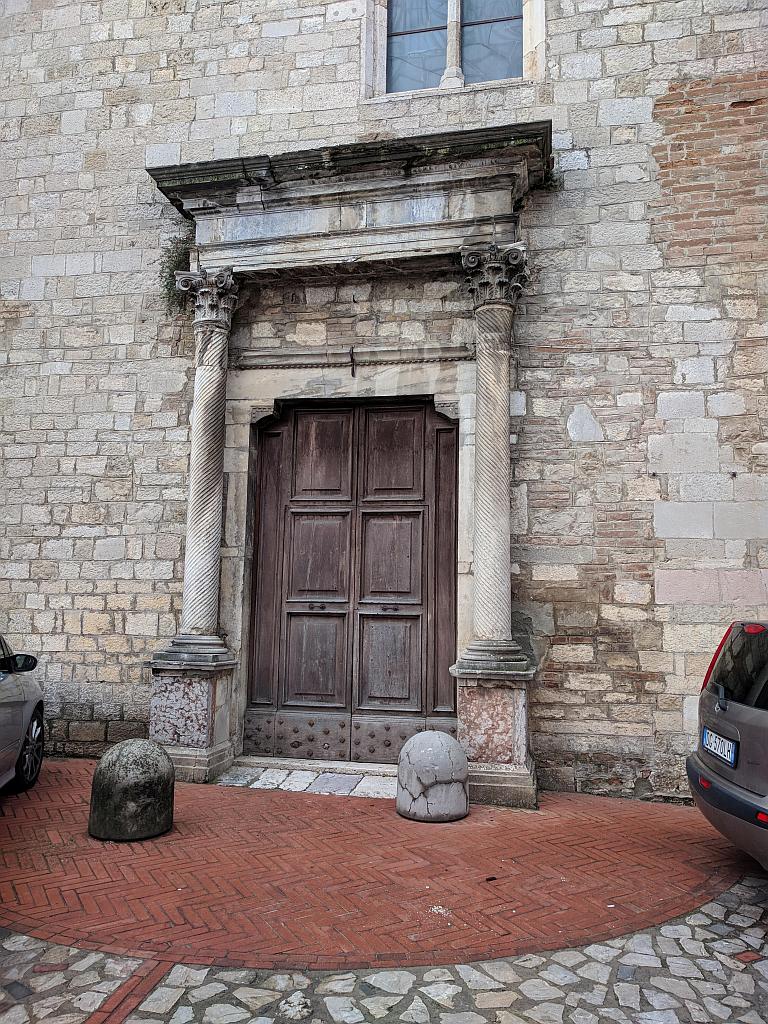
Once through the Porta Aurea, on our right we would pass a temple on the site of the present church of Santa Maria in Cammuccia (sometimes spelled Camuccia; no one knows what it means), which was dedicated either to Venus or Minerva, depending on which local tradition you follow. That there was a Roman temple there seems clear enough – part of it has been incorporated into the façade of the medieval church, and re-dedication to the Virgin Mary of temples of both Venus and Minerva seems to have been fairly common. But I have not been able to find an authoritative source – I asked ChatGPT for one but it directed me to one of my own blog posts, which is not exactly a peer-reviewed publication. Moreover, while I agree that I am not an authority, I thought ChatGPT’s tone was a little condescending (only a photo blog, after all).
Santa Maria in Cammuccia
The church of Santa Maria in Cammuccia, incorporating elements of a Roman temple. Nokia 6.1 phone camera (click to enlarge).

The Gate of Mars

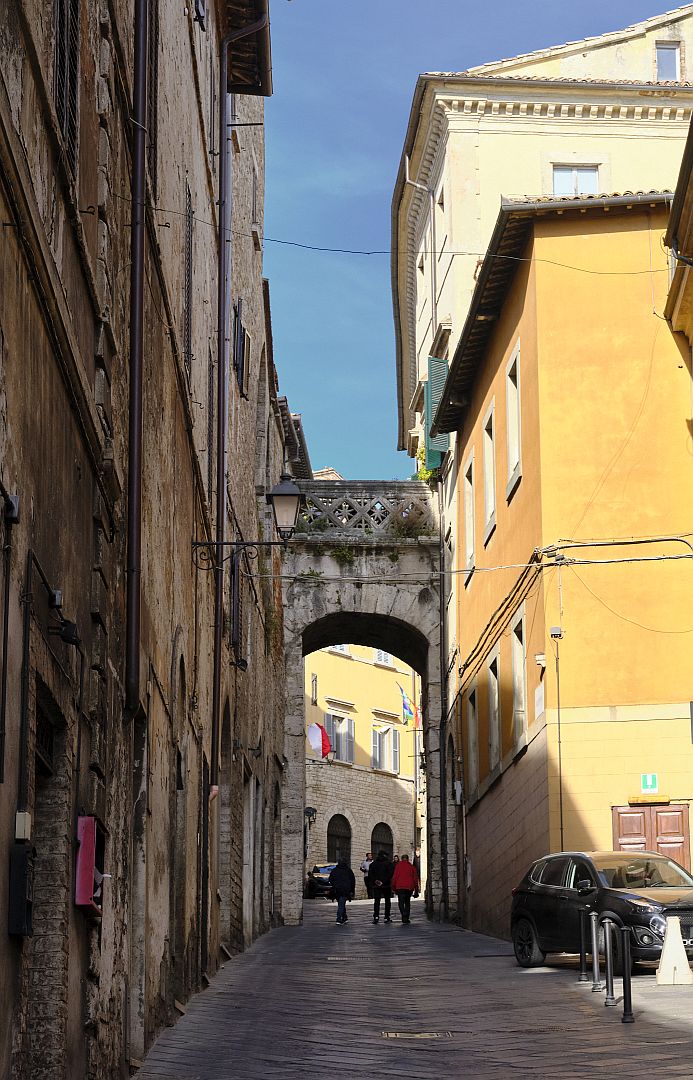
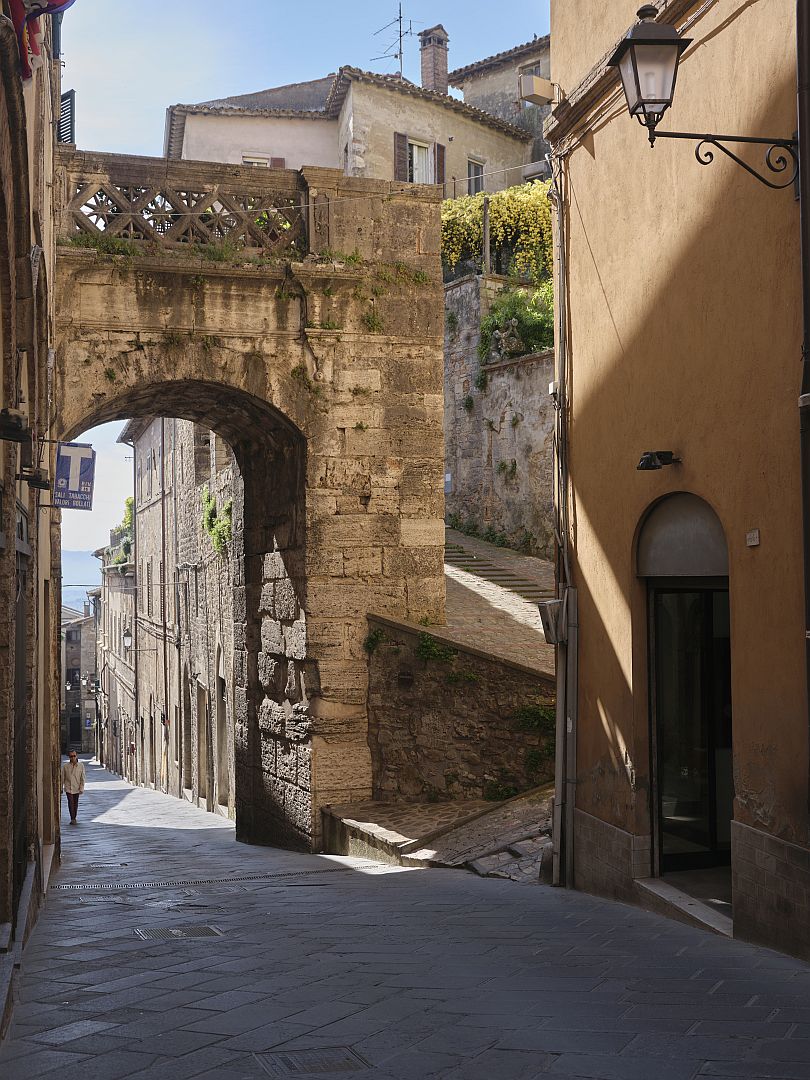
Continuing, both the ancient and the modern road then take a sharp left turn uphill and pass under a gate which was here before the Romans – the Porta Marzia, or Gate of Mars, in the pre-Roman walls (number 4 in the Mancini/Tenneroni drawing).
Porta Marzia
The Porta Marzia from below, as you enter the oldest “Etruscan” part of the town. While here the walls of which it was part have long since disappeared into surrounding buildings, the width and height of the gate, and its general appearance, may well be much as they were in the 5th Century BC – except for the stone balustrades on the top, which I read somewhere are from the 17th Century. Fujifilm GFX-50R medium format digital camera, 32-64mm lens (click to enlarge).
The Porta Marzia from the inside. Fujifilm GFX-50R medium format digital camera (click to enlarge).

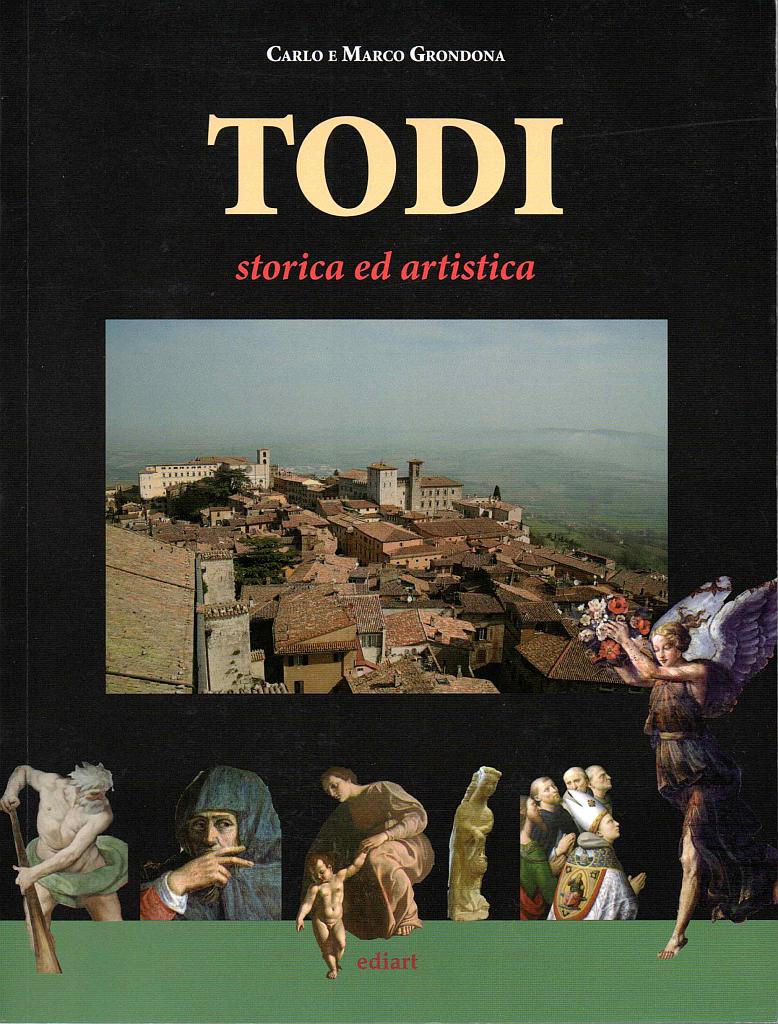
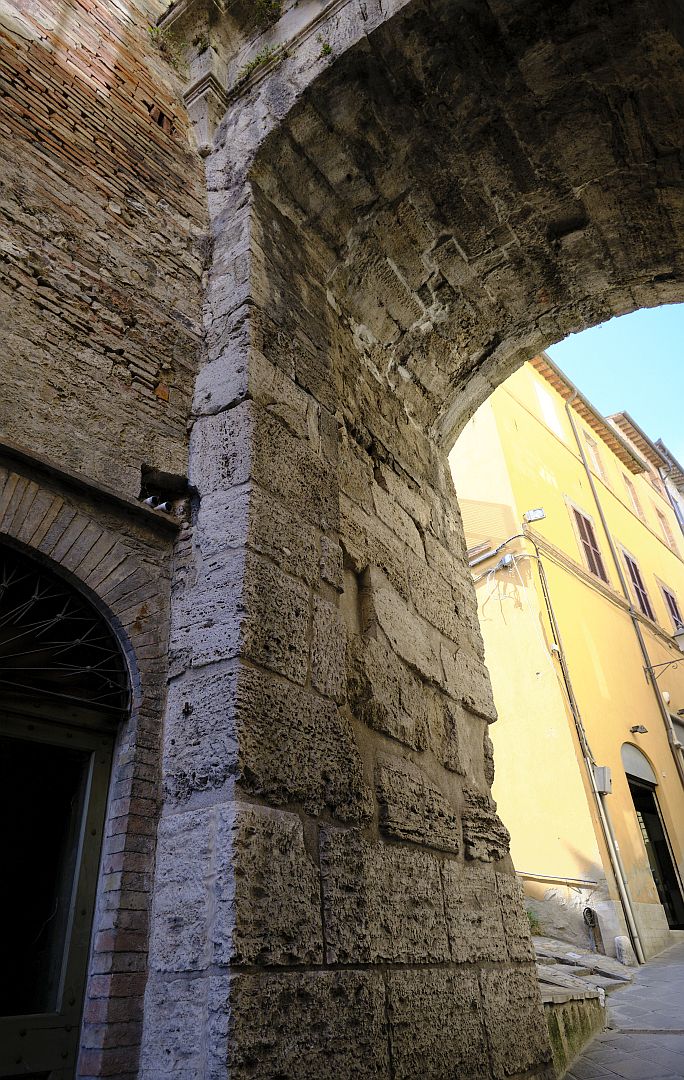
In the photograph below, you can see that the lower two courses of stones are of a size and regularity that one associates with pre-Roman work. In their book Todi: Storia ed Artistica, Carlo and Marco Grondona record that the stones were a source of wonder to the medieval inhabitants of the town. But I have been puzzled by them; closer inspection reveals that they look modern and are laid with mortar. The mystery was explained in the same book – apparently during work to re-pave the city streets the original stonework was damaged and had to be refaced. What a terrible shame – hundreds of cars pass through the gate every day and it would be very cool if they were passing authentic stonework from 2,400 years ago.
Porta Marzia
The Porta Marzia, showing the repaired lower stonework. Pre-Roman, Roman, Medieval and Baroque – the gate has stood for well over 2,000 years, despite the efforts of the council road workers. Fujifilm X-Pro 3 digital camera, 16mm lens (click to enlarge).

The Nicchioni

Now inside the very oldest boundaries of the city, to our right we pass a road that leads down to the old town marketplace, now a car park. Beside the Mercato Vecchio is one of the largest and most complete Roman structures in Todi – the Nicchioni (“big niches”).
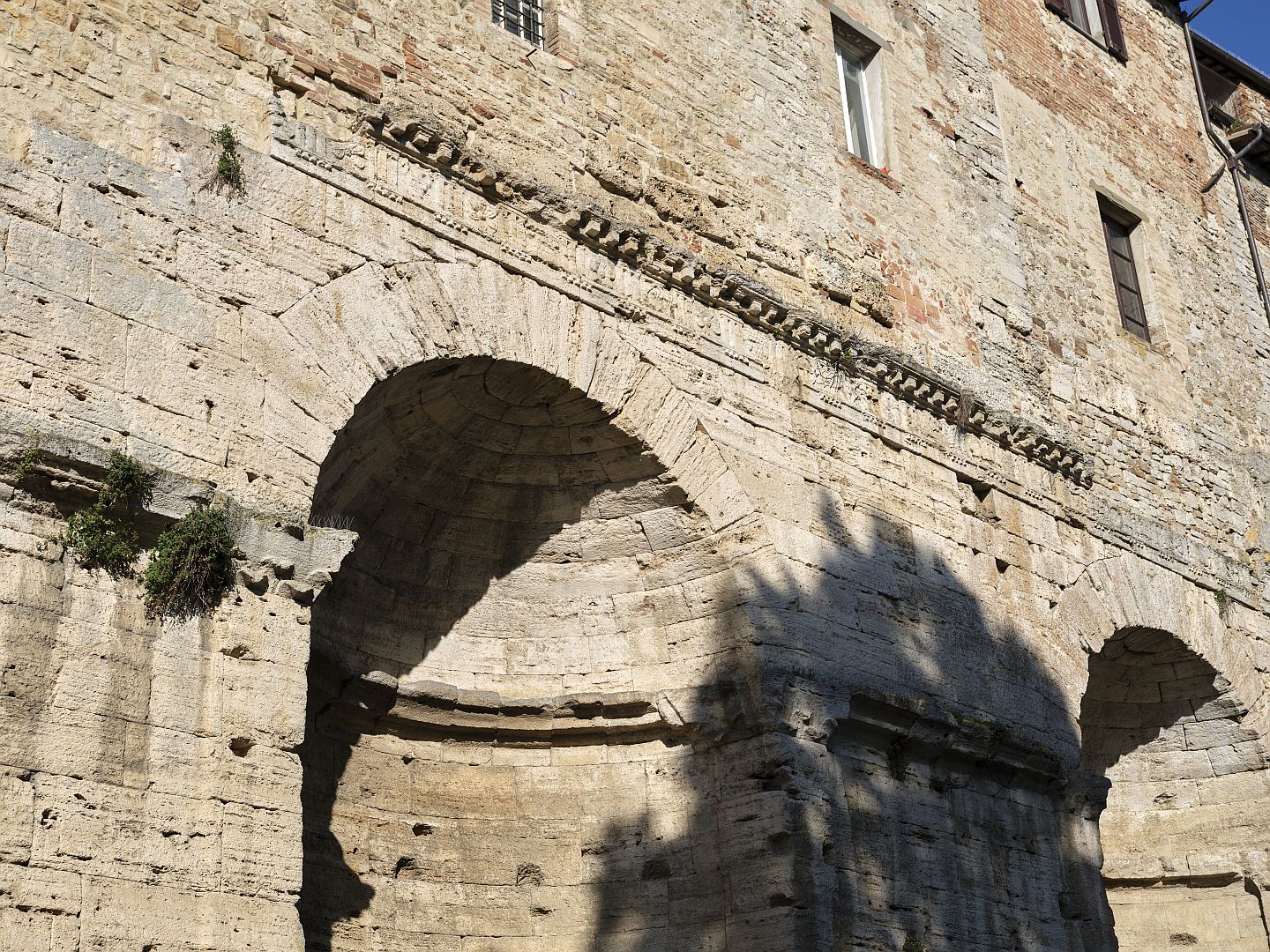
Nicchioni
The “Nicchioni”. Note the decorative frieze along the top, separating the Roman work from the medieval buildings that rest on them. Fujifilm GFX-50R medium format digital camera, 32-64mm lens (click to enlarge).
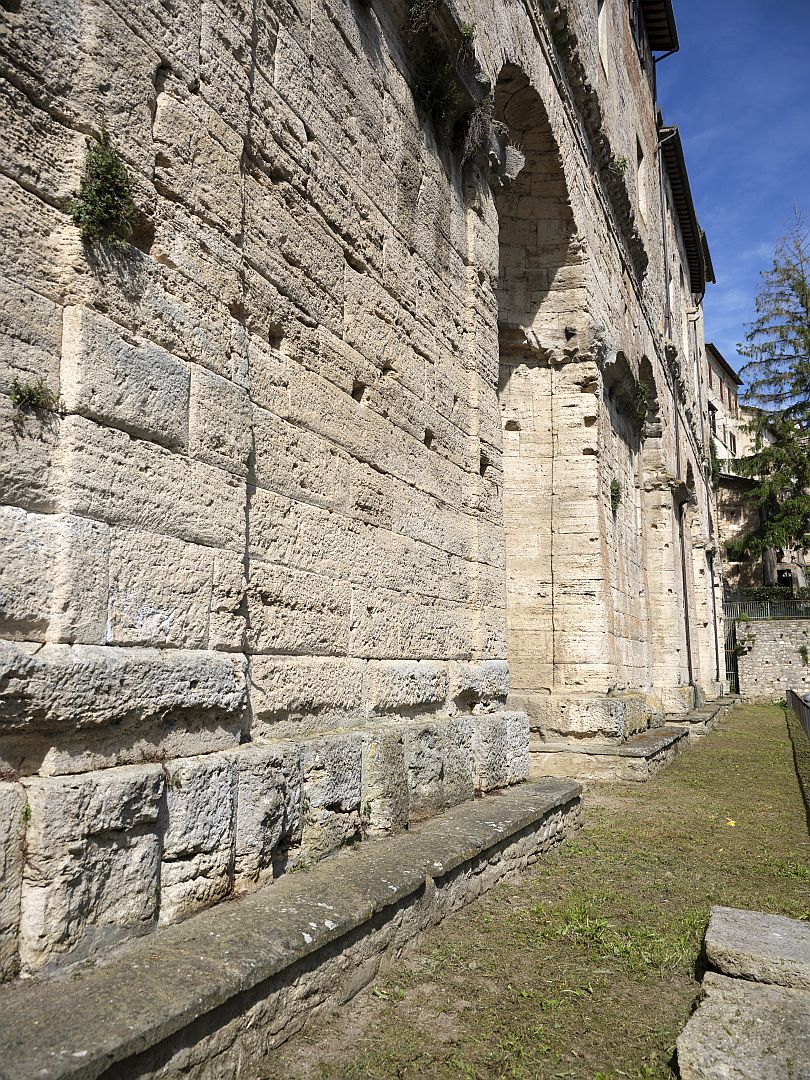
Nicchioni
The base of the Nicchioni, showing the massive Roman stonework. Fujifilm GFX-50R medium format digital camera, 32-64mm lens (click to enlarge).

Local tradition once had it that the Nicchioni were part of a temple of Mars, but the modern view of their function is more prosaic, yet in a way more impressive. They are thought to be nothing more than compression arches, supporting the immense weight of the buildings above. Through a couple of millennia of earthquakes and fears of subsidence they have stood there holding up people’s houses and shops, and they still do today.
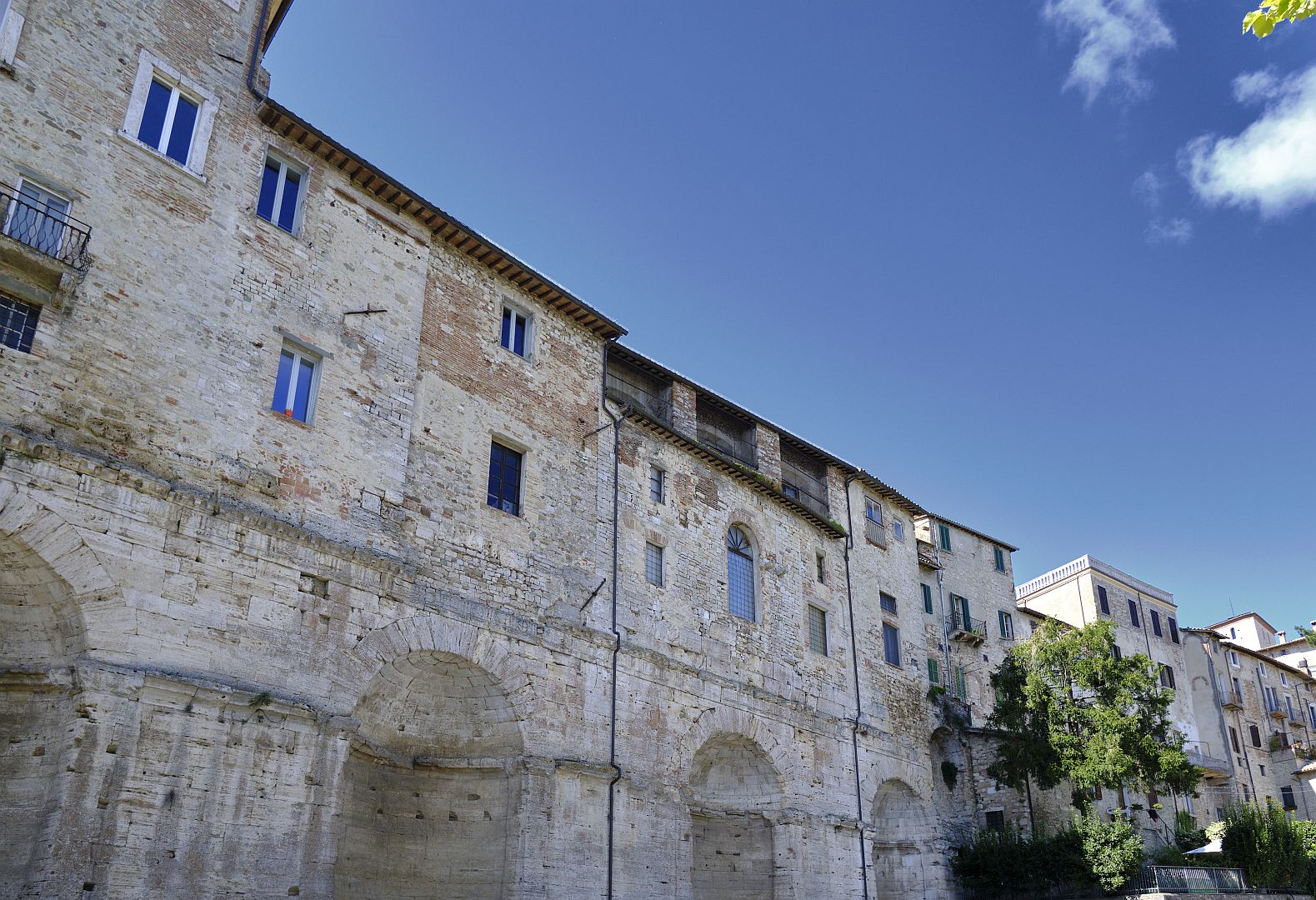
Nicchioni
The “Nicchioni showing the buildings that they support. Fujifilm X-Pro 3 digital camera, 16mm lens (click to enlarge).

The Forum and the Temple of Jupiter

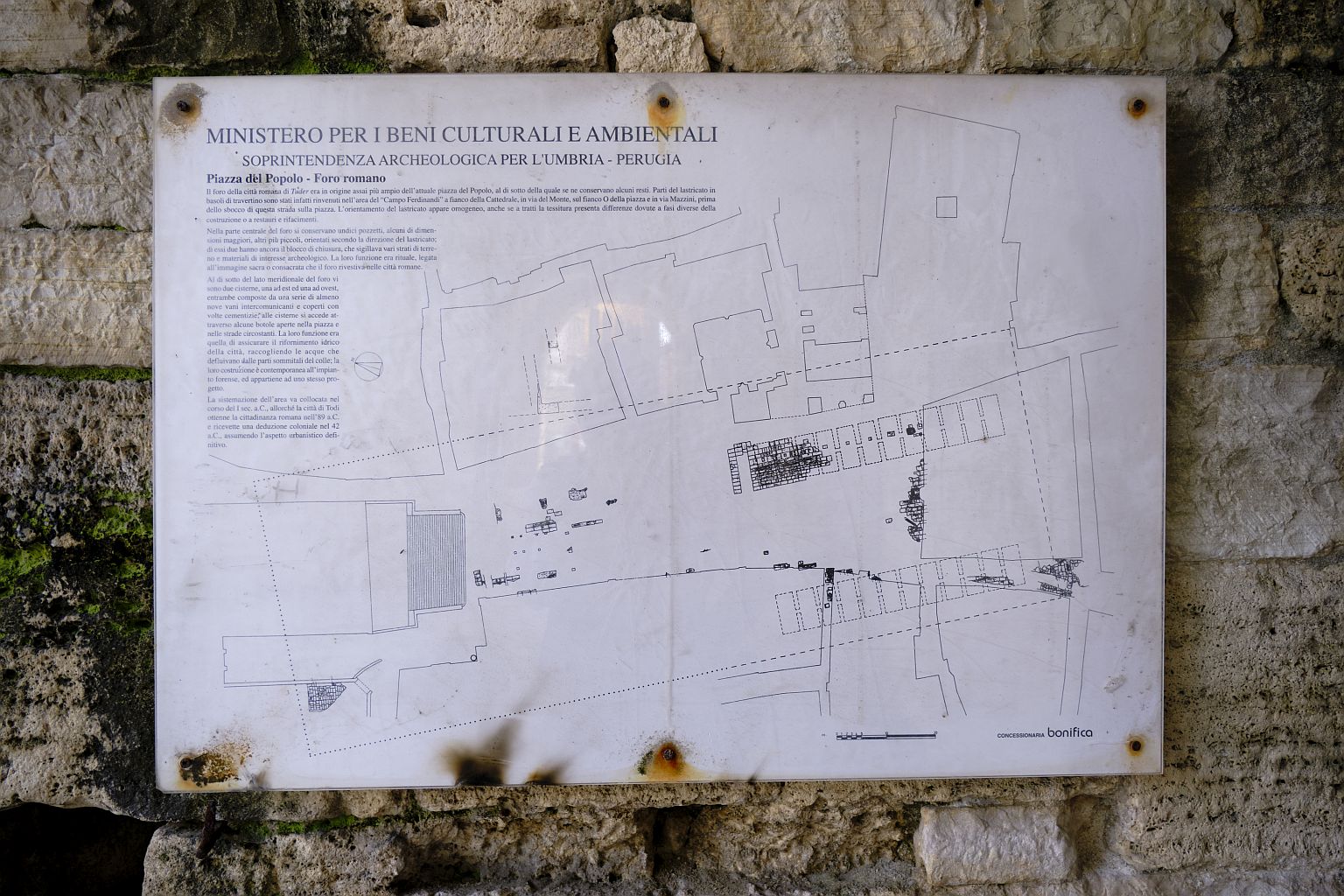
Now we are at the highest point on the road, where it opened out into the forum. The modern Piazza del Popolo is in the same location, but is a good deal smaller than was the forum, as Renaissance palaces have encroached on the western side, and the duomo on the northern side.
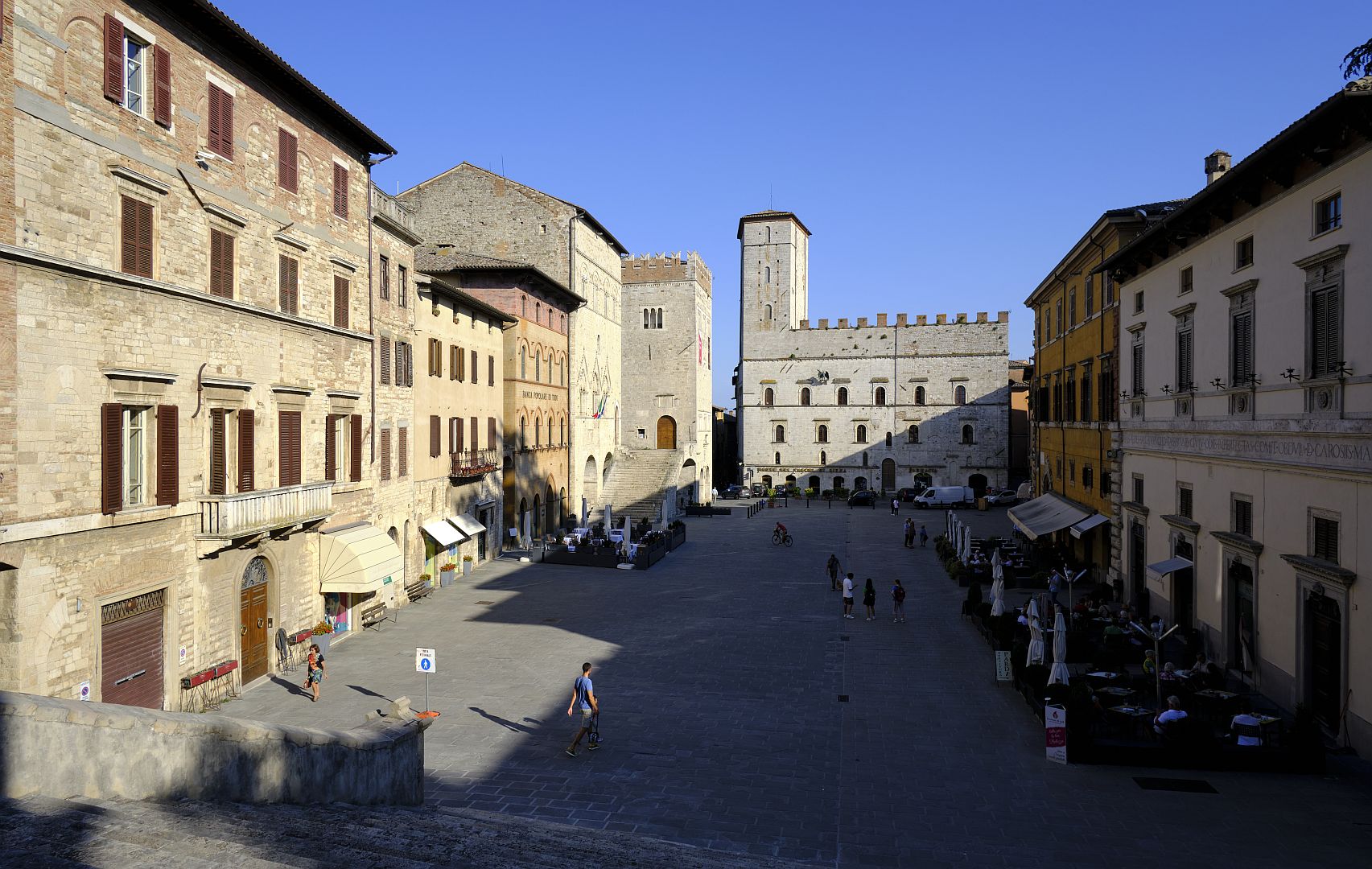
Piazza del Popolo
The Piazza del Popolo as it is today, from the steps of the duomo, looking back towards the 12th and 13th-Century civic palaces. The Roman forum was wider, particularly on the right. Fujifilm X-Pro 3 digital camera, 16mm lens (click to enlarge).

The picture below, of a panel on display in the piazza, shows the Roman forum as a rectangular dotted line, with the medieval and renaissance buildings superimposed (NB: north is on the left).
Plan of the forum
Plan of the forum. Note how the present buildings have encroached on the ancient public area. (click to enlarge).

The main temple in Roman Todi is always described as having been a temple of Jupiter – I don’t know whether there is evidence for this or whether it is assumed that the principal temple would always have been dedicated to the chief of the gods. In the drawing near the top of this article, it is shown at the top, next to the letter E.

These days the approximate site is occupied by the duomo, and if you go down into the crypt you can see a few bits of stone dating from the late-Roman period. However to the non-expert eye any remains of the Roman temple, and indeed of the Lombard-era church that replaced it, have been obliterated by the medieval Romanesque building that was begun around 1100 and largely completed by around 1300. A bit further up the hill behind the duomo there are some Roman remains but they are only partly visible in an overgrown pit covered by a thick glass plate.
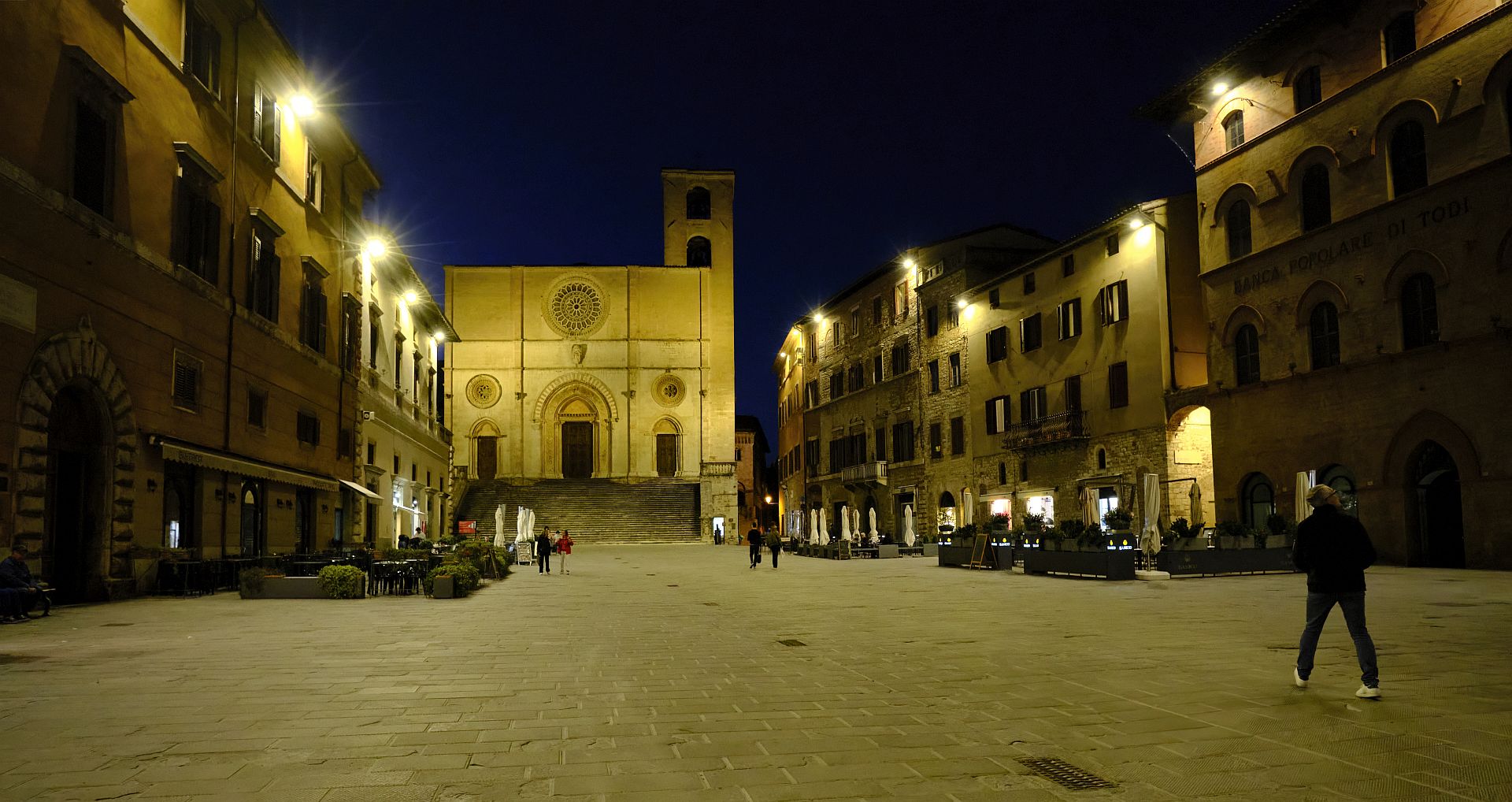
The Piazza del Popolo and the duomo in the evening. It seems that the temple of Jupiter was further back than the present duomo building. Fujifilm X-Pro 3 digital camera, 16mm lens (click to enlarge).

The Cisterns

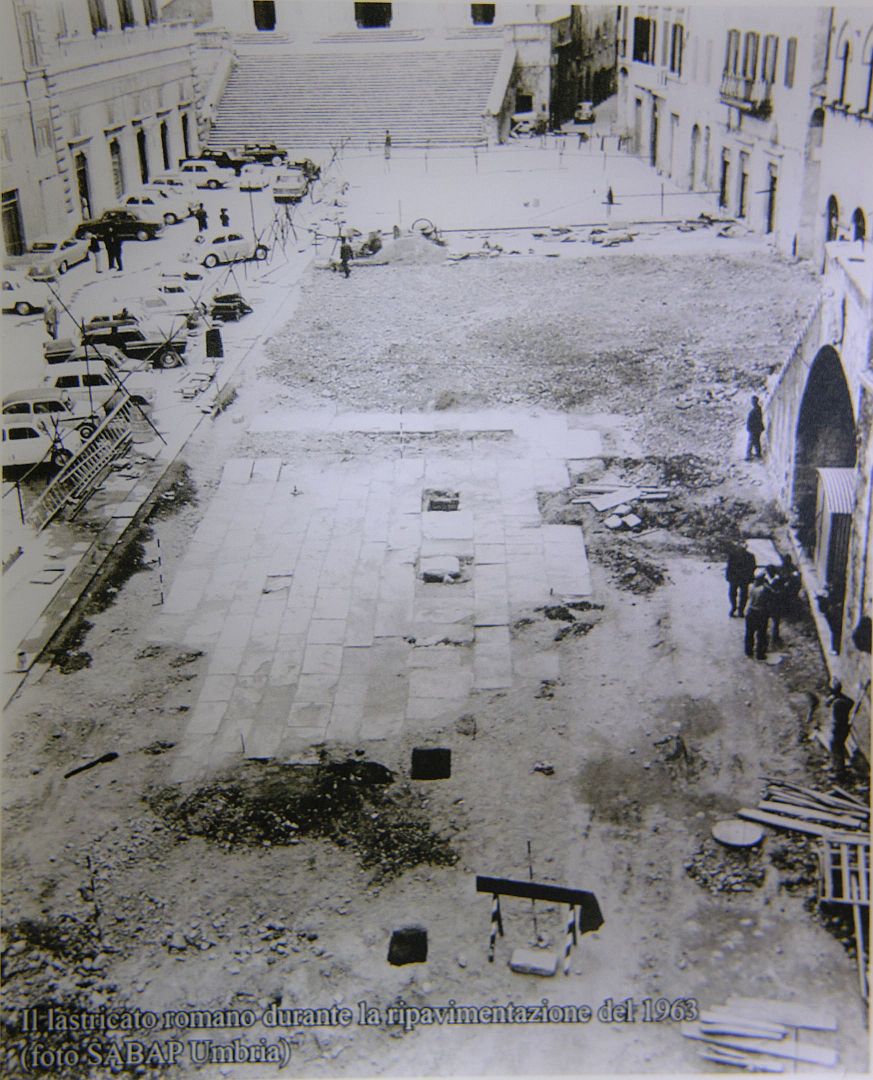
The most remarkable Roman remains in Todi are not immediately visible – they are the cisterns that lie underneath the Piazza del Popolo. You see, the flat expanse that was the forum and is now the piazza, and which carries the weight of buildings, cars, concert stages and the occasional baffling modern sculpture, is not only entirely artificial, but also partly hollow. The original space was a saddle between two hills – the Romans excavated it further, built two rows of giant concrete cisterns, then filled it all in and paved over the top. The Roman paving is still there, only a few inches beneath the modern surface.
Piazza del Popolo in 1963
In 1963 the Piazza del Popolo was re-paved, revealing the underlying Roman paving. The square holes are the upper entrances to the eastern line of cisterns. The photograph is on an illuminated display in the cisterns themselves (click to enlarge).

If you look back at the diagram of the forum further up, you can see two lines of twelve connected rectangles – these are the cisterns. If you go into the tourist office and pay a few euros, you can visit them. The picture below, taken from an illuminated information panel in the cisterns themselves, shows the method of construction: wooden formwork created a space into which concrete could be poured to make the lower walls, then the formwork was raised, allowing concrete to fill the space between the cisterns, then finally a barrel vault was constructed, over which more concrete was poured, with stone wells at the top through which water could drain into the cisterns, or be drawn up from above. The timber must then have been removed from within, and the cisterns allowed to fill with rainwater, or from aqueducts fed by springs.
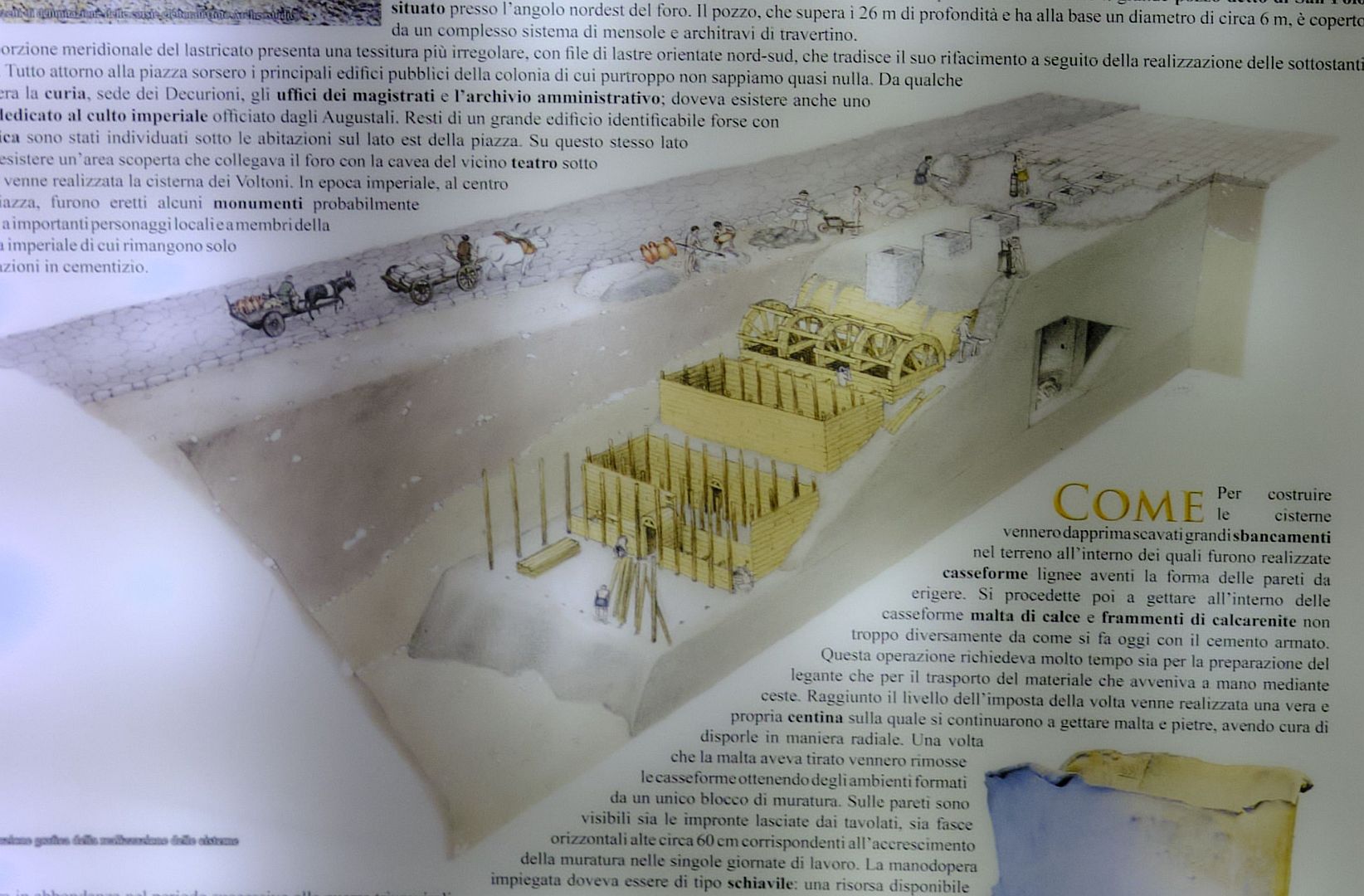
Diagram showing the construction of the cisterns (click to enlarge).

The two sets of twelve cisterns were not connected – according to one of the guides this was to prevent any contamination of one set affecting the other.
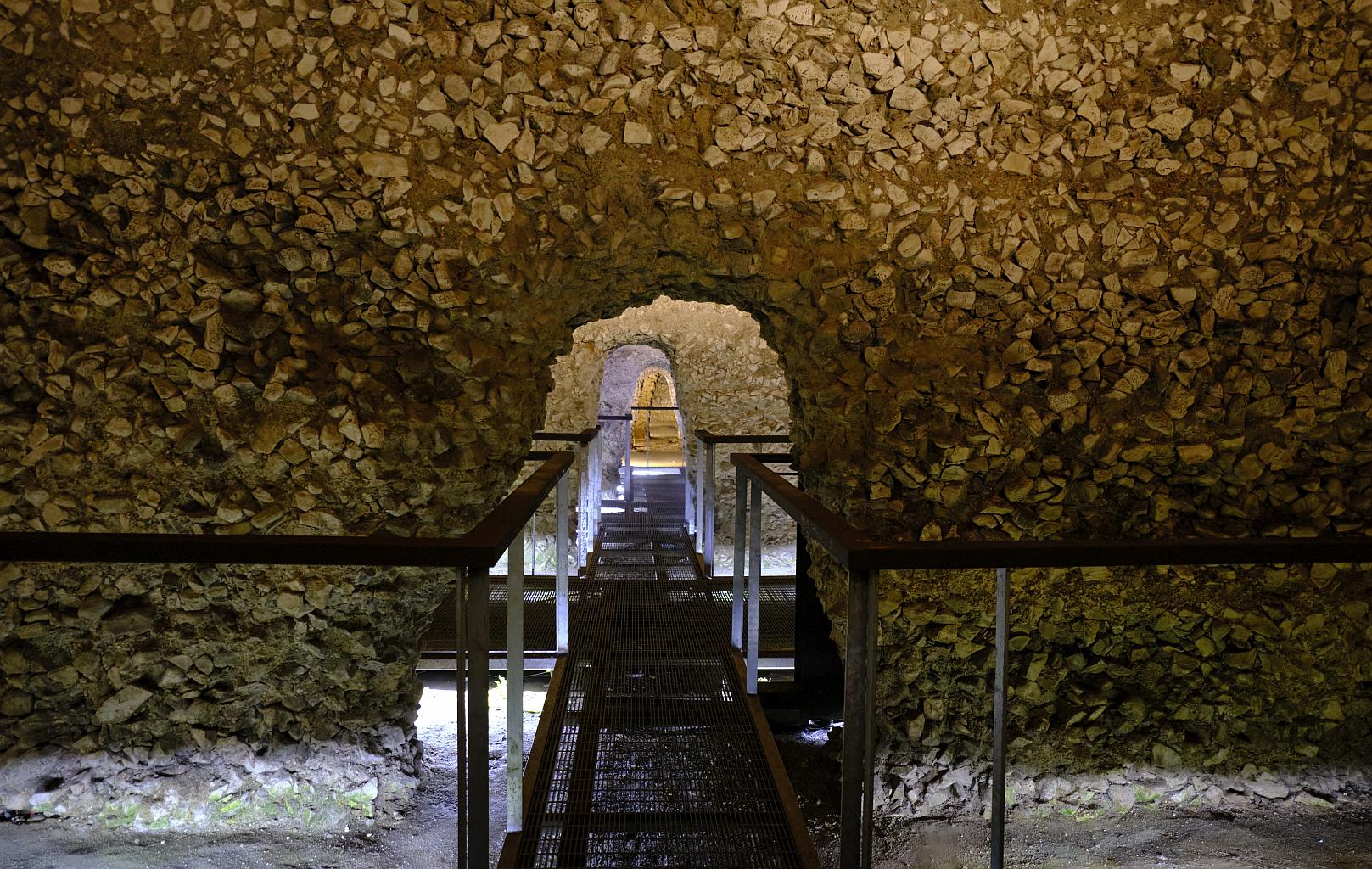
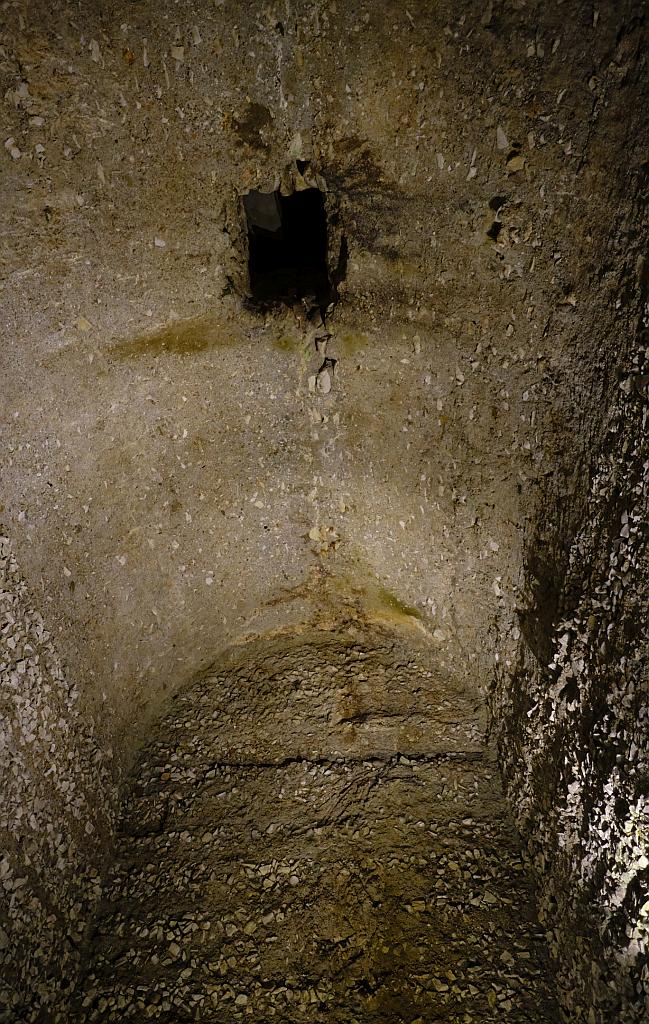
Cisterns
Inside the cisterns, showing the openings between them, and the rough Roman concrete of which they were made. Fujifilm X-Pro 3 digital camera, 16mm lens (click to enlarge).
Cisterns
Inside a cistern, showing the well opening at the top, and the horizontal striations on the walls which are the impressions left by the timber formwork of two thousand years ago. Fujifilm X-Pro 3 digital camera, 16mm lens (click to enlarge).

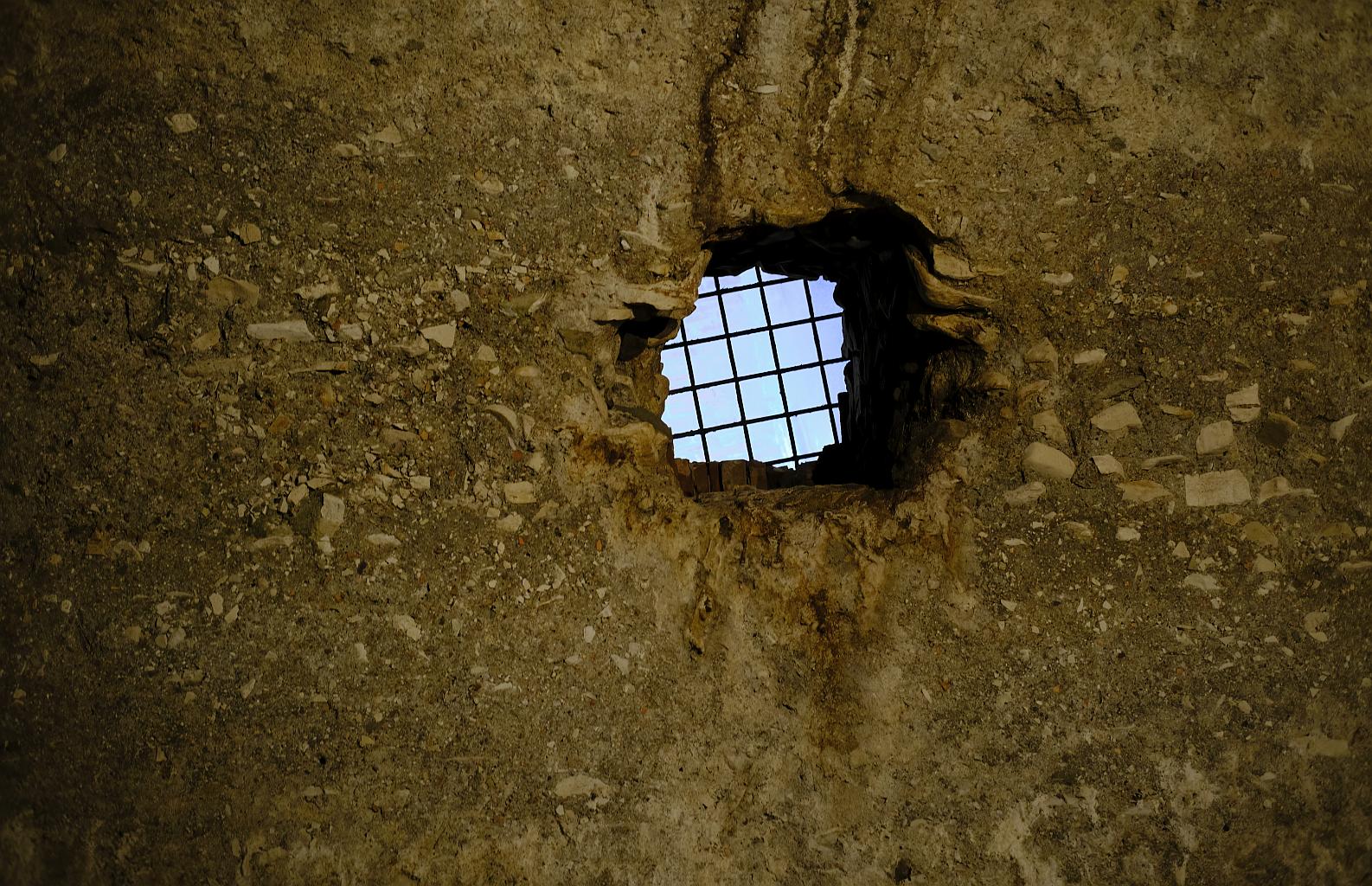
At some point after the fall of Rome, the cisterns were forgotten. The eastern line (the line that runs down the middle of the modern piazza) was rediscovered some time before the mid-13th Century, but – remarkably – the western line was not rediscovered until the 1990s, during renovations to the tobacconist’s shop in the corner of the piazza. Today there is a thick glass tile in the floor of the tobacconist, through which you can look down. And from below in the cisterns, you can look up and see the feet of customers in the shop.
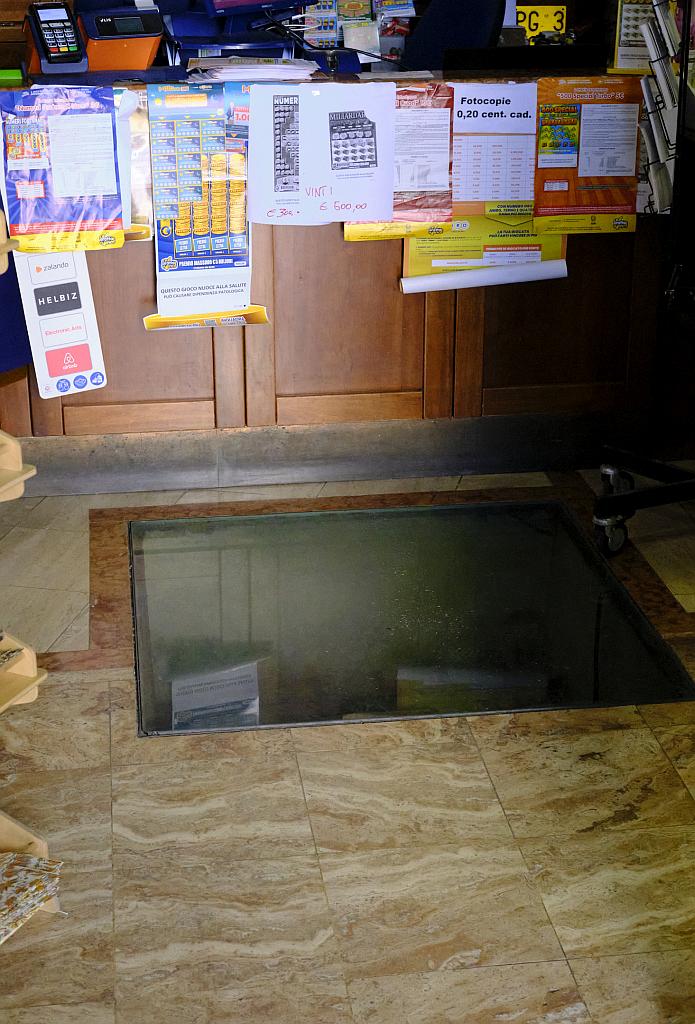
Tobacconist
The glass tile in the floor of the tobacconists. Fujifilm X-Pro 3 digital camera, 35mm lens (click to enlarge).
Tobacconists from below
Looking up at the tobacconists from below. Fujifilm X-Pro 3 digital camera, 16mm lens, cropped (click to enlarge).

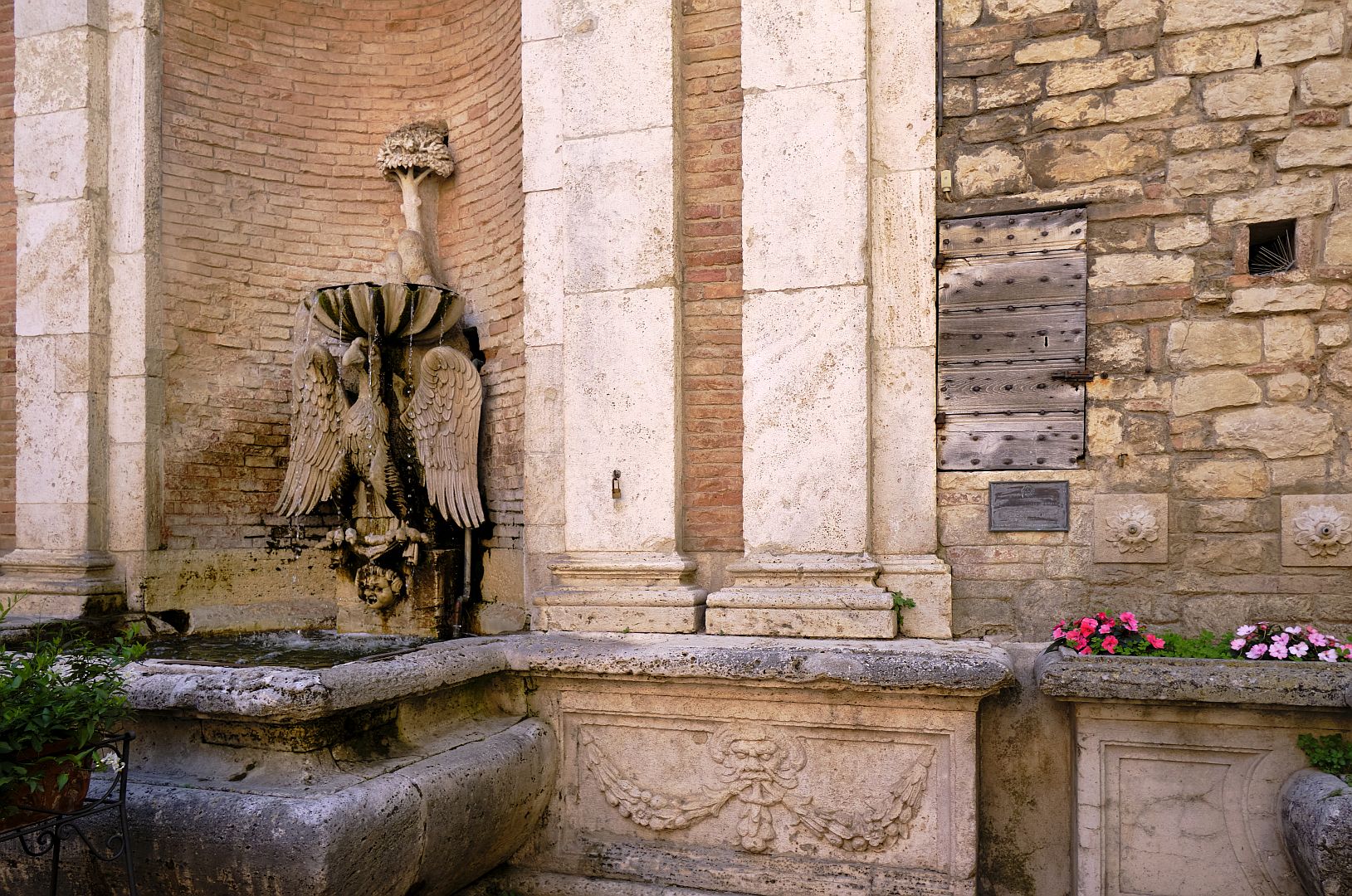
After the fall of the Western Empire, the aqueducts that the Romans built inside the hill fell into disrepair (which later created significant subsidence problems as the hill became waterlogged). But in the early 1600s Bishop Angelo Cesi commissioned an elegant fountain, the Fonte Cesia, featuring the legendary eagle of Todi and fed by water from one of the Roman aqueducts. If you go and have a gelato or an aperitivo at the excellent Bar Pianegiani, you will be sitting in front of the fountain, and in the wall beside it you will see a wooden access door. Behind it is the tunnel built in the 17th Century to divert the water to the fountain from the Roman aqueduct.
Fonte Cesia
The Fonte Cesia, fed by a diverted Roman aqueduct, with the wooden access door on the right. Fujifilm X-Pro 3 digital camera, 16mm lens (click to enlarge).

The Theatre and Amphitheatre

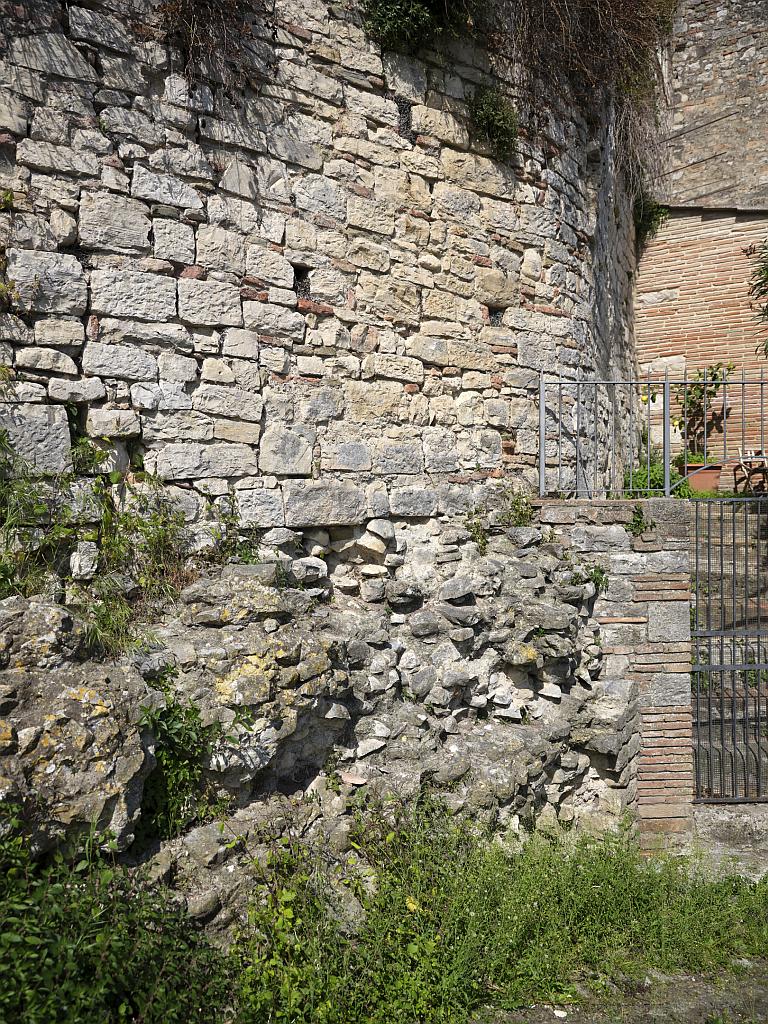
Like any Roman town, Todi had places of public entertainment. A theatre was located near the forum, just below the modern Piazza Garibaldi – and like the Piazza Garibaldi it would have had magnificent views across to the Martani Hills. Very little of it remains now, at least that can be seen by the public. Apparently there are a few more bits in someone’s garden.
Teatro
Remains of the theatre, in the aptly-named Via del Teatro Antico. Fujifilm GFX-50R medium format digital camera, 32-64mm lens (click to enlarge).

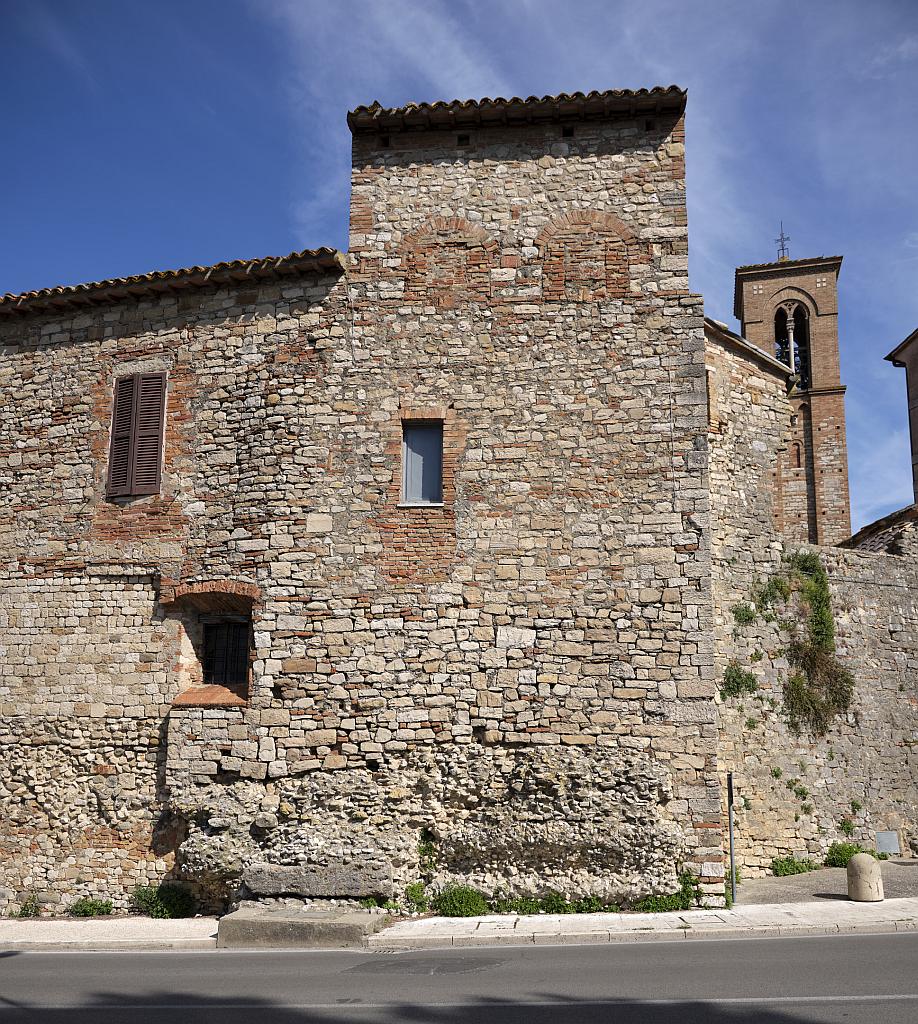
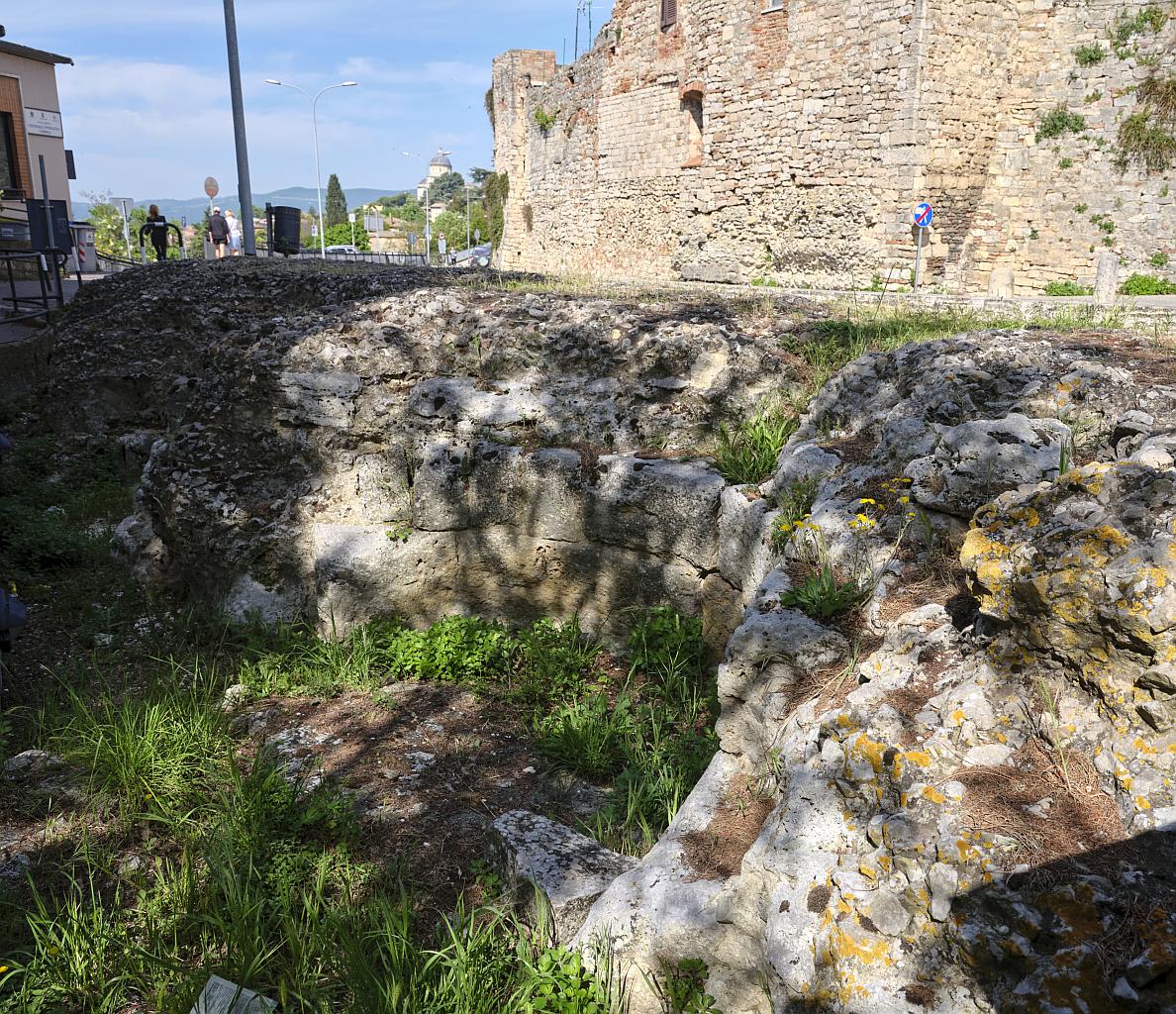
The remains of Todi’s amphitheatre, on the other hand, are comparatively substantial. Parts of it stick out of the medieval walls near the Porta Romana, and some modern streets and buildings trace its outline. It can be clearly seen at the lower right of the Mancini/Tenneroni drawing. The remains of both the theatre and the amphitheatre are easily distinguished from the medieval stone, because they are of concrete, which was not used in the Middle Ages. The Romans were great users of concrete, as we saw with the cisterns, but by the time the medieval walls came to be built the recipe had been forgotten, and a satisfactory new recipe was not found until the 18th Century.
Amphitheatre
Remains of the amphitheatre sticking out from under the medieval wall. Fujifilm GFX-50R medium format digital camera, 32-64mm lens (click to enlarge).
Amphitheatre
Niches from the surrounding area of the amphitheatre, with other remains on the other side of the road. Fujifilm GFX-50R medium format digital camera, 32-64mm lens (click to enlarge).
Amphitheatre
External wall of the amphitheatre, in Via Anfiteatro Antico. Fujifilm GFX-50R medium format digital camera, 32-64mm lens (click to enlarge).
Amphitheatre display
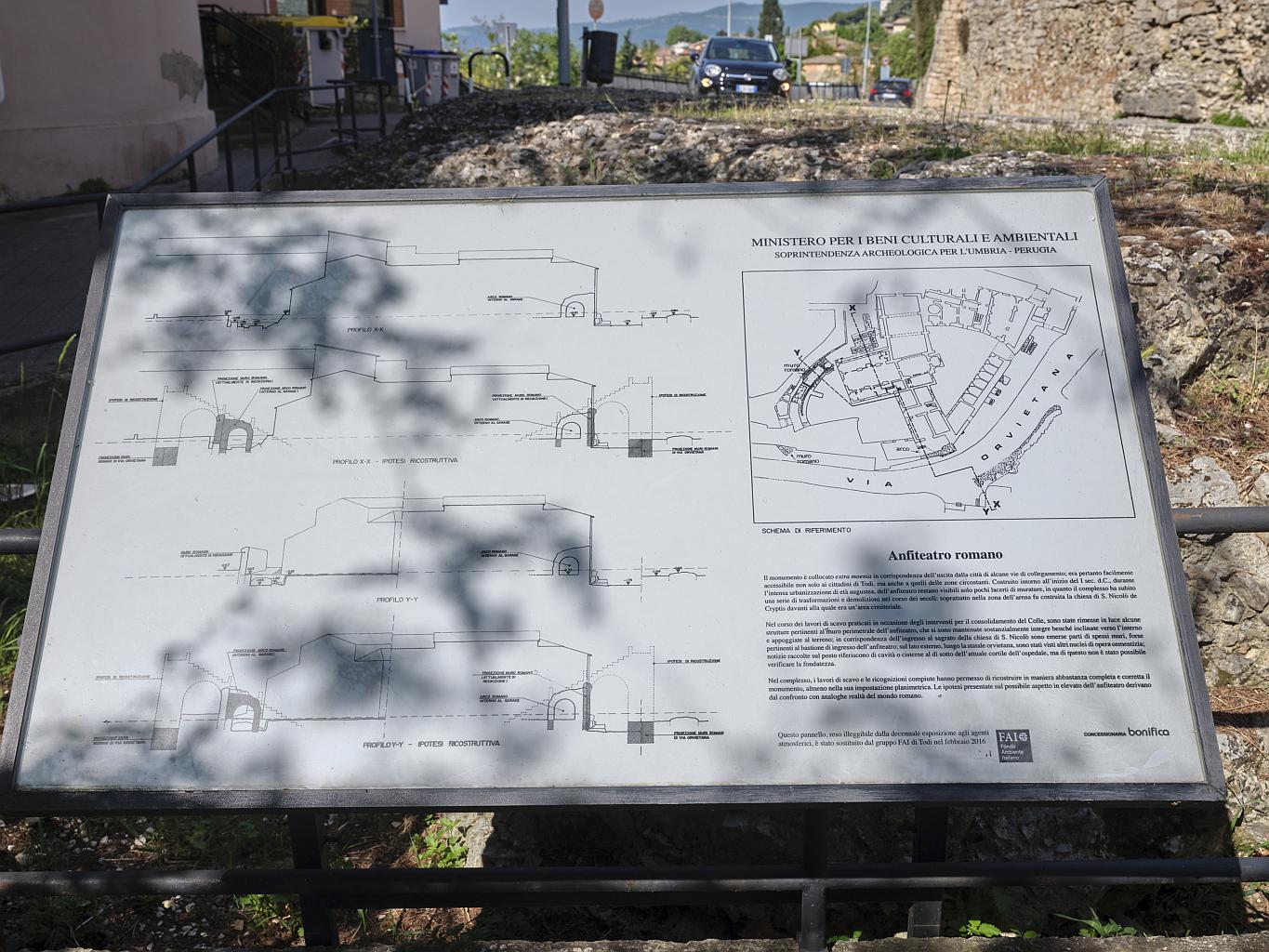
Information panel showing the ancient amphitheatre with existing (mainly medieval) buildings superimposed. Fujifilm GFX-50R medium format digital camera, 32-64mm lens (click to enlarge).

Another substantial bit of concrete work is the so-called Carcere di San Cassiano (prison of St Cassianus) which is in the grounds of the Franciscan monastery that is now a high school. The Cassianus in question, of whom little is known, is said to have been an early Christian martyr in Todi and is one of the town’s patron saints. Archaeologists tell us that the “prison” was actually a building over a well, but as the traditional site of the saint’s imprisonment before martyrdom, it was converted into a chapel dedicated to him, and thus preserved.
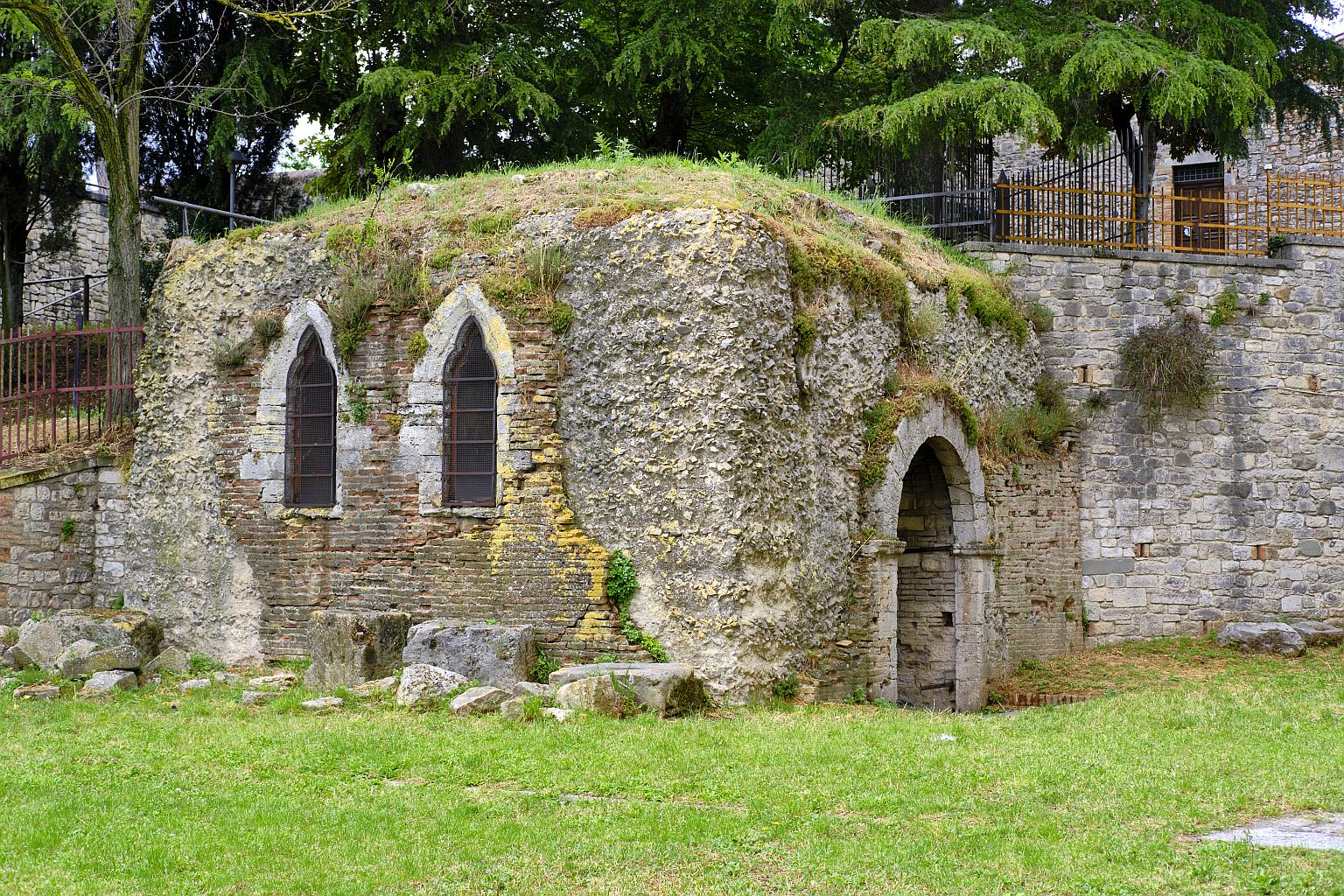
The so-called “Prison of St Cassianus”, actually a Roman well. Fujifilm X-Pro 3 digital camera, 35mm lens (click to enlarge).
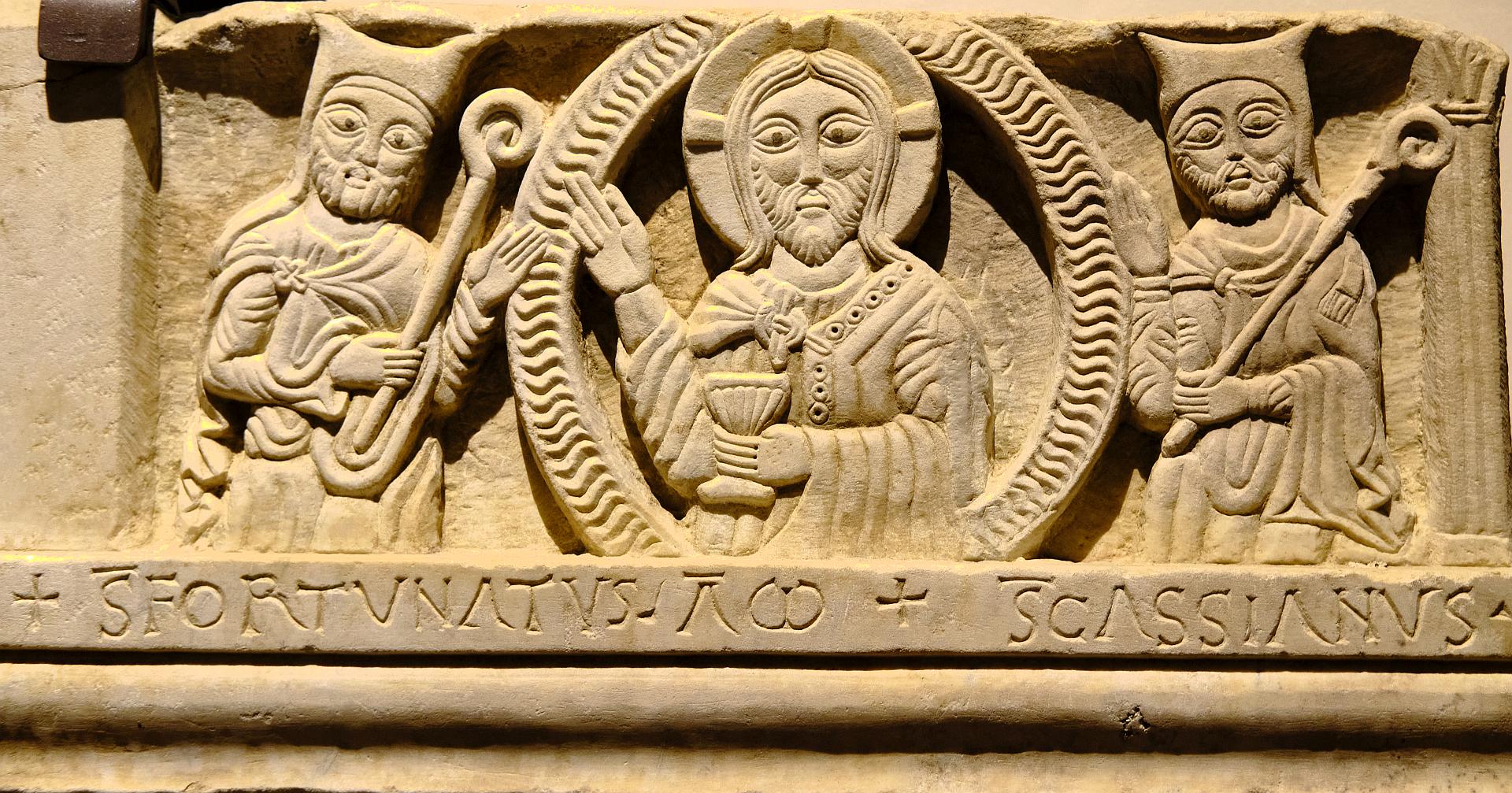
SS Fortunatus and Cassianus
In the Civic Museum is this medieval carving of Saint Fortunatus, Christ (“alpha and omega”) and Saint Cassianus. Since Cassianus is holding a bishop’s crook we may assume he was a bishop as well as the historically-attested Fortunatus. Fujifilm X-Pro 3 digital camera, 35mm lens (click to enlarge).

Odd Bits of Stone and Bronze

There are two other places in town worth visiting for the seeker after ancient things. They are the civic museum in the Palazzo del Popolo and the Lapidarium in the Convent of the Lucrezie. The former holds an eclectic collection, including the replica of the “Mars of Todi” that I mentioned in the article on pre-Roman Todi and also a saddle which belonged to Anita Garibaldi. The citizens of Todi gave her a new one as she, her husband and their small band of troops passed through while escaping northward from Rome in 1849.
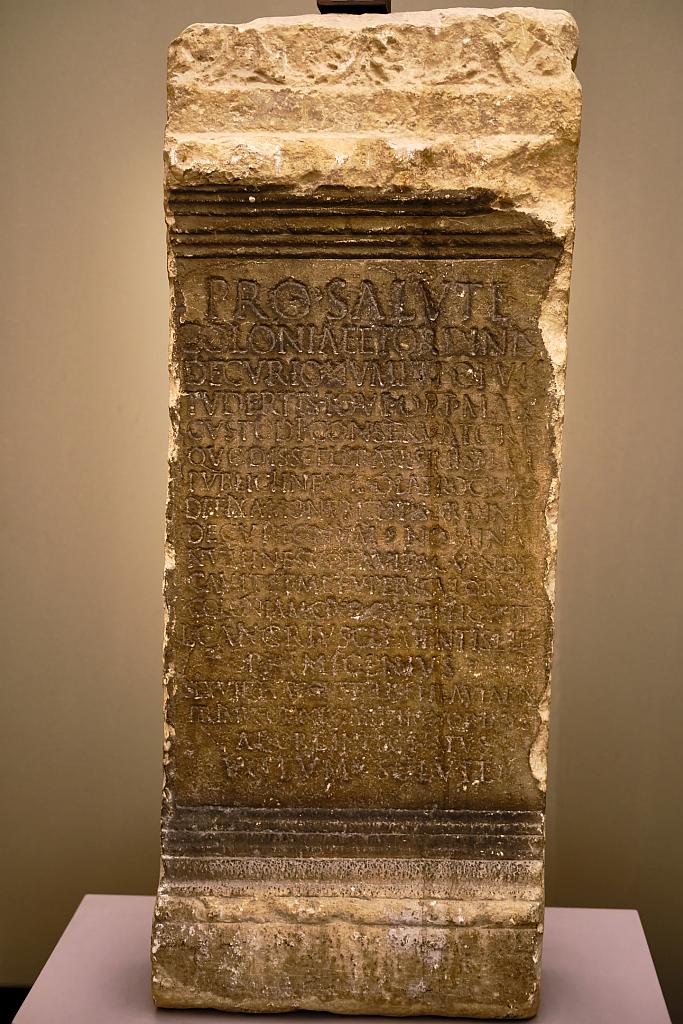
Votive column
Votive column in the Civic Museum. The text refers to the recovery of an important document (a “list of decurions”?) that had been stolen, and that its recovery would restore the “health of the city”. Fujifilm X-Pro 3 digital camera, 35mm lens (click to enlarge).
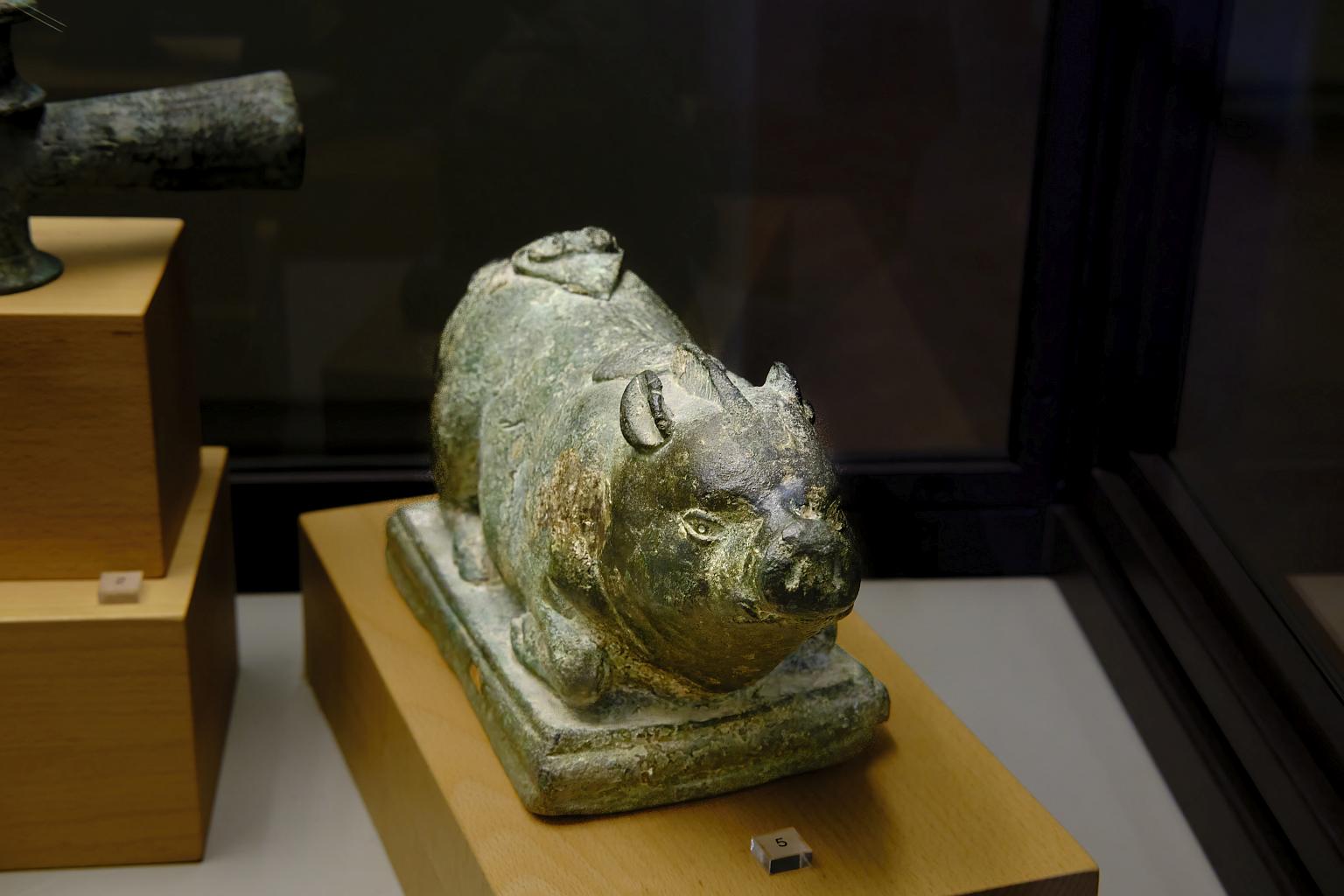
Bronze weight
A bronze weight in the shape of a pig, recovered from a property in the modern Via Ciufelli, now in the Civic Museum. Fujifilm X-Pro 3 digital camera, 35mm lens (click to enlarge).
Bronze valve
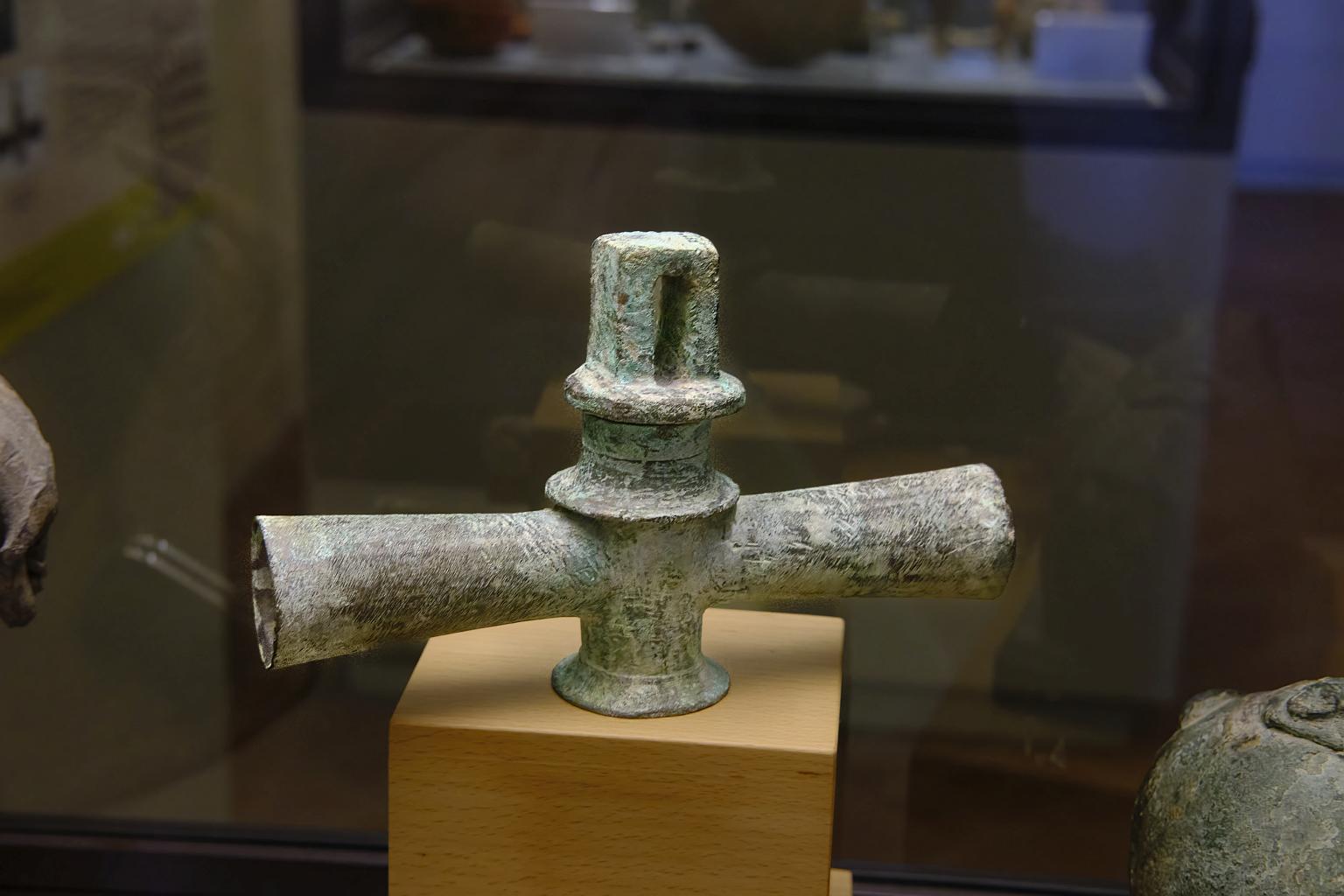
A bronze tap in the Civic Museum. Fujifilm X-Pro 3 digital camera, 35mm lens (click to enlarge).
Lapidarium funerary monument
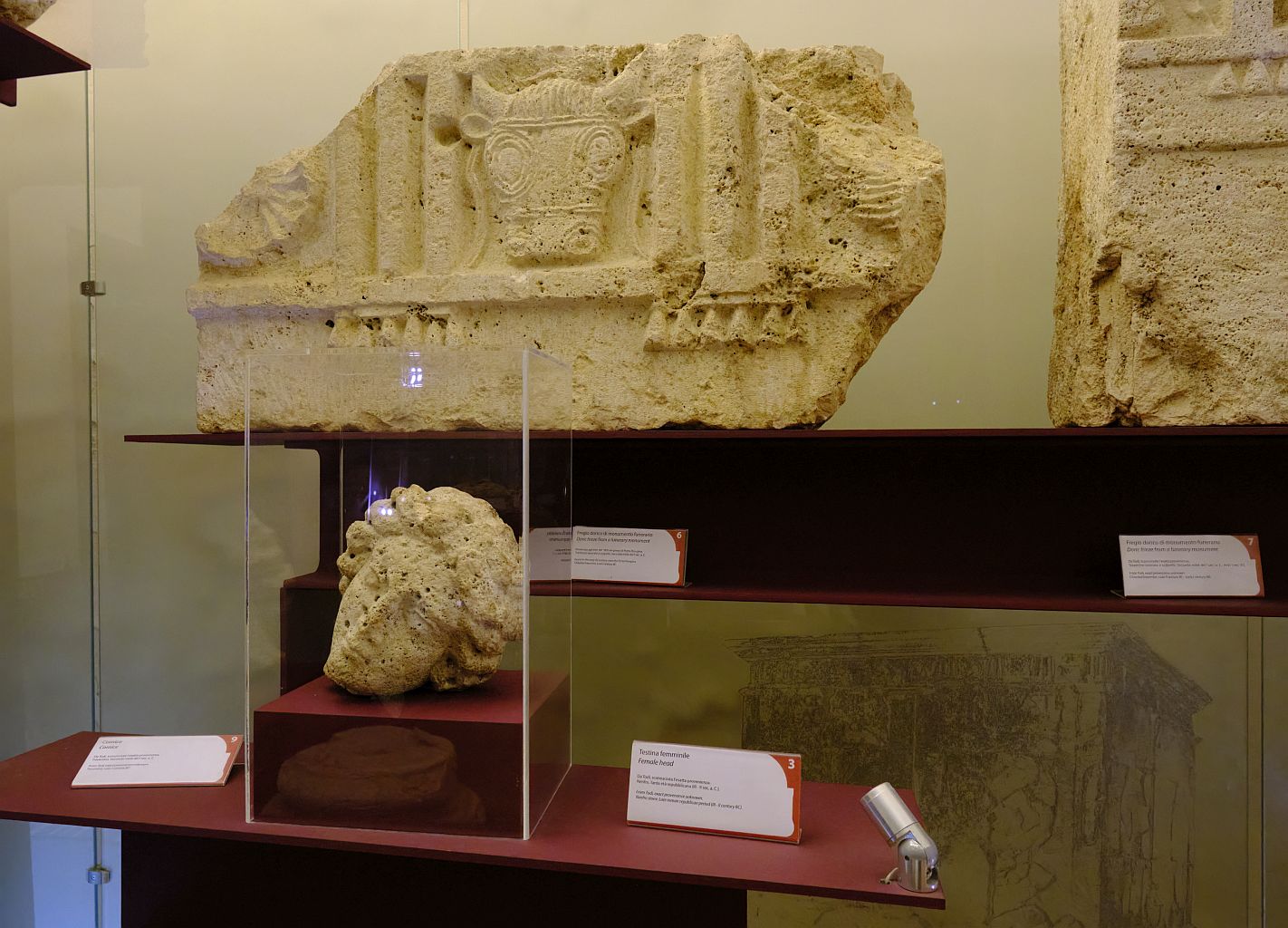
Part of a funerary monument in the Lapidarium, recovered from one of the tombs beside the Via Amerina near the current Porta Perugina. The bull’s head may indicate that the deceased was an adherent of the cult of Mithras, one of several eastern religions which became popular in Rome in the late imperial era. Fujifilm X-Pro 3 digital camera, 35mm lens (click to enlarge).

The Lapidarium is not always open at the advertised times, but if it isn’t you can always go and enquire at the tourist office; they might send someone round to open it up.

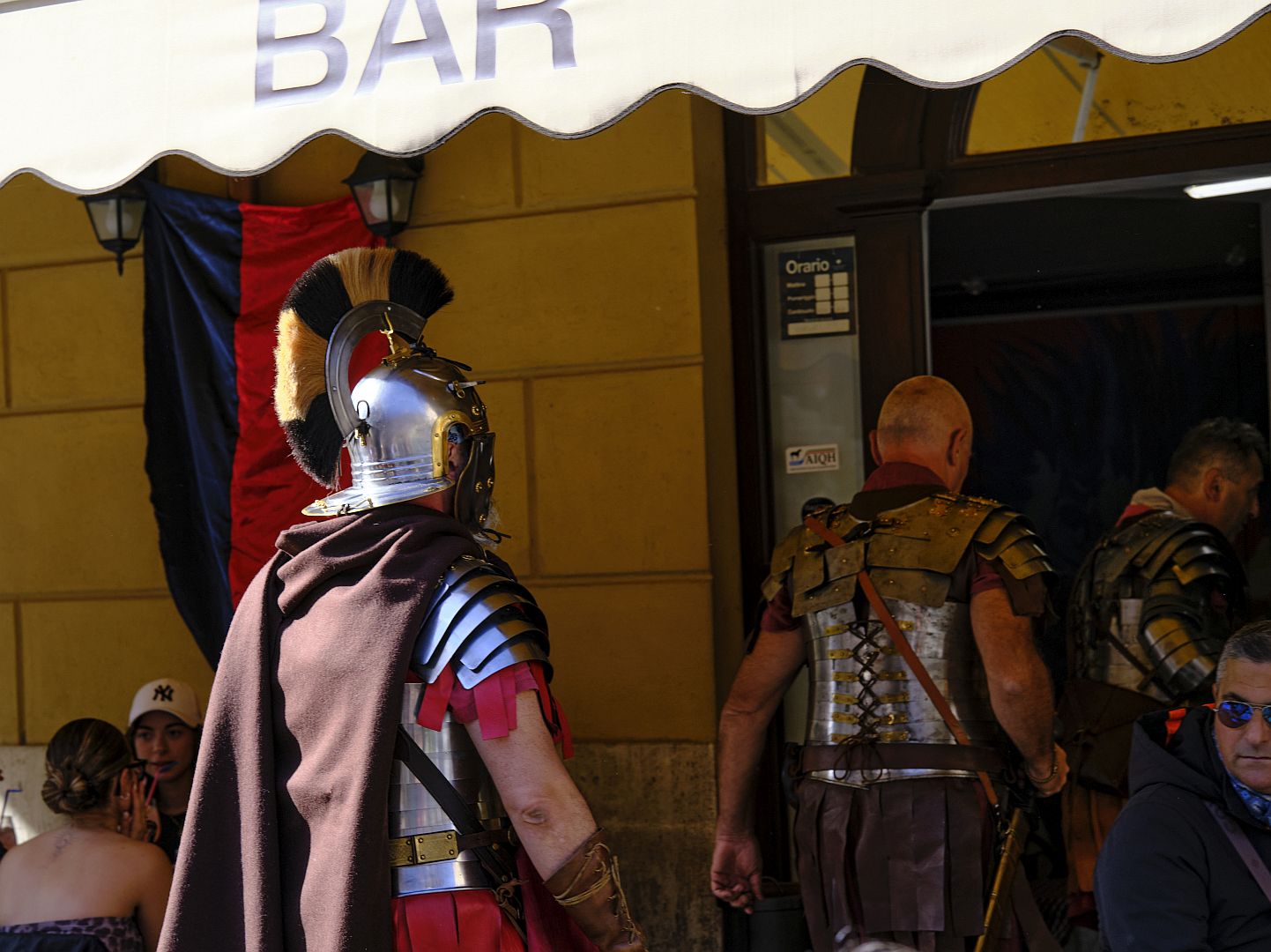
Update: If you pay close attention, you may spot other signs of the Roman presence in Todi. The picture below was taken at the annual festival of San Fortunato in 2025.
Centurion
A centurion walks into a bar… Fujifilm X-Pro 3 digital camera, 52mm lens (click to enlarge).
Roman Todi 1 – Becoming Roman

The city of Todi became Roman not through conquest, but in stages. In an earlier article titled Ancient Todi – Before the Romans I talked about its legendary origins, its martial character and some of the remains of the pre-Roman period that can still be seen in the town. Now I propose to take the story forward into a period in which written records paint a much clearer picture.

Roman carving
Carving from the Civic Museum, Todi, possibly showing a person and a priestess making an offering to a deity. Fujifilm X-Pro 3 digital camera, 53mm lens (click to enlarge).

According to the classic mock-history 1066 and All That by Sellar and Yeatman, every important event in history was either A Good Thing or A Bad Thing. So I found myself wondering whether becoming part of the Roman Empire, and more particularly becoming a colonia, was A Good Thing or A Bad Thing.

1066 and All That

The conventional view of the Roman period which I absorbed as a child was partly based, at one or two removes, on the histories of ancient Roman writers themselves (in which the Romans, naturally, were the heroes), and partly on the views of Edward Gibbon, who wrote in The Decline and Fall of the Roman Empire that “If a man were called to fix the period in the history of the world, during which the condition of the human race was most happy and prosperous, he would, without hesitation, name that which elapsed from the death of Domitian to the accession of Commodus.”

Such were the traditions that shaped my early impressions of Ancient Rome. Moreover it occurs to me that what I read was largely written by Englishmen of the first half of the 20th Century, who thought that being part of an empire was A Good Thing – civilisation, law, education, commerce, infrastructure and so forth (cue the inevitable “what have the Romans ever done for us?” reference from Monty Python).

Frieze
Roman-era frieze from the end of the 1st Century BC, Lapidarium Museum, Todi. Fujifilm X-Pro 3 digital camera, 35mm lens (click to enlarge).

An equivalent child in the 21st Century would read a somewhat different story. Modern revisionist historians, even if not actually post-Marxists, have thoroughly absorbed the zeitgeist and tend to start from the position that empires and colonies were A Bad Thing. This, I feel, is as solipsistic as anything written by a Cambridge don from 1900 who was projecting the British Empire onto the Roman. Or indeed by Kipling. His Roman centurions on Hadrian’s Wall in Puck of Pook’s Hill could have come straight from an English public school.

Either way, the Roman Empire happened, and the political views of people two thousand years later will not alter that.

My starting point was wondering what it would be like for people in places like Todi to come under Roman hegemony. The first stage in this was that Todi became a civitas foederata, for which I think “allied city” would be a better translation than “federated city”. From what I can tell, this meant that the city remained self-governing, but was bound by a formal treaty under which Rome took control of its foreign relations, and it was obliged to provide men to the Roman army. Since this happened to Todi in the 3rd Century BC, our records of how this happened are not as complete as we would like, but it is known that a coalition of Etruscans, Umbrians and others was defeated at the battle of Sentium in 295 BC. Of course Umbria was a region, not a unitary state, so in the absence of hard information we cannot say whether that coalition included the city of Todi or not.

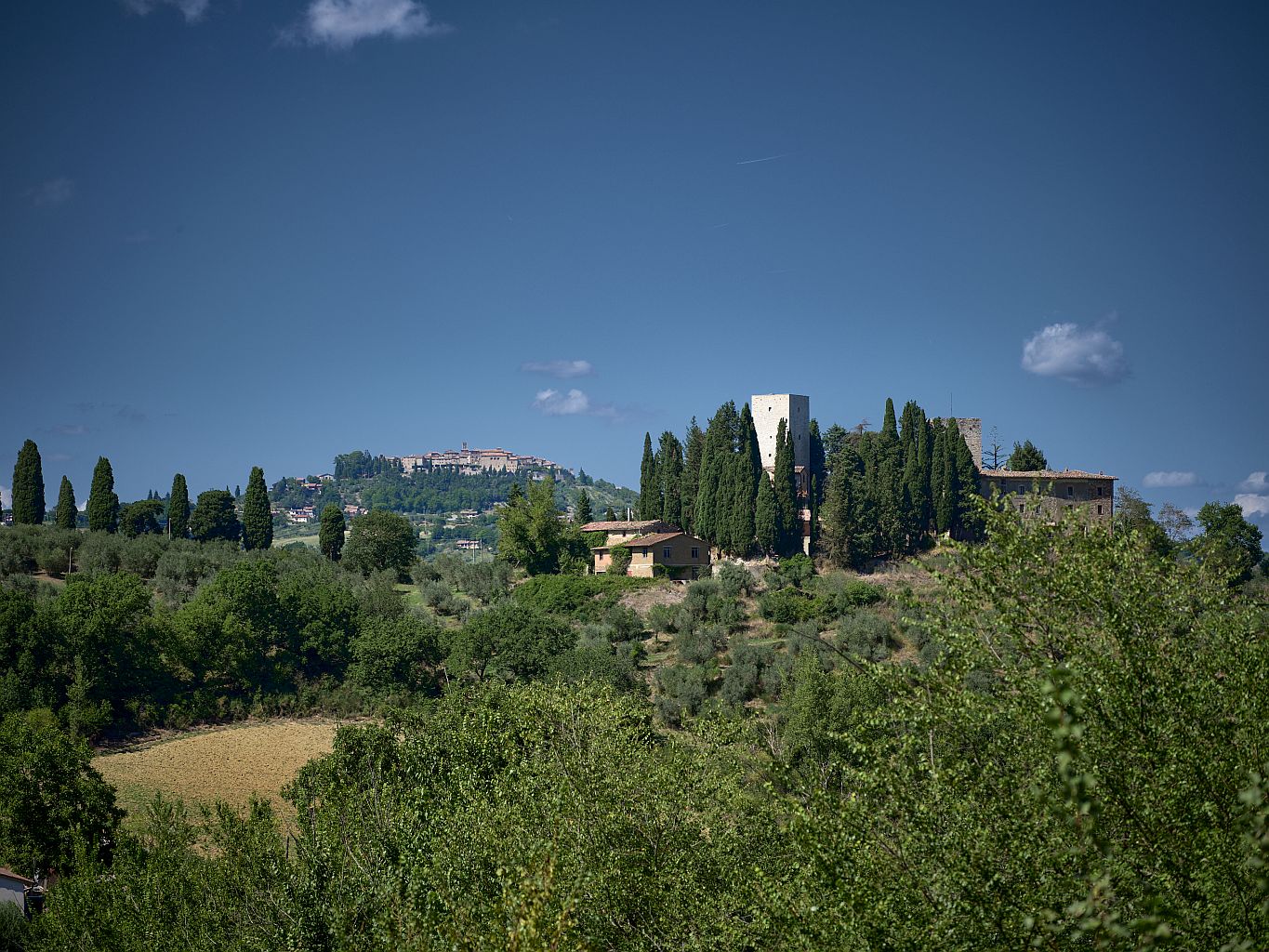
However a date that is most often given for this change of status is 217 BC. As far as I can tell there is no primary source for this, but it seems that historians have inferred it from various other changes that happened in the region after the Second Punic War and Hannibal’s invasion (I recently read that after Hannibal’s victory at Trasimene, his Carthaginian army came south along the west bank of the Tiber, passing through the village of Cecanibba, just to the north of Todi).

Cecanibba
Looking north from the village of Cecanibba, with the town of Montecastello di Vibio in the distance. Hannibal supposedly came this way down the west bank of the Tiber, although I don’t know if he still had any elephants with him at that stage. Fujifilm GFX 50R medium-format digital camera, 100-200mm lens (click to enlarge).

The next stage in Todi’s absorption into to the Roman world was in 89 BC when it became a municipium. This was during the so-called Social War of 91-87 BC when various allied states (soci) rose up against Rome. These states were mostly in the lands south of Rome, and I believe that Umbria was only peripherally involved. Paradoxically, the war ended with most people in central and southern Italy, even some who had fought Rome, being granted Roman citizenship. The late-Roman historian Arrian used this to argue that the desire for equal treatment with Rome was the root cause of the war (modern historians differ, of course).

The big thing about your city becoming a municipium was that while your city continued to be sort of self-governing, you became a Roman citizen, with a set of rights and responsibilities which included (for the knightly class and above)  the right of appeal against actions of local officials.

By contrast, Roman overseas subject territories were governed by officials who could, and often did, enrich themselves through rapacious taxation. Most of what we know of this system comes from the letters of two of the honest ones – Cicero and Pliny the Younger. The late-republican senator Cicero accepted the post of governor of Cilicia in Asia Minor with great reluctance, and his letters document the excesses of his predecessor. Then later he famously prosecuted the venal ex-governor of Sicily for corruption and extortion. 160 years later, Pliny was appointed governor of Bithynia, also in Asia Minor, by the Emperor Trajan. We saw the remains of Pliny’s Umbrian country villa in this article.

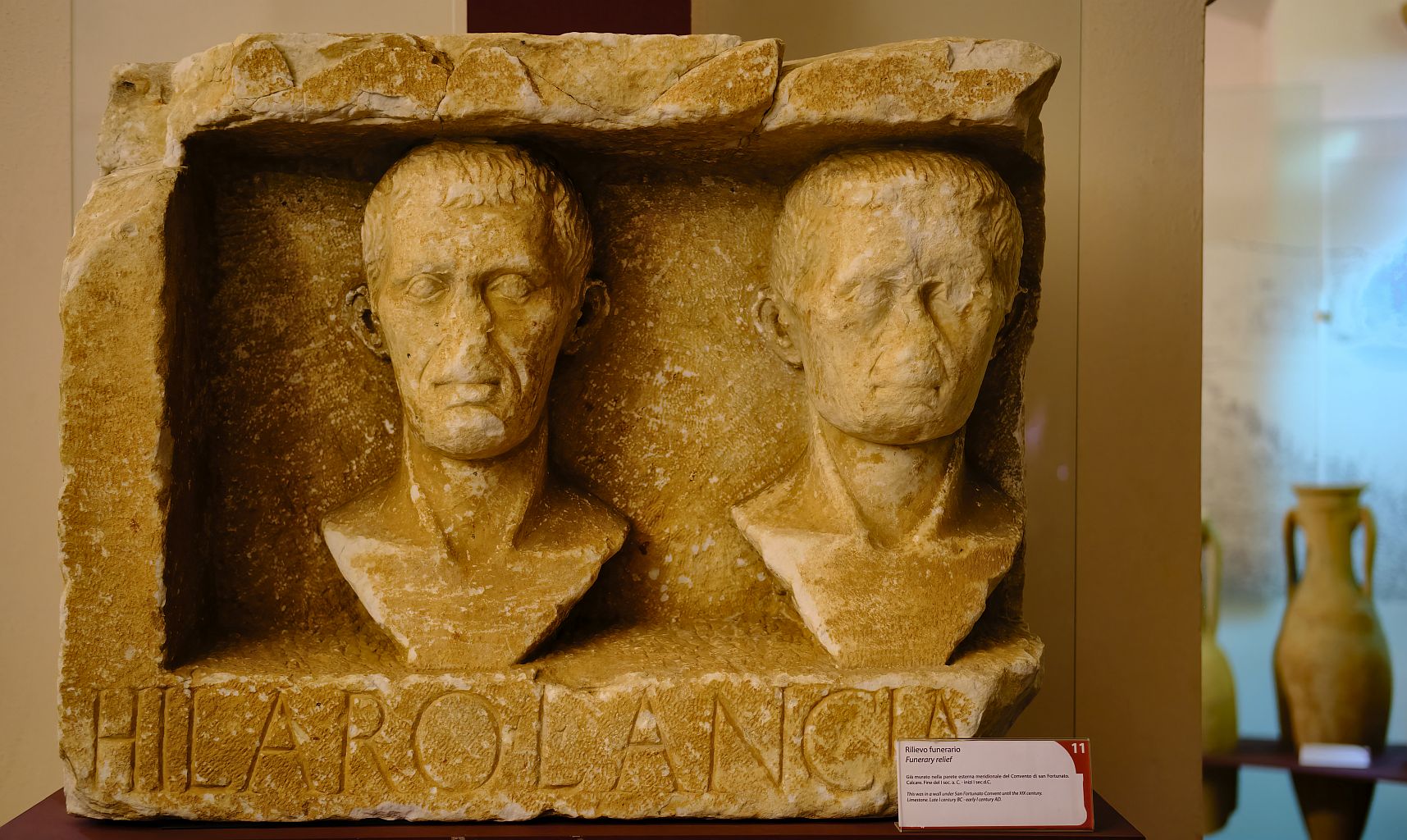
Funerary relief
Funerary relief from the 1st Century BC, Lapidarium Museum, Todi. Fujifilm X-Pro 3 digital camera, 35mm lens (click to enlarge).

The next stage in the absorption of Todi into Rome (by which time it must already have been completely Romanised) was in 42 BC under the Emperor Augustus, when it was granted colonia status with the title Colonia Julia Fida Tuder. I’m guessing, although I do not know, that the “fida” meant that Todi had been faithful to Octavian/Augustus in the civil war against Mark Antony, in which Perugia famously picked the wrong side and was razed to the ground. If I am right, it would be by no means the last time that Todi and Perugia were on different sides.

Being a citizen of a colonia effectively meant that you were now Roman. There would have been plenty of advantages, but a downside was that discharged Roman legionaries could be granted land on your territory. Of course some of those legionaries might also have been recruited from your territory, so there would always have been winners and losers.

Among the winners were ancient Todi families called the Ulpii and the Traii, members of which joined the Roman army and rose to senatorial rank. From a marriage between the clans came Marcus Ulpius Traianus, who became the Emperor Trajan in AD 98. Although he was actually born in Spain and spent his whole life on the move, Todi ever since has claimed him as a local boy. According to some accounts (and local tradition), the Colonia Julia Fida Tuder title was actually granted by Trajan rather than Augustus, although this seems unlikely.

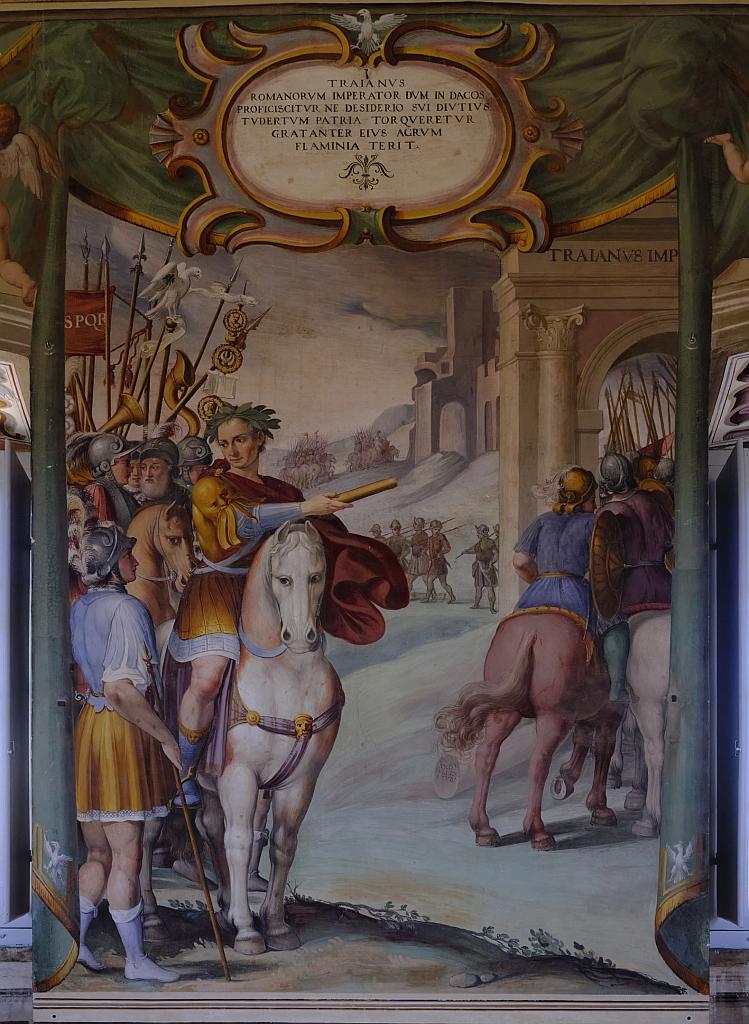
Emperor Trajan
The Emperor Trajan honours the City of Todi on his way to defeat the Dacians, as depicted in the Episcopal Palace, Todi. Fujifilm GFX 50R medium format digital camera, 32-64mm lens (click to enlarge).

At the end of the previous article on ancient Todi, we left Todi as a prosperous Umbrian city on the border with Etruria, with strong Etruscan cultural influences but (probably) not under actual Etruscan rule. Its world was shaped by warfare and it stood ready to defend itself. Three centuries later, it was a still-prosperous Roman city in an economically important region of central Italy, but it was now at peace and would remain so for four hundred years. Maybe those 19th-Century historians weren’t all that wrong about the Pax Romana.

Elevation of Todi
In this elevated plan of Todi seen from the south, “E” marks the so-called Etruscan walls, “R” marks the Roman walls, and “M” the medieval ones. The Temple of Apollo just to the right of the E is on the site of the current Duomo. The picture is taken from “Todi e i suoi Castelli” by Franco Mancini, 1960. I have only just acquired this book, and the somewhat ornate quality of the Italian is going to take me a while to work through, but I expect to rely on it quite a lot in future (click to enlarge).

In future articles, I propose first to look at some of the impressive Roman engineering that can still be seen in Todi, and then to consider the fortunes of the town at the end of the empire and the Gothic Wars of the 5th Century.

Edit: that article on Roman Engineering in Todi has been written and can be found here.

The Witch, the Warrior and the Preacher – the story of Matteuccia da Todi

This is a sad and rather terrible story about the trial and execution of an innocent Umbrian woman – Matteuccia da Todi – and the political context in which the events occurred.

Warning: it is not possible for me to tell this story without criticism of a popular Catholic saint. If this is likely to offend you, you may not wish to continue.

The Warrior – Braccio da Montone (Fortebraccio)

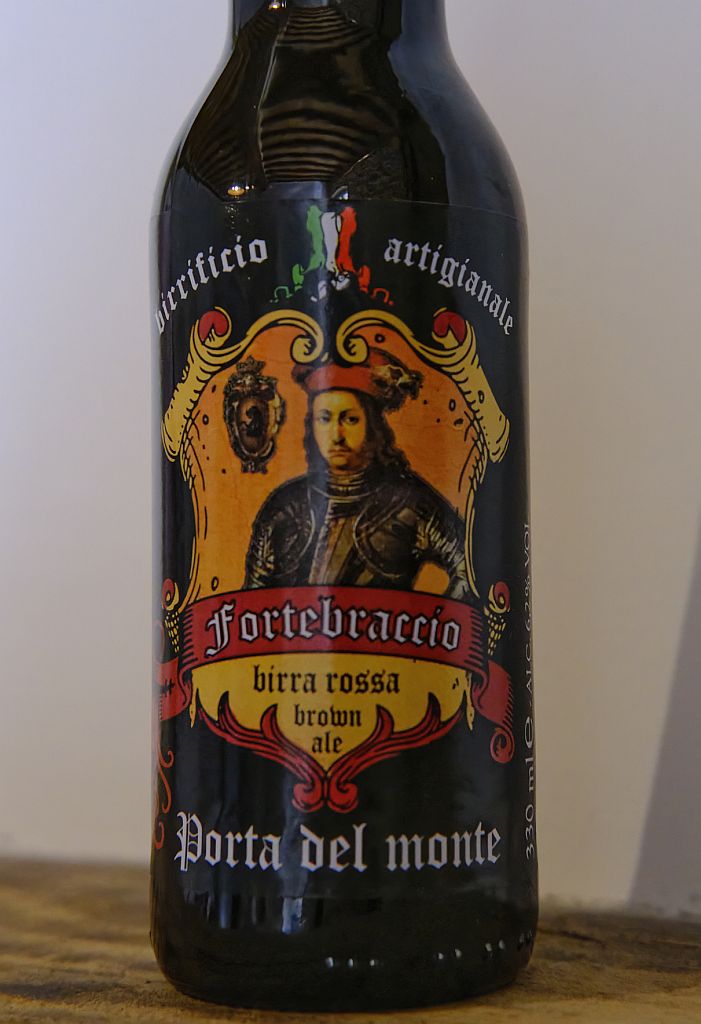
Birra Fortebraccio
Fortebraccio is remembered fondly enough that they named a brewery after him. It is on the outskirts of Umbertide, close to Montone. The beer is excellent. Fujifilm X-Pro 3 digital camera, 35mm lens (click to enlarge).

In the late 1300s, central Italy was in a state of political flux. The Black Death, which killed half the European population, and a higher proportion than that in the crowded Italian cities, was a recent memory and indeed outbreaks were still occurring from time to time. The trauma of that experience had left deep scars which showed themselves in apocalyptic religious thinking, social disruption and financial crises. But the struggle for secular power continued, with the two superpowers, the Papacy and the Holy Roman Empire, contending through their Italian proxies, the Guelphs and Ghibellines respectively. Although not playing out with as much ferocity as a century earlier, this rivalry was reflected at every level – towns and cities declared themselves Guelph or Ghibelline, while within cities ancient clan rivals did the same.

One of the main features of the period was the decline of the independent communes. Some self-governing cities like Perugia and Florence were starting to be subverted from within by powerful families, while others were subdued by Papal troops under the command of Cardinal Albornoz and henceforth ruled directly by Rome. I described some of this in my post about the return of the Papacy from Avignon, titled Catherine of Siena, Cardinal Albornoz and Sir John Hawkwood.

Part of all this upheaval was the rise of the condottieri. A literal translation of the term would be something like “contractors”, but they were mercenary warlords who fought on behalf of the remaining independent cities, or the Pope, or one of the medium powers, frequently changing sides and employers. In some cases they seized control of the cities that employed them and in time were created counts, marquesses and dukes, starting their own dynasties.

In Umbria, one of the principal condottieri was a fellow variously called Andrea Fortebraccio, Braccio da Montone, or Braccio Fortebraccio (an equivalent English surname would be “Armstrong”).  Braccio’s parents lived in Perugia but his father was, I assume, the hereditary lord of Montone, a small fortified town overlooking the Upper Tiber Valley from which came one of the names by which he was known.

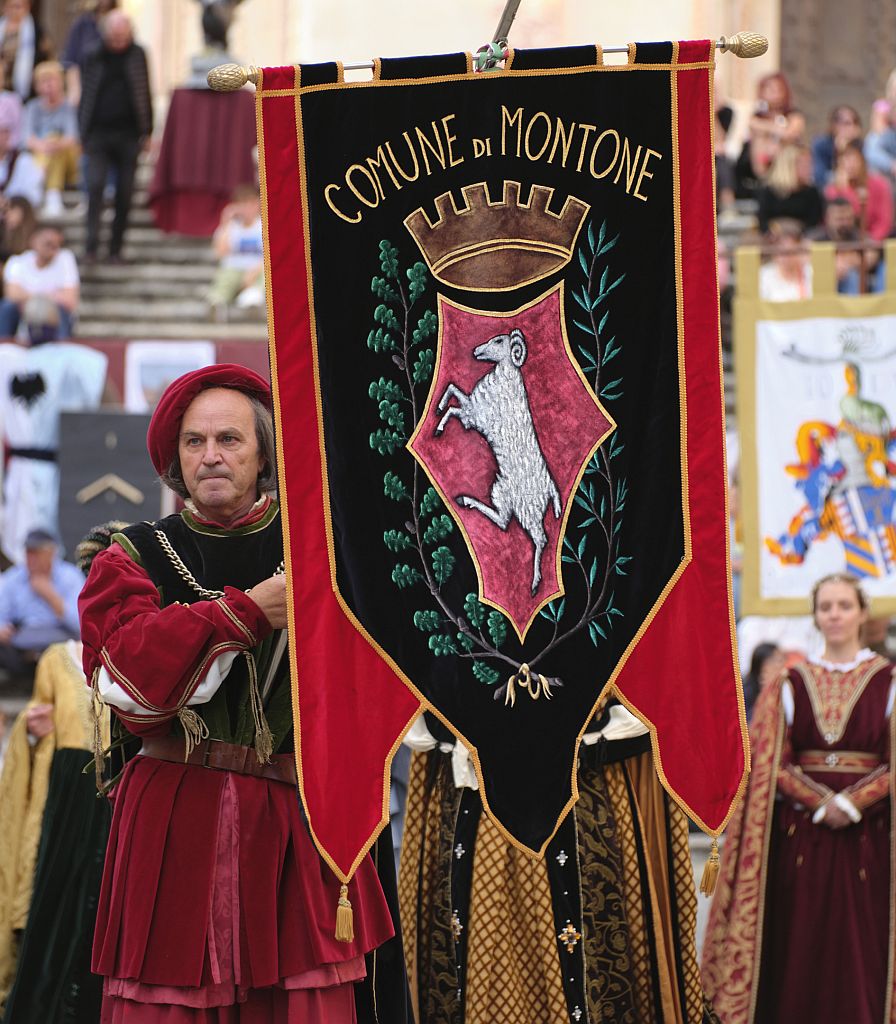
San Fortunato 2022
The arms of the Comune of Montone, carried at the Festival of San Fortunato in Todi. Fujifilm GFX 50R medium format digital camera, 100-200mm lens (click to enlarge).
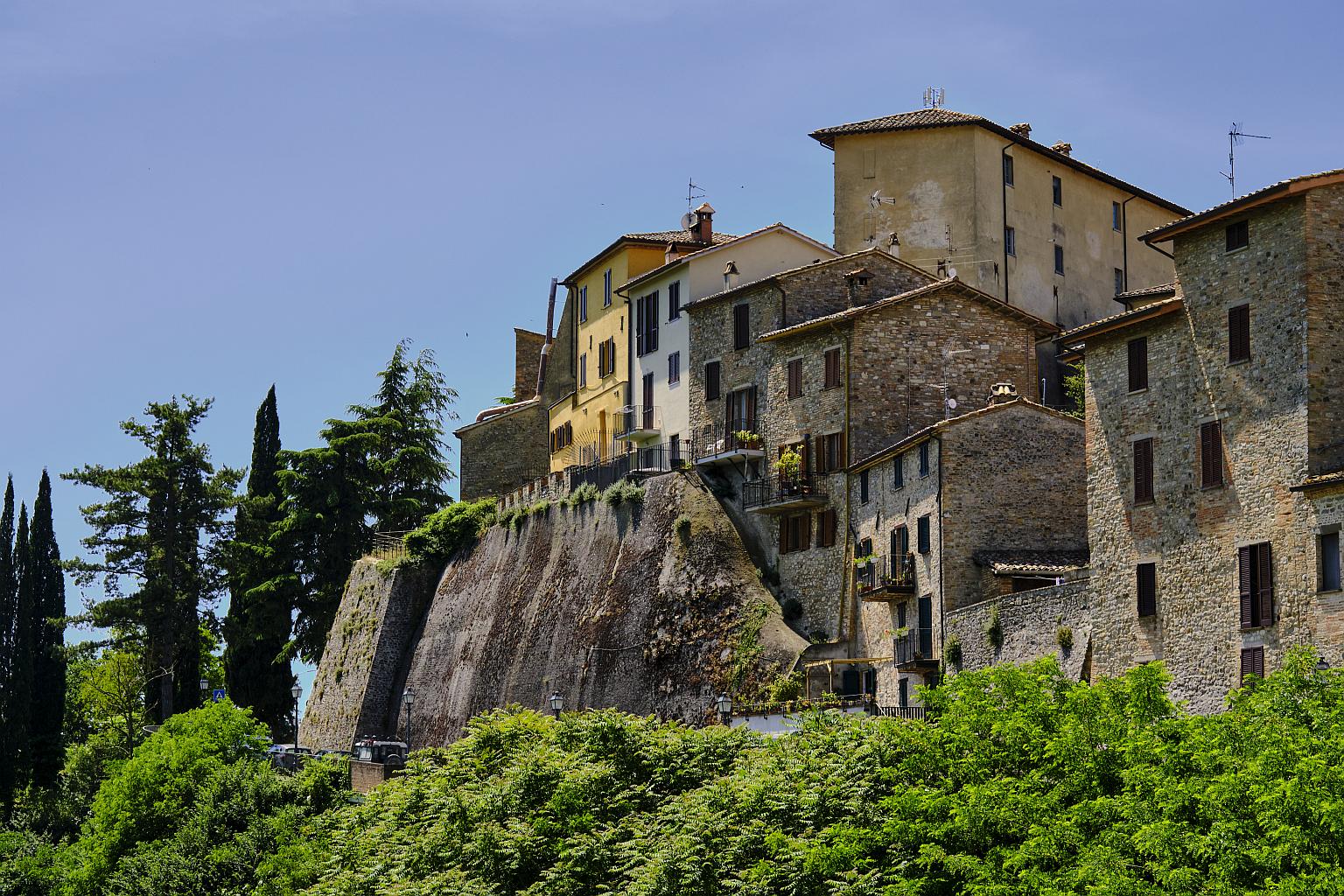
Montone
Montone today. It is a picturesque little town with beautiful views in all directions, and popular with expatriates. Fujifilm X-Pro 3 digital camera, 56mm lens (click to enlarge).
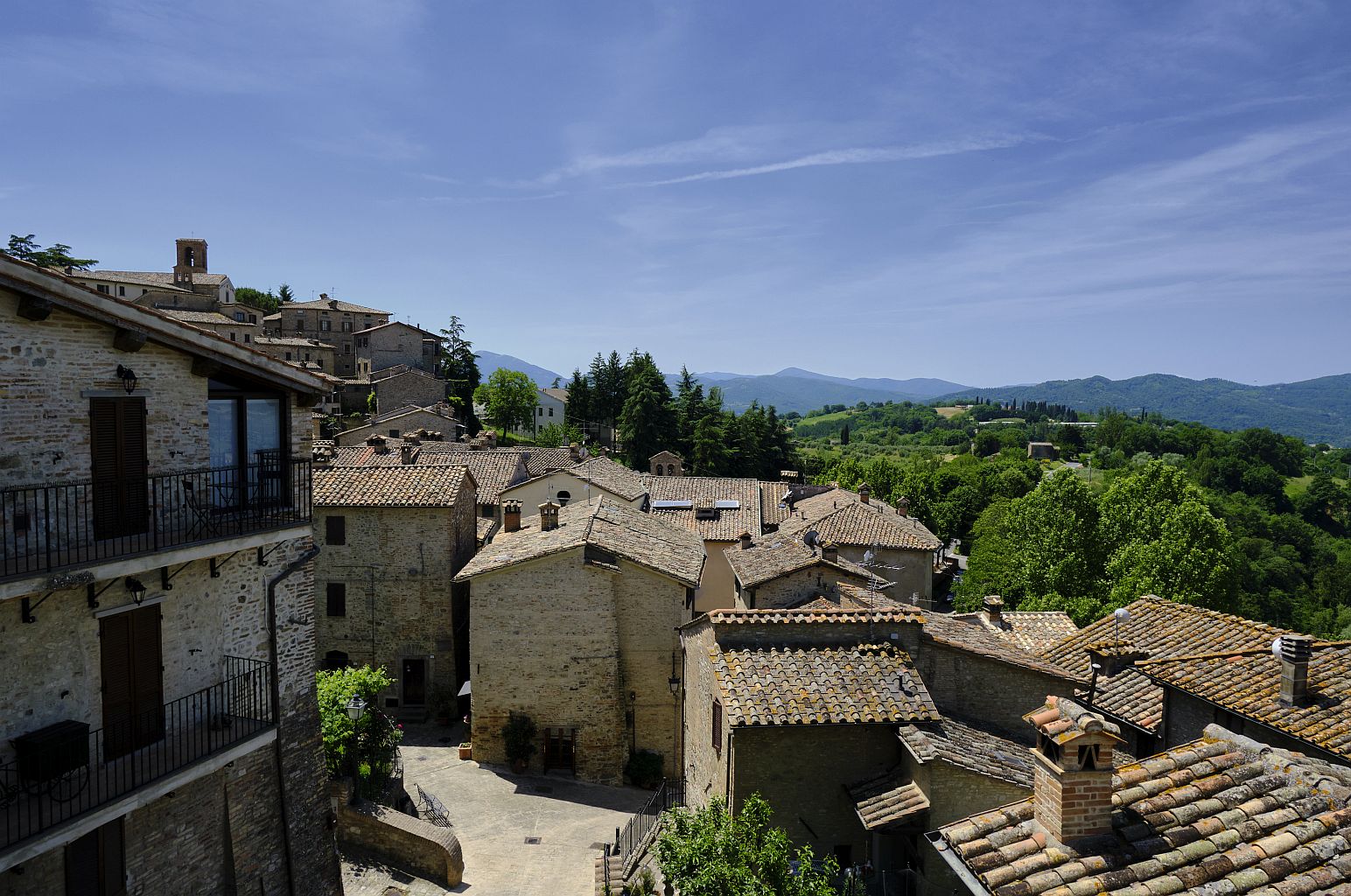
Montone
Montone, looking south towards Perugia. Fujifilm X-Pro 3 digital camera, 35mm lens (click to enlarge).

After one of the many factional fights in Perugia, Braccio’s family was forced into exile, and Braccio began his life as a professional soldier. He fought for a bewildering number of employers – for and against the Pope, for and against Florence, for and against Queen Joanna of Naples, but always he looked for opportunities to return to Perugia – preferably as its lord.

One of his signature tactics was the ability to move his forces rapidly to achieve surprise – one article I found says that in military theory of the time such a rapid redeployment became known as a Braccesca, after him.

Fortebraccio
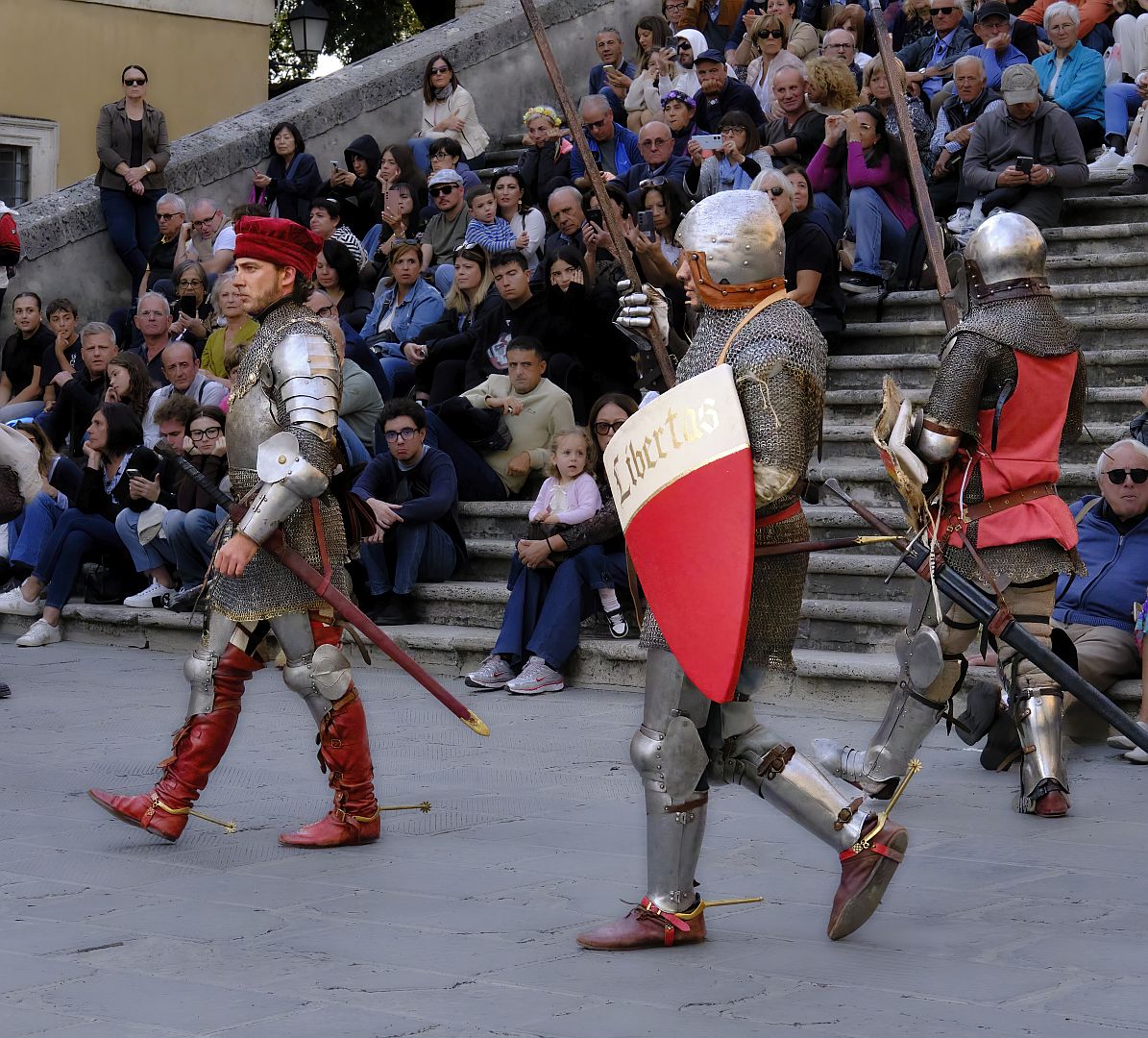
Fortebraccio and his men put in an appearance at the 2025 Festa di San Fortunato in Todi. Fujifilm X-Pro 3 digital camera, 56mm lens (click to enlarge).

In 1416, at the battle of Sant’Egidio (near the city now known as Umbertide), Braccio’s forces defeated those of Perugia and he became its ruler, along with much of Umbria including the cities of Todi, Terni, Assisi, Spello and others. He sought recognition of his conquest in the title of Papal Vicar for Umbria, but the Pope – Martin V – refused, sending troops against him, including some under the command of Francesco Sforza, who later famously married into the Visconti family and became Duke of Milan. However Braccio was able to defeat the Papal forces near Spoleto, and in due course he took up arms for the Pope against another warlord occupying Bologna, in return for which he was finally granted the title.

Perugia
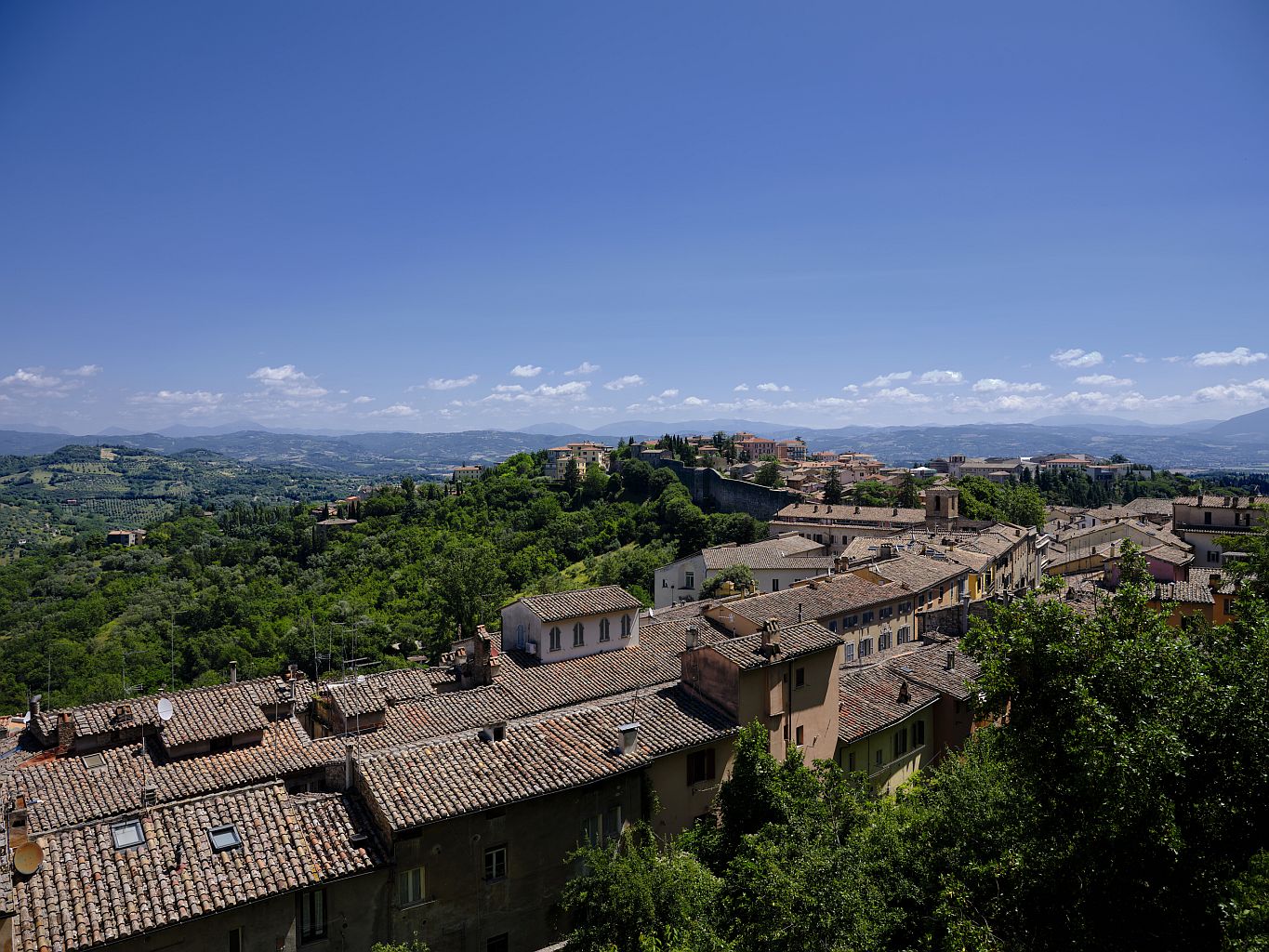
Looking north from the ancient walls of Perugia. Montone is in the hills beyond. Fujifilm GFX 50R medium-format digital camera, 32-64mm lens (click to enlarge).

That was not the end of his story. Queen Joanna II of Naples had a most complicated life – too complicated to discuss here, but after succeeding to the throne somewhat unexpectedly at the age of 41, she had been supported by Pope Martin V. But when she declined to make a financial contribution to the Papal military forces, Martin excommunicated her and supported a claim to the Neapolitan throne by Joanna’s rival, Louis of Anjou (it seems that Martin was easily offended). In return Joanna appointed Alfonso of Aragon as her heir, and employed Braccio to fight for them.

Louis’s army was led by Braccio’s old enemy Francesco Sforza. In a not-uncharacteristic move, Joanna then abandoned Alfonso and supported Louis – but Braccio stayed loyal to Alfonso and in June 1424 his army and Sforza’s met outside l’Aquila in Abruzzo. In that battle Braccio was mortally wounded, and he died in l’Aquila a few days later. Pope Martin had excommunicated everyone fighting for Joanna and Alfonso, and Braccio was therefore denied burial in consecrated ground.

L'Aquila fort
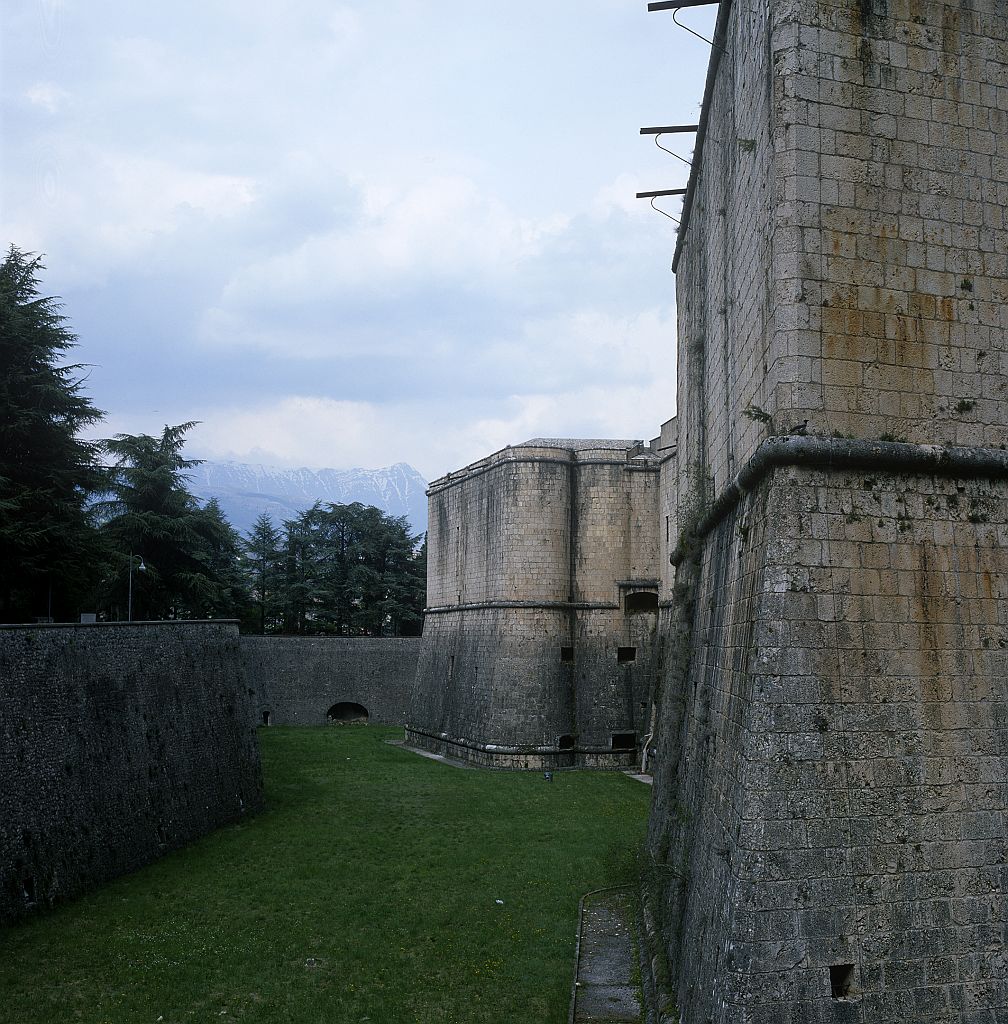
The “Spanish Fort” in L’Aquila, with the Apennines behind. This fortress dates from a few decades after Braccio’s death. Hasselblad 501 C/M camera, Zeiss Planar C 80mm lens, 6x6cm film back, Fujichrome Velvia 50 film (click to enlarge).

The Preacher – Bernardino di Siena

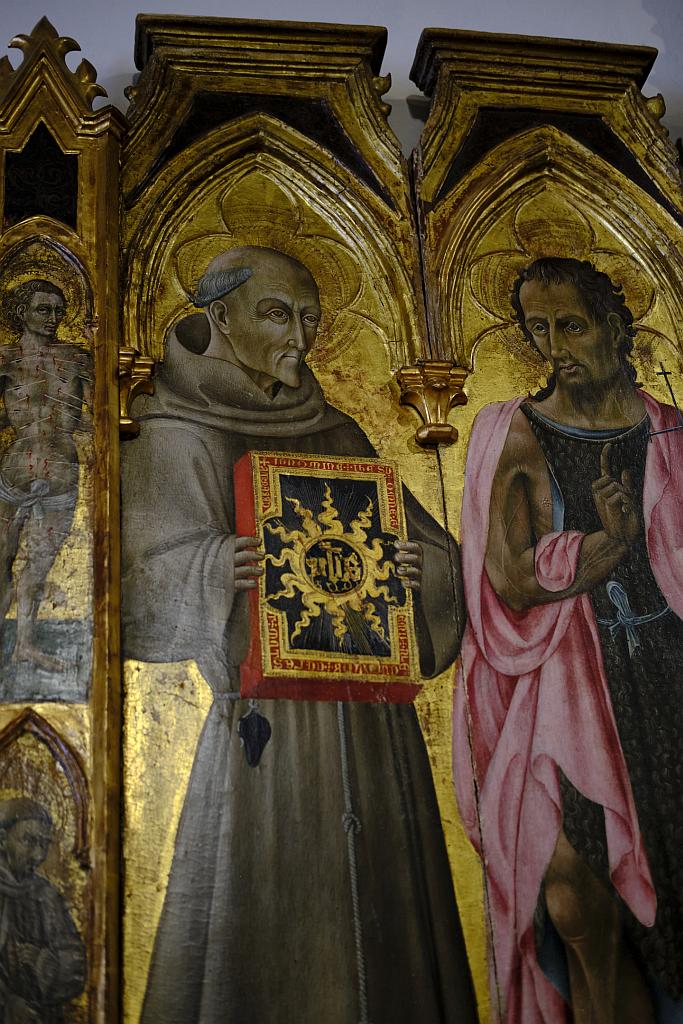
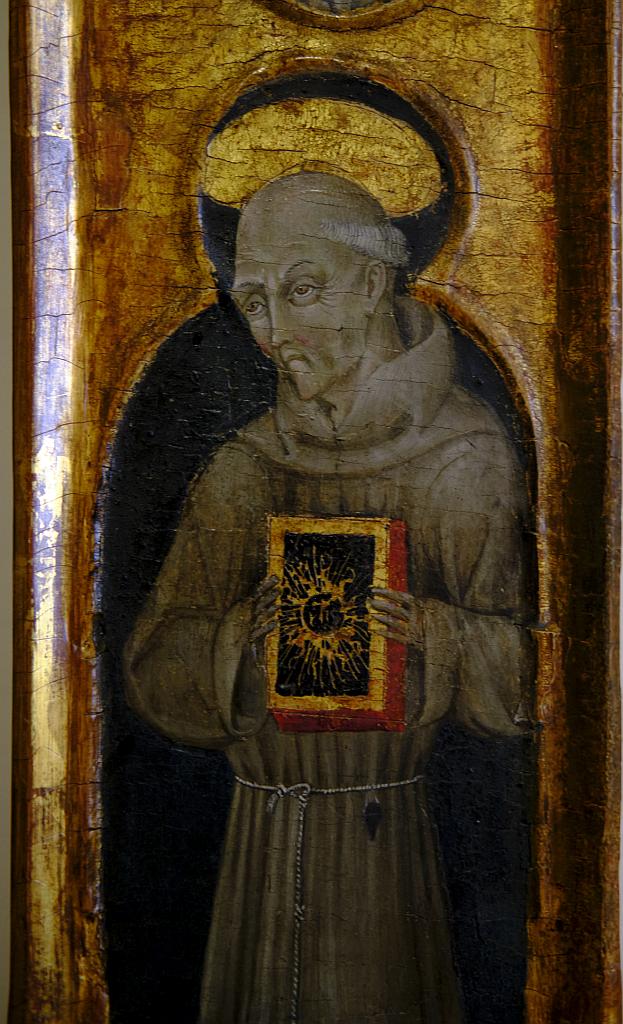
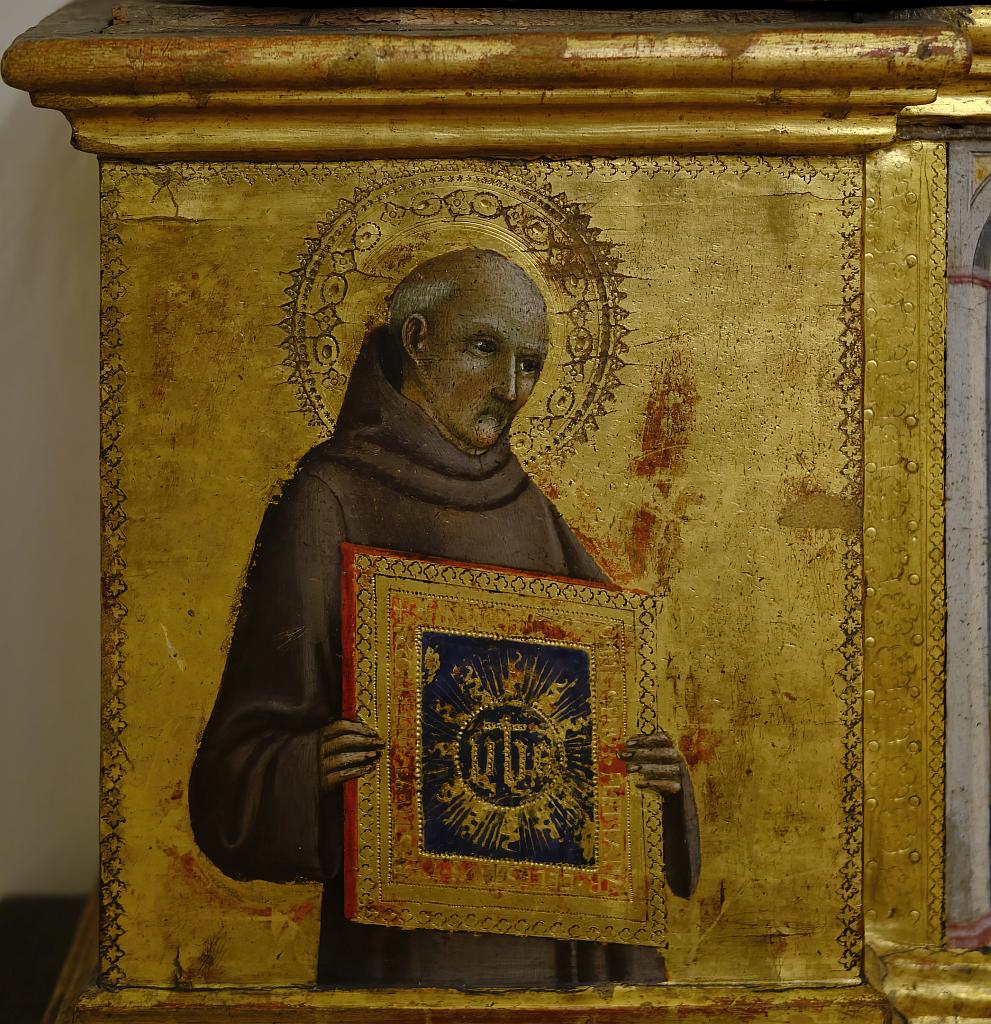
Bernardino of Siena – canonised shortly after his death in 1444 – was a Franciscan monk and a charismatic preacher. These days he is commemorated as a peacemaker, on the grounds that his emblem, the “IHS” trigraph (being the first three letters of “Jesus” in Greek), was supposed to replace the symbols used by political factions.

Bernardino
Bernardino of Siena holding the “IHS” symbol, altarpiece in Pinacoteca Nazionale di Siena. Fujifilm X-Pro 3 digital camera, 35mm lens (click to enlarge).

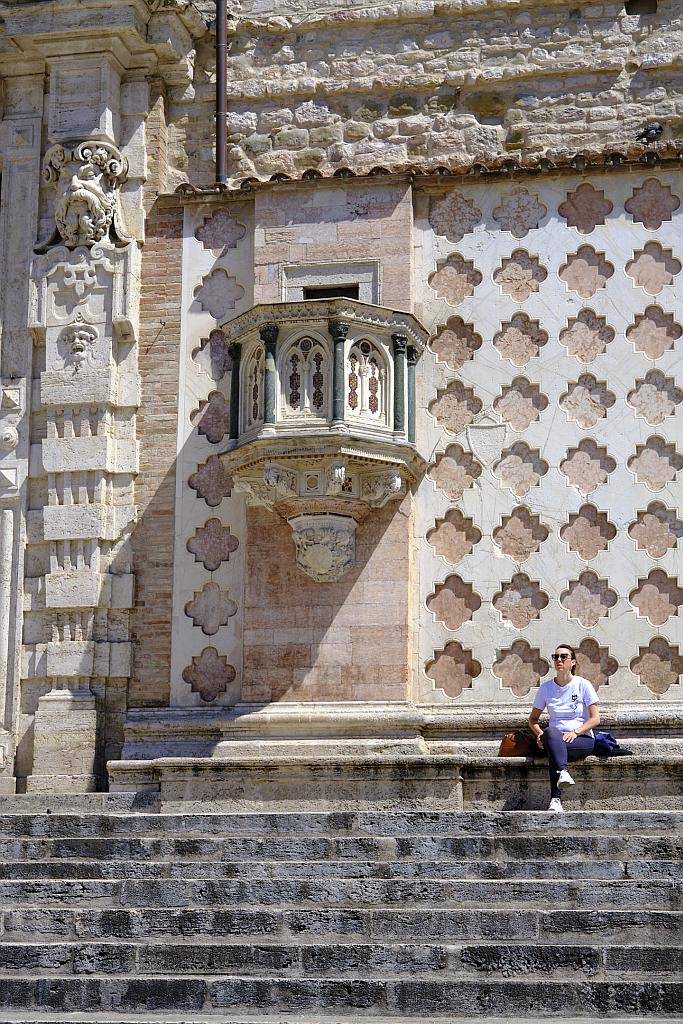
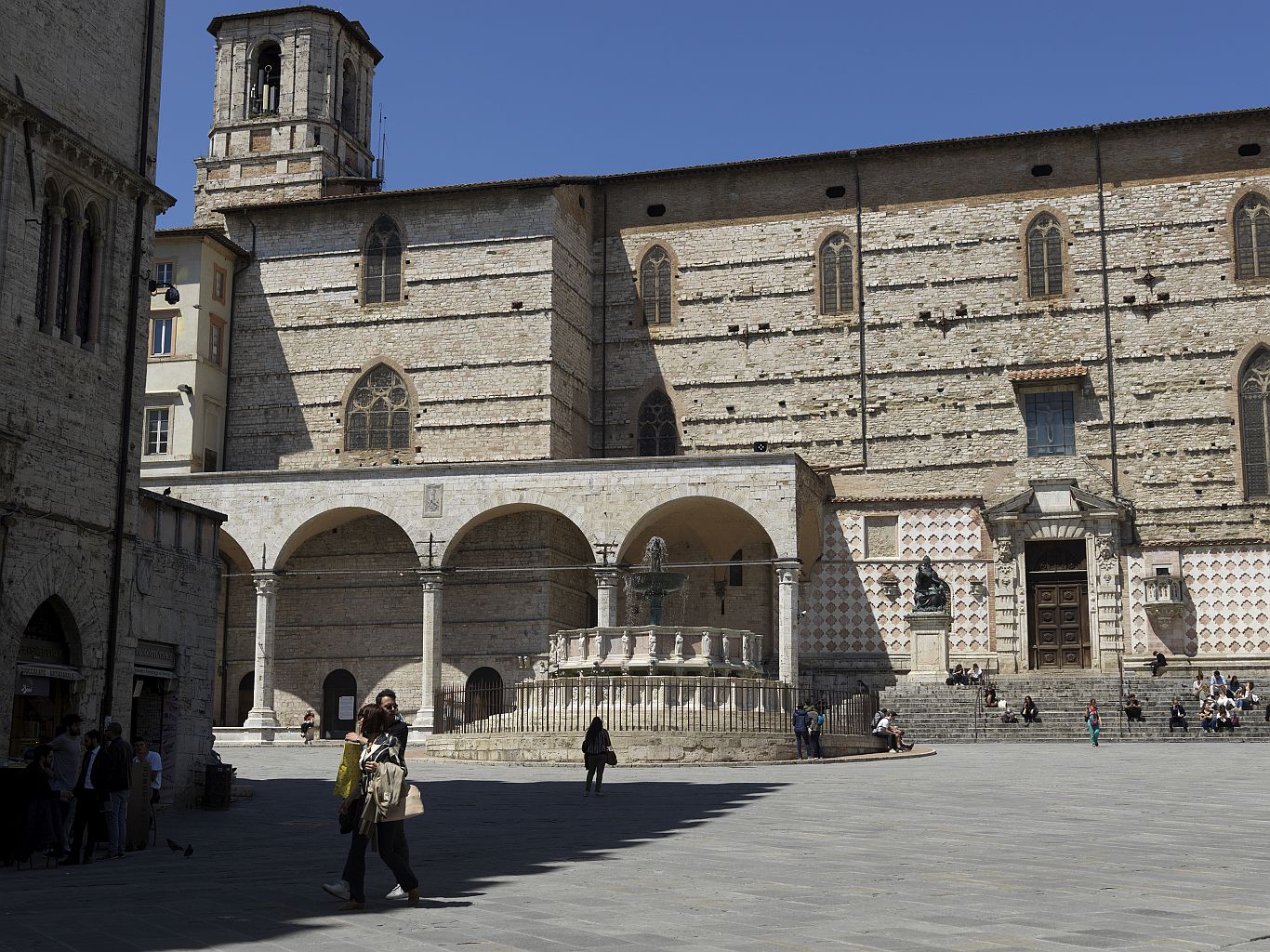
He was certainly the most famous preacher of his time. He drew large crowds, and town governments, rather than religious bodies, would often invite him to come and preach because of the income they stood to make from those who would come along to hear him. In Perugia they erected a special pulpit for him on the side of the cathedral, from which he could speak to the crowd in the piazza below. There is still a pulpit there, but not the original – this one was built a few years after his death to commemorate him.

Perugia Bernardino Pulpit
The “St Bernardino Pulpit” on the side of the Duomo in Perugia. Fujifilm X-Pro 3 digital camera, 56mm lens (click to enlarge).
A broader view of the piazza in Perugia, with the pulpit on the right beside the door. Pretty much everything in this photograph, apart from the pulpit itself, is as it would have been when Bernardino was preaching there, so you can imagine it filled by a large crowd. These days the piazza is where they put the stage for the Umbria Jazz festival, which gets pretty crowded too. Hasselblad 501 C/M camera, Zeiss Distagon CF 60mm lens, CFV-50c digital back (click to enlarge).

His sermons were not notable for advocating peace – quite the opposite in fact. Instead he condemned Jews, homosexuals, gypsies and “sorcery”, sometimes whipping up mob violence against his unfortunate targets. He told people that the Great Plague had been a punishment from God for sodomy, and was particularly critical of Florence, which had traditionally been comparatively tolerant of homosexuality (both Donatello and Leonardo were homosexuals, and Michelangelo may well have been).

San Bernardino
St Bernardino looking characteristically cheerful, Pinacoteca Nazionale di Siena. Fujifilm X-Pro 3 digital camera, 35mm lens (click to enlarge).

He didn’t always get things his own way though – on one occasion he was set upon by “sodomites” who attempted to beat him, and on another someone sabotaged a wooden pulpit by sawing through the legs, causing it to fall over backwards when he climbed into it.

Like Savonarola, he held “bonfires of the vanities”, where people brought their luxury possessions to be destroyed, and he also enjoyed publicly burning books of which he disapproved.

His views on women were considered somewhat regressive even by the standards of the 14th Century: they should never go out alone, they should obey men, they should dress with extreme modesty, and unmarried women should never speak to a male unless their fathers were present. Today his views sound like something of which the Taliban would approve, but shocking as all that is to modern sensibilities, it is said that women comprised the majority of people in his audiences.

Despite all that he proved a popular saint, although the Church understandably puts more emphasis on his supposed peacemaking than it does on his intolerance. His image is very common in religious art, and his traditional likeness probably dates from when he was alive, or shortly after his death. It may therefore be taken as truthful, and he is certainly one of the easiest saints to recognise – he is always represented with an expression of intense disapproval on his face.

San Bernardino
St Bernardino looking positively furious, Pinacoteca Nazionale di Siena. Fujifilm X-Pro 3 digital camera, 35mm lens (click to enlarge).

The “Witch” – Matteuccia da Todi

Matteuccia was born in the town of Ripabianca, a few miles north of Todi on the road to Perugia. As in so many Umbrian towns, the medieval centre was built on a hill for defence and to reduce the risk from malaria, while the modern town now extends along the valley floor beside the Tiber River (Ripabianca means, I think, “white banks”, so it probably refers to the river). We have passed the unremarkable modern town many times, but it was not until we visited there in order to take some photographs that we visited the historic centre, which is quite attractive.

Ripabianca
Ripabianca today, with the Tiber valley visible in the distance. Fujifilm X-Pro 3 digital camera, 16mm lens (click to enlarge).
Ripabianca
Ripabianca, the central piazza. Fujifilm X-Pro 3 digital camera, 16mm lens (click to enlarge).

Matteuccia was a herbalist and healer. No doubt there would have been a degree of ritual involved with the preparations of her ointments and infusions, typically invoking the blessing of saints – and perhaps something darker and more mysterious, although such suggestions need to be treated with caution under the circumstances.

As with folk medicine and charms throughout the ages, the rituals would not have been canonically Christian, but you could find similar superstitions today.

Ripabianca
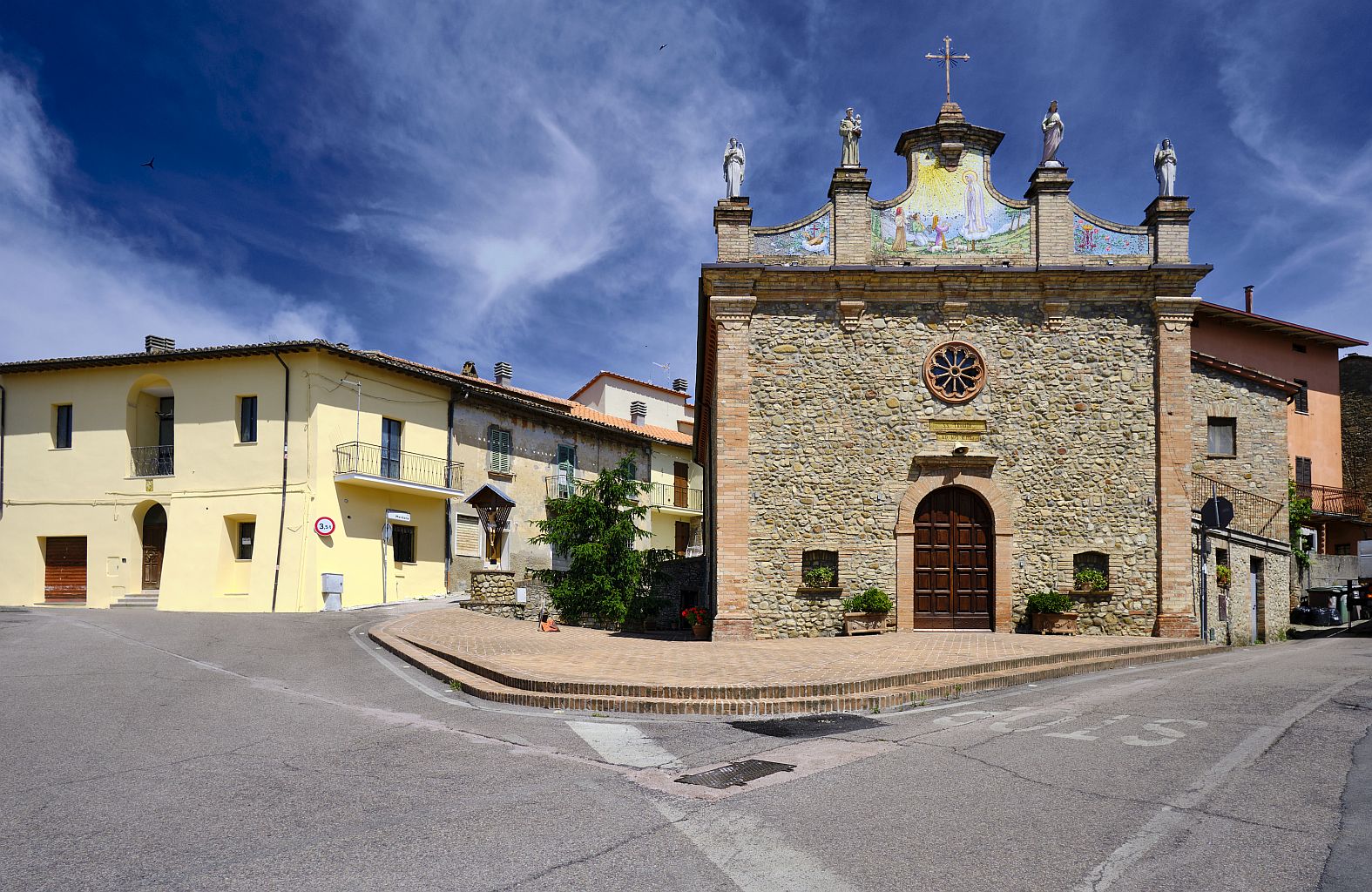
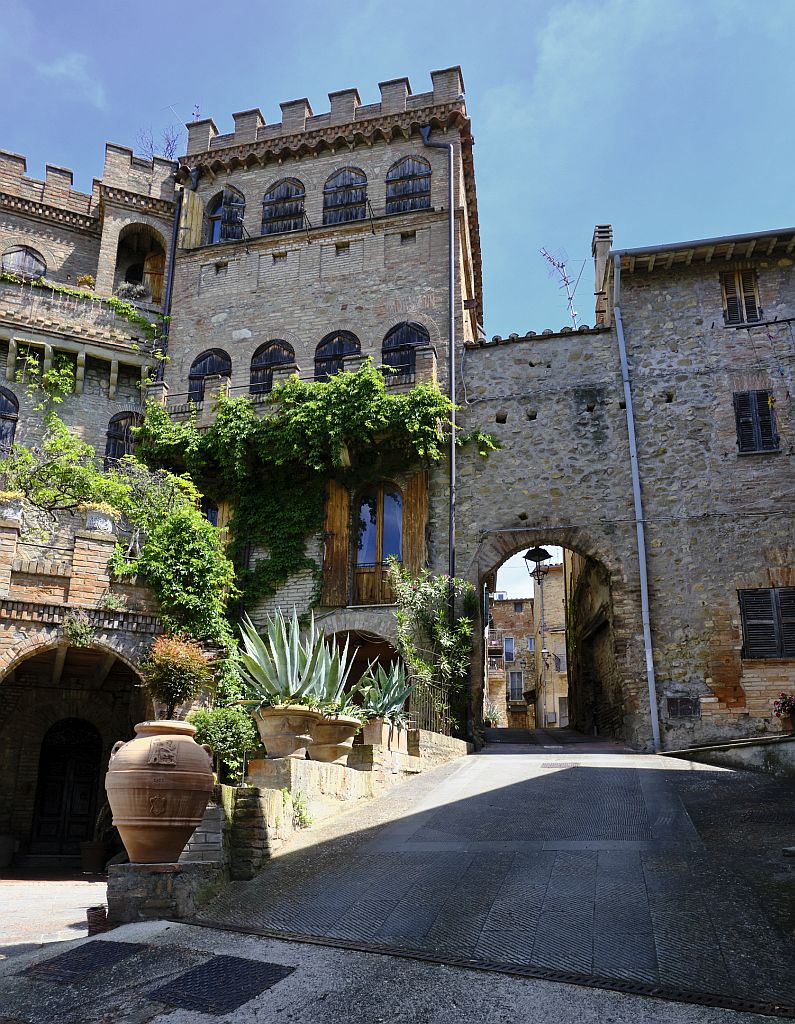
Ripabianca. “Matteuccia’s House” is through the gate on the left. Fujifilm X-Pro 3 digital camera, 16mm lens (click to enlarge).
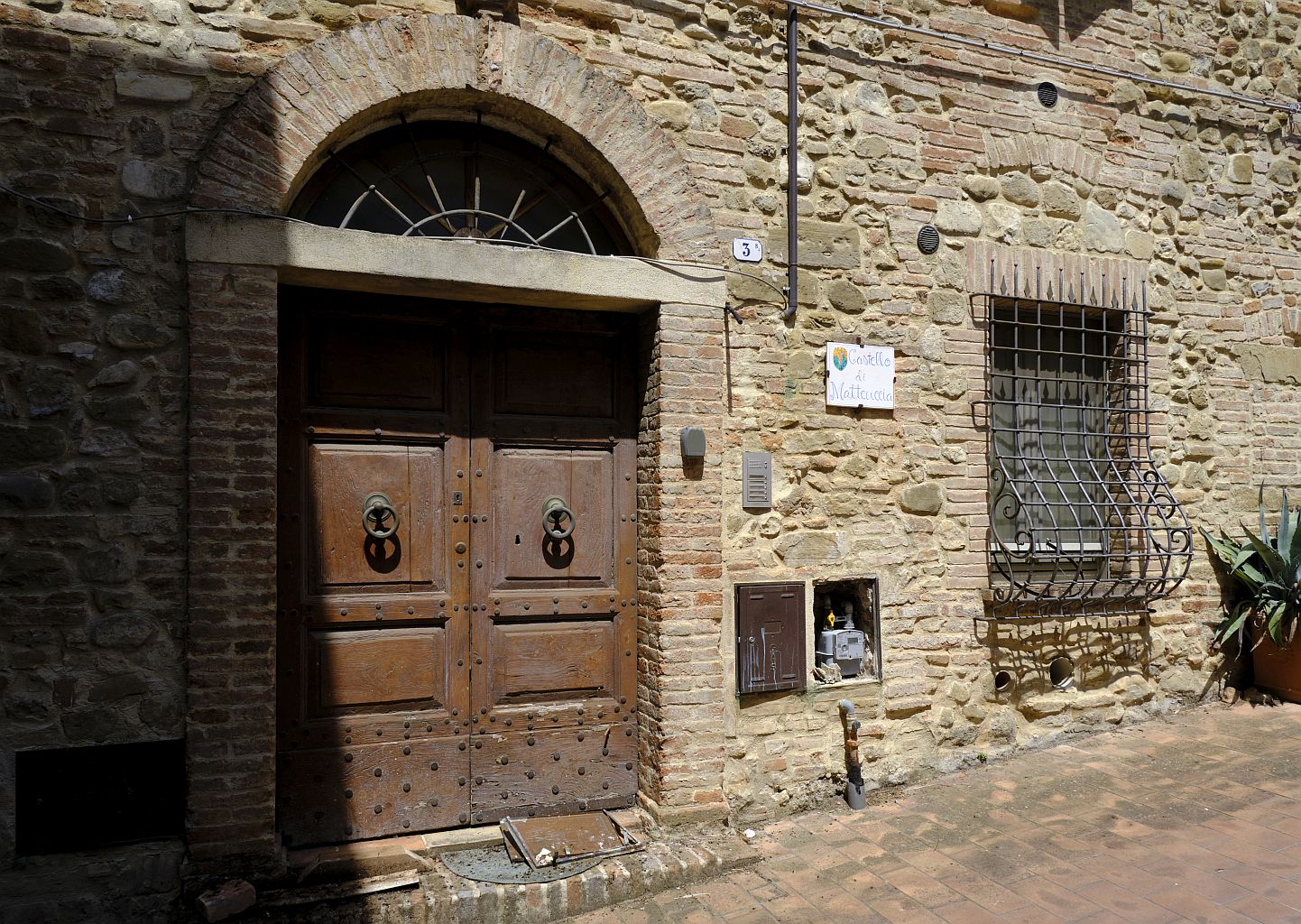
Castello di Matteuccia
Ripabianca, the “Castello di Matteuccia”. I have no idea if this is where she actually lived, but a passing council worker assured me that it was. Fujifilm X-Pro 3 digital camera, 35mm lens (click to enlarge).

But Matteuccia did not lead a conventional life, and the early 1400s was not a good time to be unconventional. In 1428 Bernardino of Siena visited Todi, where he accused Matteuccia of witchcraft. She was arrested and, after interrogation under torture, charged with a range of crimes including sexual relations with other women, selling love potions, infanticide, flying through the air, consorting with demons and other witches, and turning herself into a cat. The records of the trial are still held in the Todi municipal archives, and apparently make no mention of anything she might have said in her own defence.

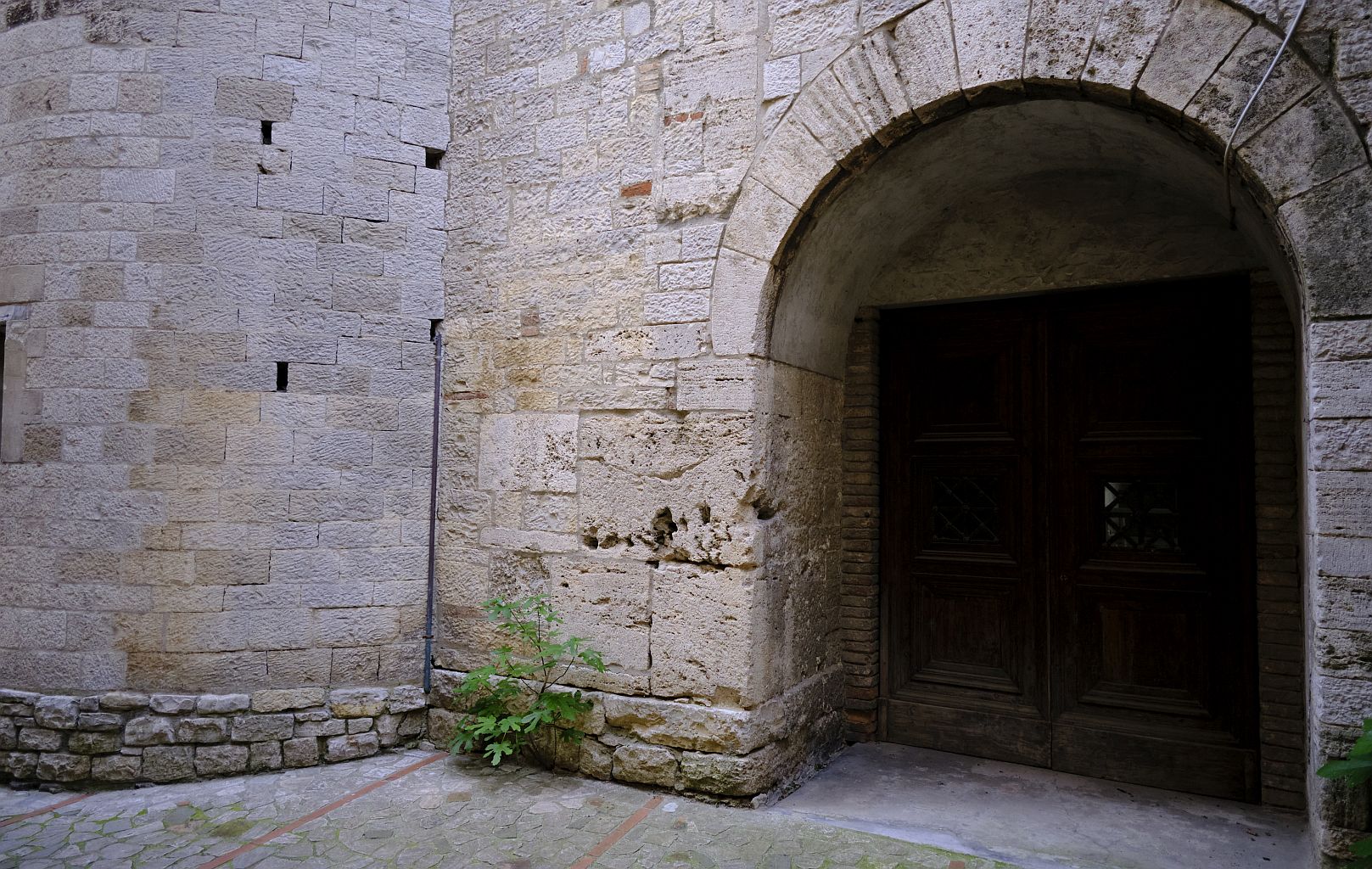
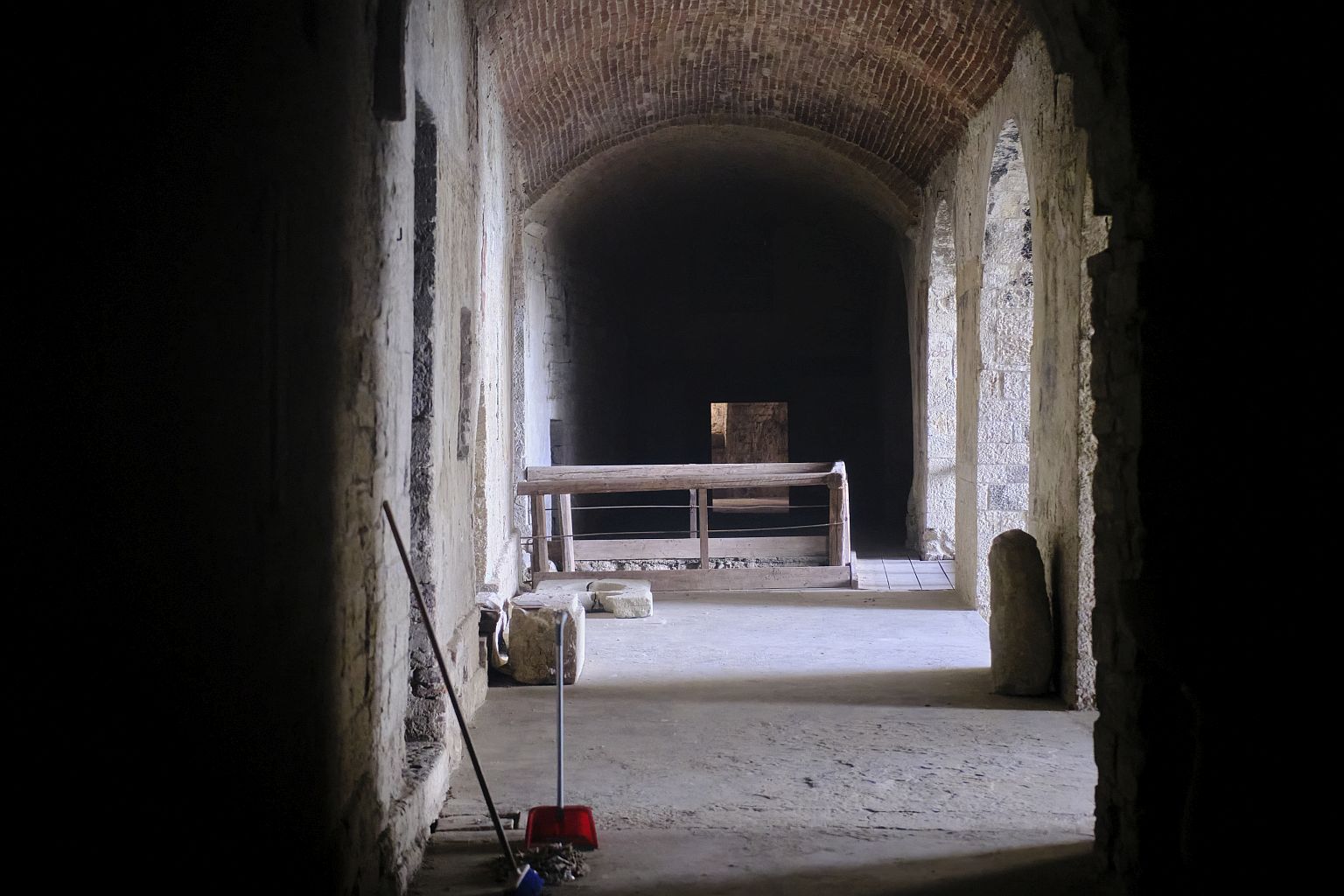
I don’t know if the documentary evidence tells us where the trial took place, but local tradition has it that the court of the Inquisition met in a gloomy cloister beneath the church of Santa Maria in Cammuccia.

SM in Cammuccia
The entrance to the cloister beneath the church of Santa Maria in Cammuccia, Todi, where the court of the Inquisition is said to have convened. The church is built on the site of a Roman temple, and some of the stonework looks as if it might have been Roman. Fujifilm X-Pro 3 digital camera, 35mm lens (click to enlarge).
SM in Cammuccia
Inside the cloister where the trial of Mattuccia is said to have taken place. Fujifilm X-Pro 3 digital camera, 35mm lens (click to enlarge).

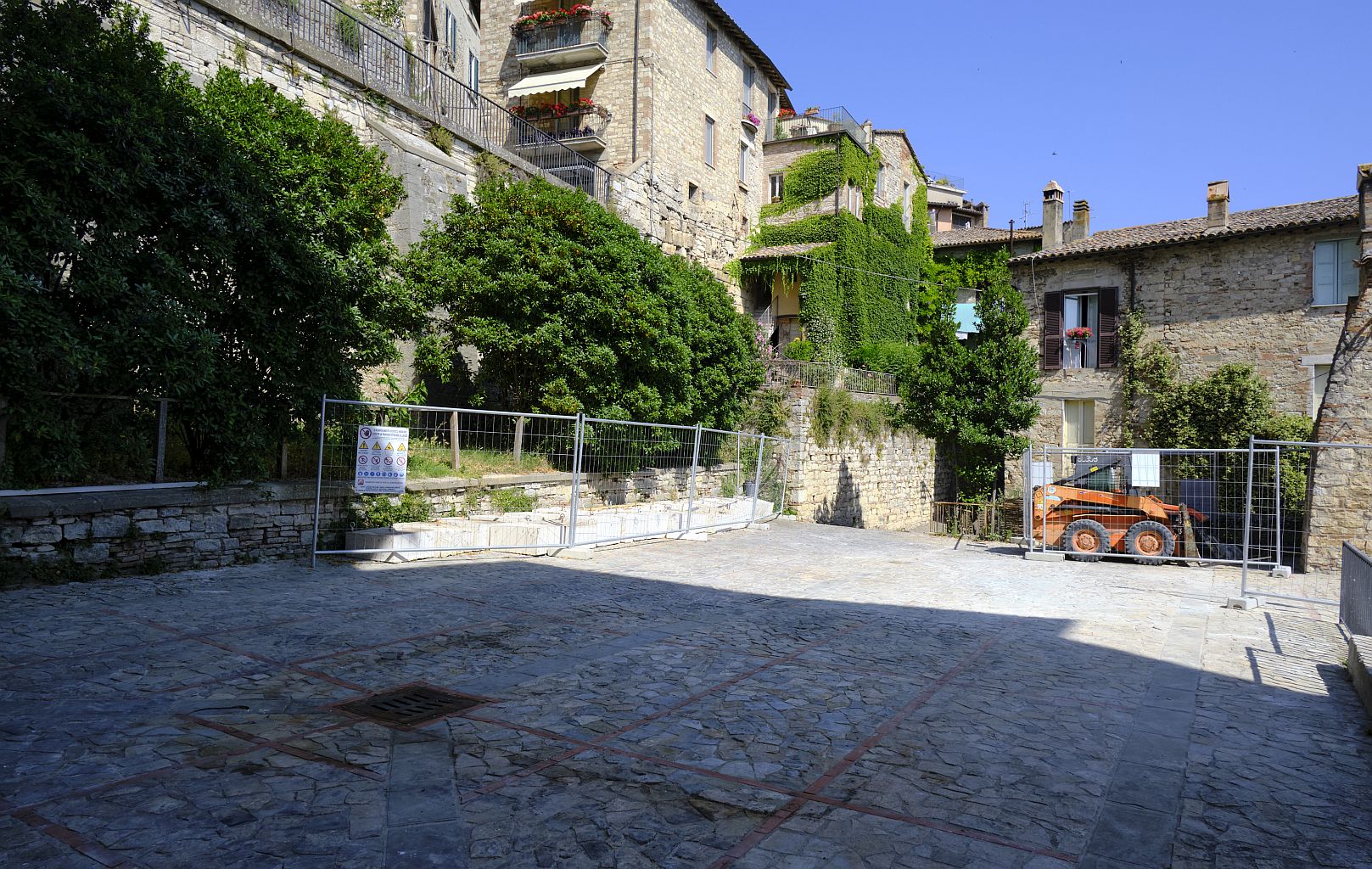
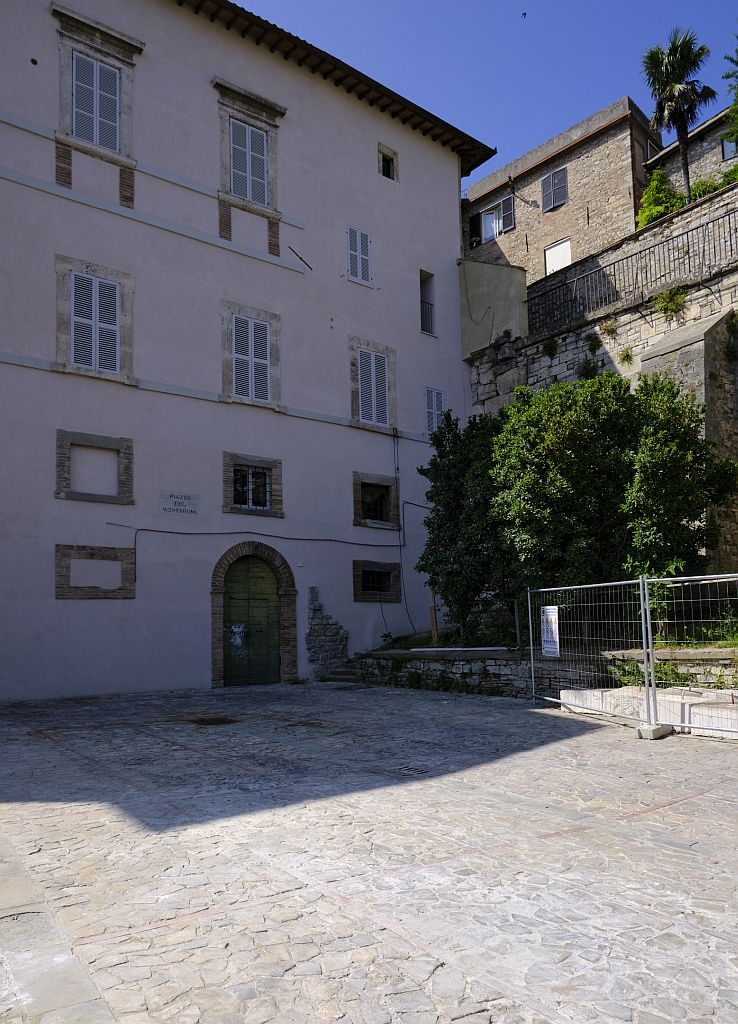
On the 20th of March 1428 she was tied to a stake in Piazza del Montarone, and burned alive.

Piazza del Montarone
Piazza del Montarone today. Unfortunately it has been a building site for the last three years and they hadn’t quite finished clearing it up when I took this. When I can take a better photograph I will update this post. Fujifilm X-Pro 3 digital camera, 16mm lens (click to enlarge).
Piazza del Montarone
Piazza Montarone. Going by an old photograph I have seen, this paving has only been added in the last few decades, so it is hard to say what it would have looked like when Matteuccia died here. The wall to the right would definitely have been there – it dates from pre-Roman times. Fujifilm X-Pro 3 digital camera, 16mm lens (click to enlarge).

Apparently Matteuccia’s was one of the first witchcraft trials in Europe, and she may even have been the first woman to have been executed as a witch. She was not, alas, the last. It is strange – we tend to think of witch-burning as an example of medieval ignorance and superstition, but in fact witch-burning became common after the Middle Ages – especially during the Reformation and Counter-Reformation. Bernardino really started something.

I suspect that there may have been a cynical political aspect to poor Matteuccia’s ordeal. It is said that Fortebraccio had been her friend and protector, but as we have seen he had died in battle four years earlier, fighting for Alfonso of Aragon against the Papacy, for which he had been excommunicated. It would have suited authorities to associate him and his allies with devil-worship, and conveniently some of Matteuccia’s alleged crimes were said to have been committed on behalf of Fortebraccio’s soldiers.

Matteuccia’s Legacy

So what do we make of all this, almost six hundred years later? Somewhat understandably, Italian feminists celebrate Matteuccia as a victim of systemic misogyny. New-age crystal-wearing hippie types tend to be fascinated by the witchcraft part, but not in a negative way. Bernardino, as we have seen, was canonised and is now the patron saint of Italy, and also of advertising and public relations. He also has a city in California named after him. Fortebraccio has a brewery named after him.

Being quite possibly the first town anywhere to burn an accused witch at the stake is not something to be particularly proud of, but modern Todi does not attempt to hide it; various commemorations ensure that Matteuccia will not be forgotten. I’m not convinced that all of these have been in the best of taste; there have been pageants and imaginative re-enactments of the trial, and in an art gallery we saw a painting of Matteuccia depicted as a voluptuous naked woman flying over the skyline of Todi.

Halloween has recently become a thing in Italy, and last year a local restaurant advertised a “witch’s soup (if you dare!)” which fortunately derives its flavour from herbs rather than organs of newts or toads. They advertised it with a poster showing someone dressed in a Halloween witch outfit with black conical hat and so on. Enough people must have been brave enough to try it because it is still on the menu.

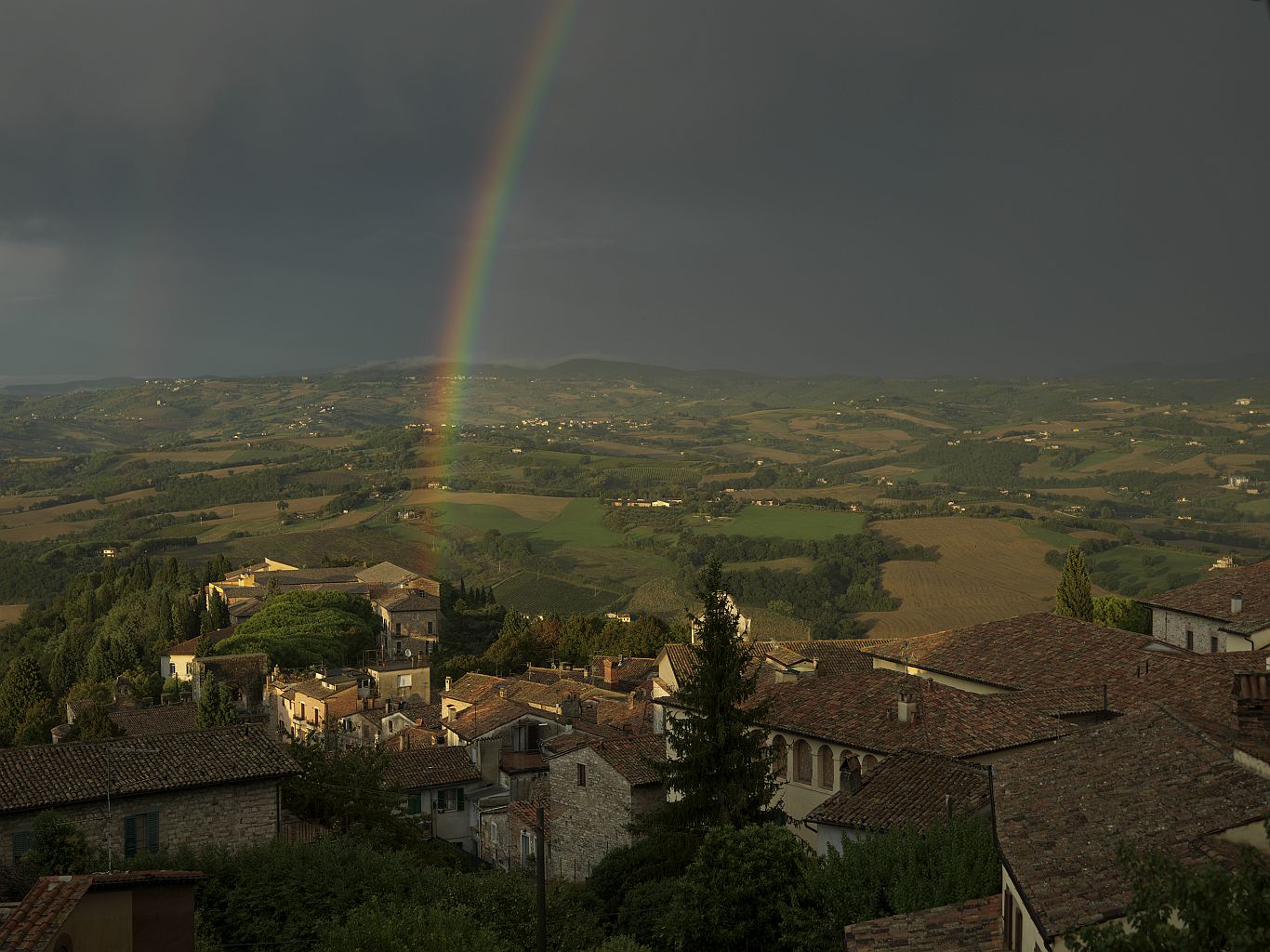
The most respectful  tribute to her is surely the “Orto della Strega Matteuccia” (Garden of the Witch Matteuccia) at the Agricultural Institute of Montecristo in Todi, in which traditional medicinal herbs are grown and studied. It would have been even more respectful if they had dropped the word “strega”, but there you are.

Agricultural college
The aftermath of a thunderstorm in Todi, with a rainbow helpfully indicating the location of the agricultural college, where the memorial garden for Matteuccia is located. Hasselblad 501 C/M camera, Zeiss Sonnar CF 150mm lens, CFV-50c digital back (click to enlarge).

Ancient Todi – Before the Romans

Todi is a town in Umbria, rising on a rugged hilltop beside the River Tiber. These days it is known for its almost perfectly-preserved medieval town centre, but there are traces of a far more ancient town, and many of them are not hard to find.

Todi
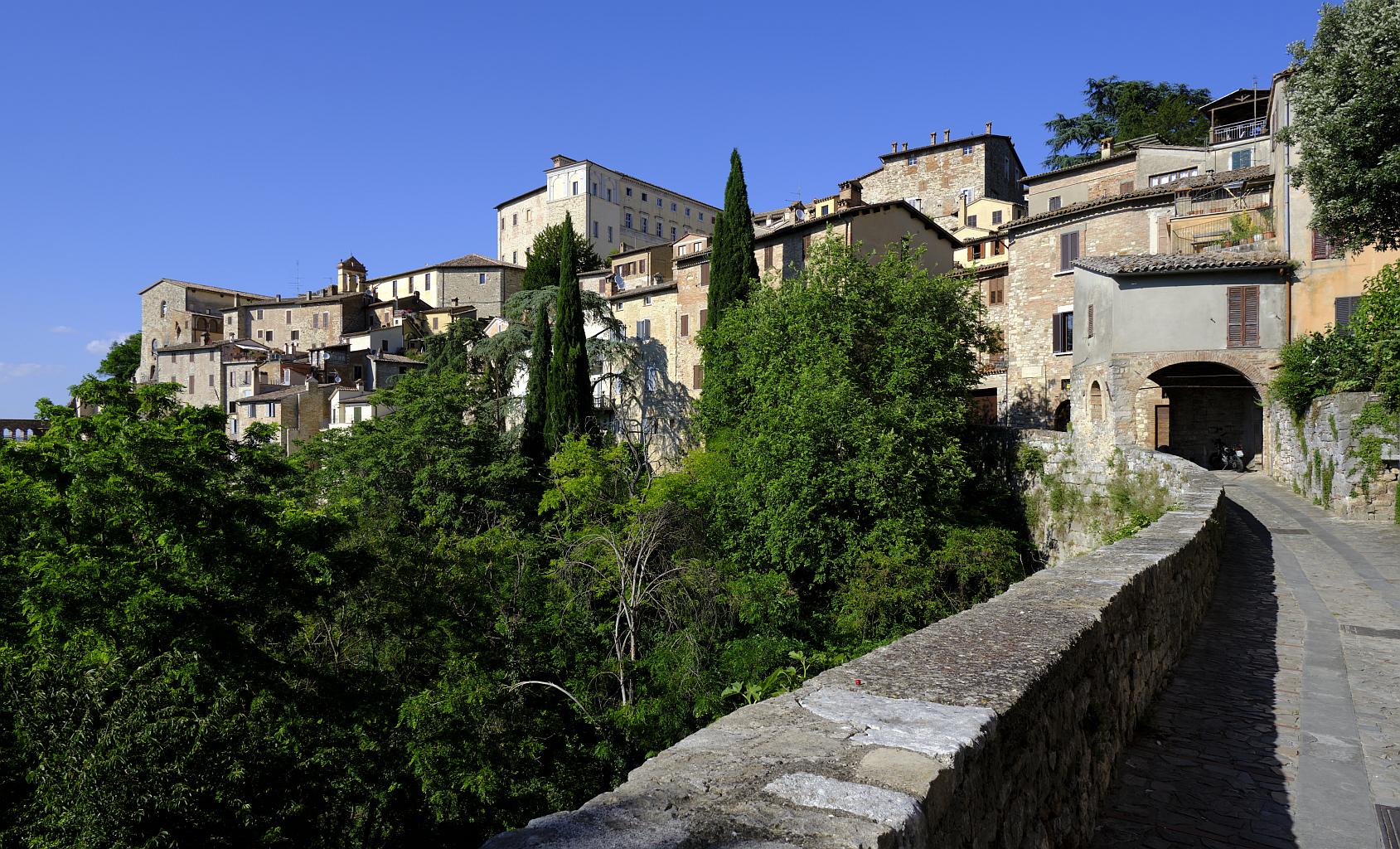
The classic view of Todi, from the ancient walls. In the distance is the Tiber valley, where the river marked the boundary between Etruscan and Umbrian territory. The area at the left of the town is called “The Eagle’s Nest” and is the traditional site where the Eagle deposited the stolen tablecloth. Fujifilm GFX-50R medium format digital camera, 32-64mm lens (click to enlarge).

Todi has two things that marked it as a good site for a town – firstly a steep defensible hill, and secondly, despite its height above the valley, it is a hill on which there are sources of fresh water. Water falls on the Martani mountains to the east and seeps down through the limestone, but then gets trapped under a layer of impermeable clay in the valley, where it builds up pressure. Todi’s hill is a plug of limestone up through which the water is forced, emerging in multiple places as springs. In addition, wells could easily be sunk through the soft rock.

So it was the obvious place for a settlement, and there are signs of there having been continuous occupation since Neolithic times, when the river valley below was variously swampy or even inundated by a huge lake.

The Legend of the Eagle

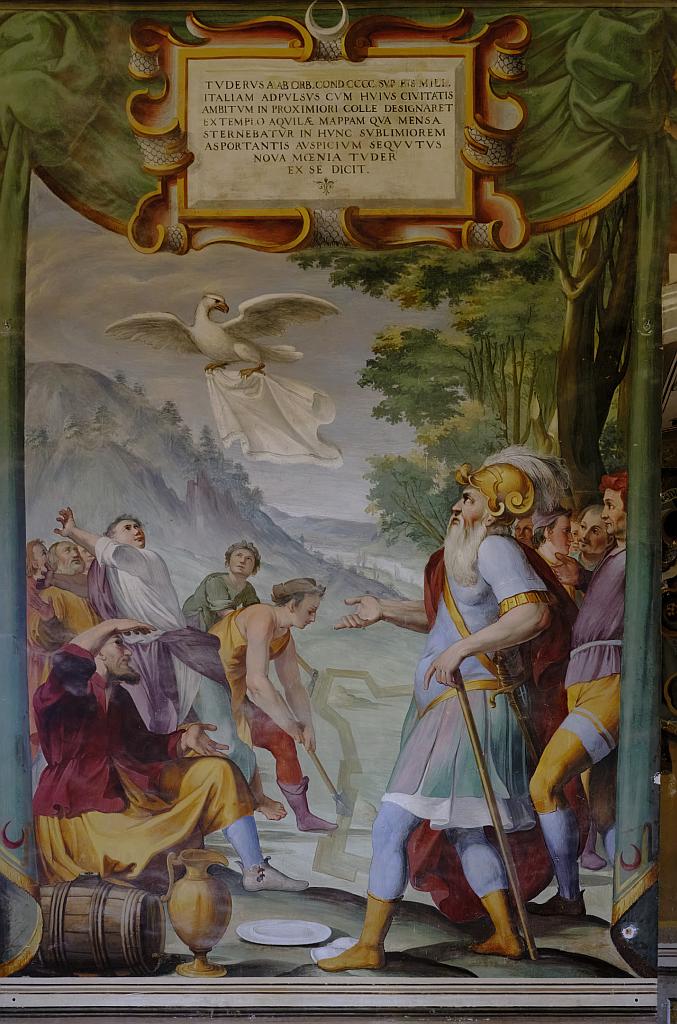
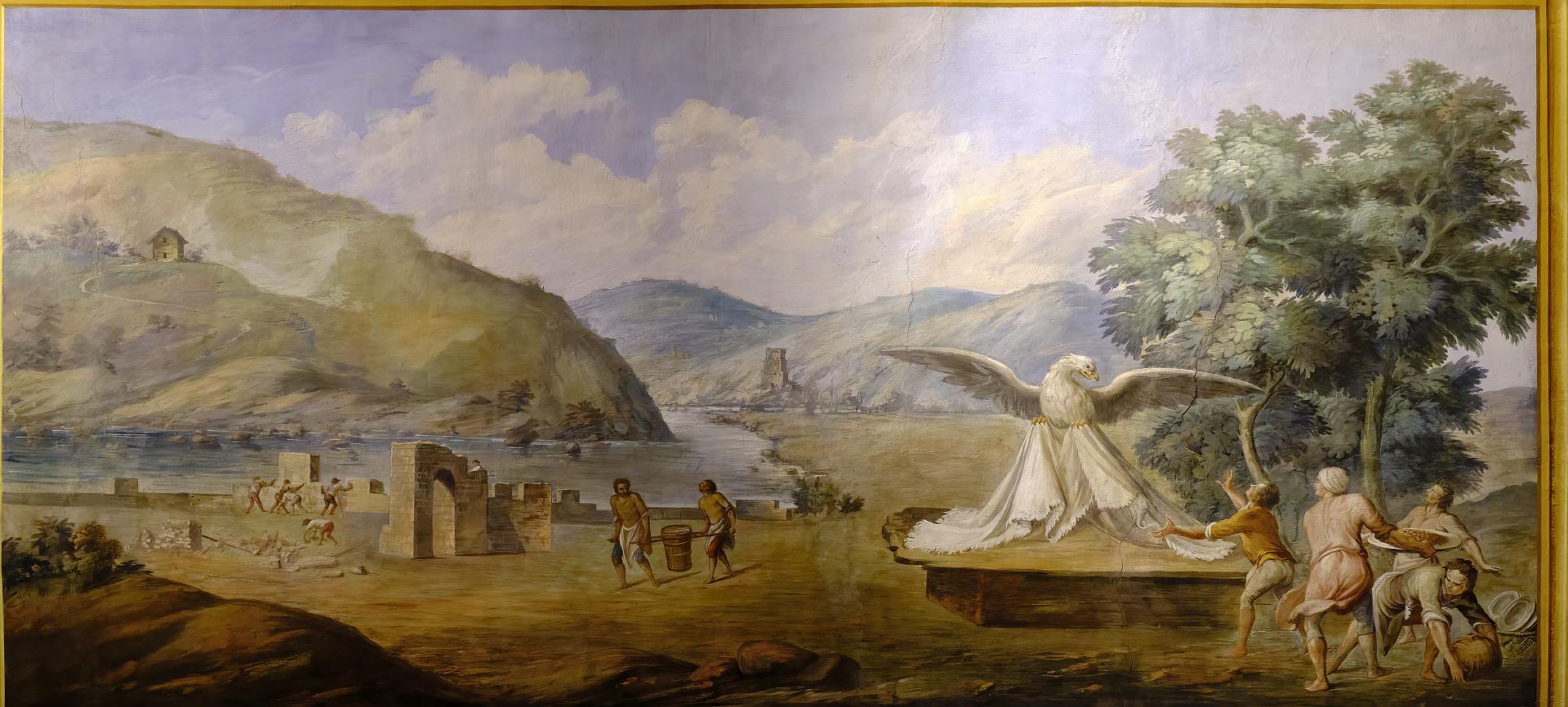
However the foundation myth of Todi is a bit more elaborate. According to the story, Todi was originally intended to be built by the banks of the Tiber, and after the first morning’s work, the builders stopped for lunch (that part is believable, at any rate). But as soon as the tablecloth was laid, an eagle swooped down, seized it, and carried it away to the top of the hill. Augurs interpreted this event as a sign that the town should have been built up there, and so the plan was changed. And thus it also was that the eagle became emblematic of Todi. It is still on the town’s coat of arms.

Eagle and tablecloth
The eagle disrupts lunch, and the story of Todi begins. 17th-Century fresco from the Episcopal Palace, Todi. Fujifilm GFX-50R digital camera, 32-64mm lens (click to enlarge).
Eagle and tablecloth
Another version of the same incident, from the Civic Museum in the Palazzo del Popolo. Fujifilm X-Pro 3 digital camera, 16mm lens (click to enlarge).

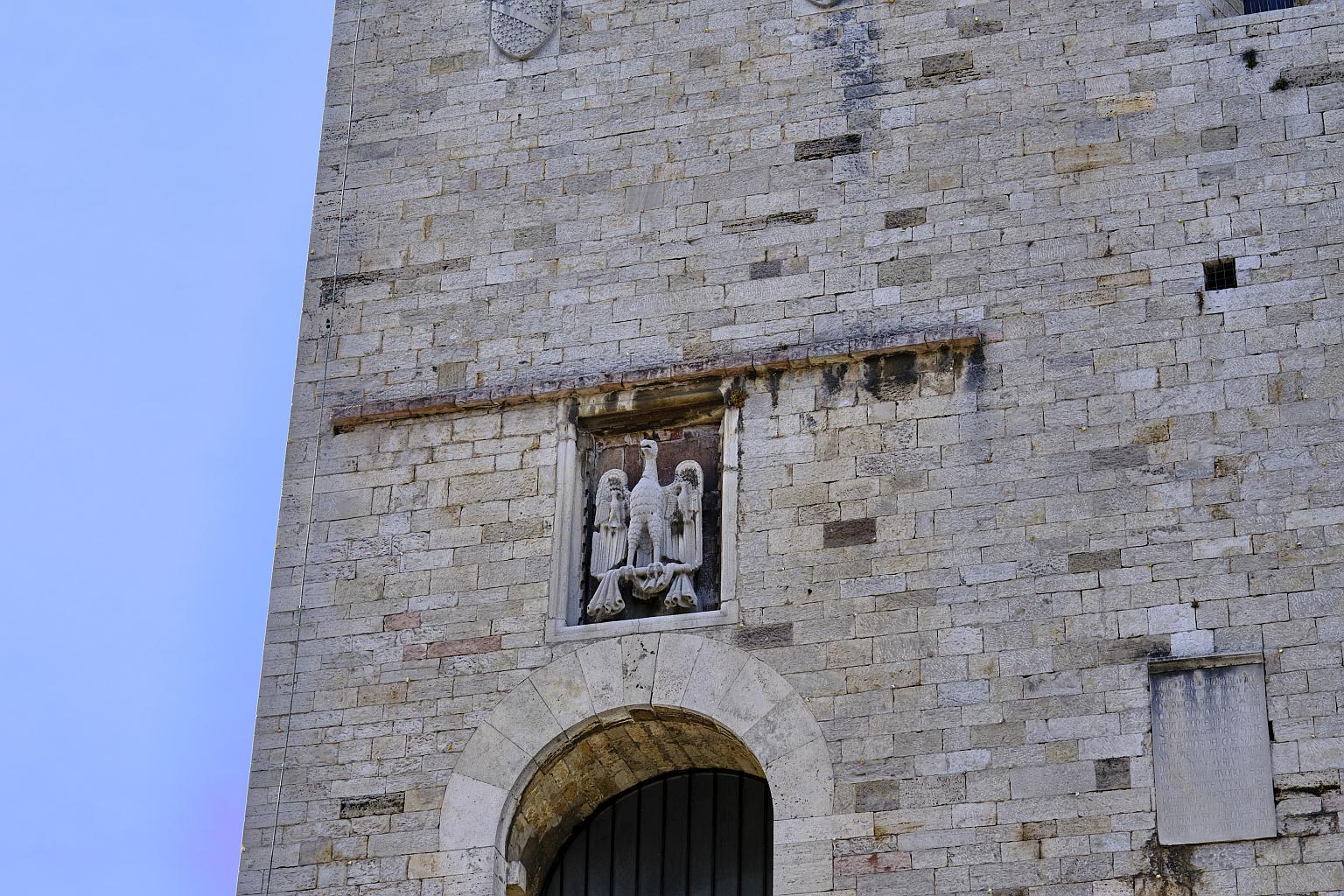
Who knows how old that story is, but it may have been a medieval invention because the first recorded appearance of the eagle in a Todi context was not until 1267. It is conventionally represented as clutching the stolen tablecloth in its talons, and it is often also seen sheltering two eaglets under its wings; these represent the towns of Terni and Amelia, which were subject to Todi for a period in the 13th Century, something of which modern Tuderti (Todi citizens) remain very proud.

I have come across one fascinating hint that the story might be older – a very ambiguous reference to the hill on which the Duomo now sits having been called the Nidola (nest) in Roman times.

Eagle on Palazzo del Popolo
The eagle, with its junior partners under its wings, and the tablecloth, on the exterior of the Palazzo del Popolo. Fujifilm X-Pro 3 digital camera, 56mm lens (click to enlarge).
Eagle on Palazzo dei Priori
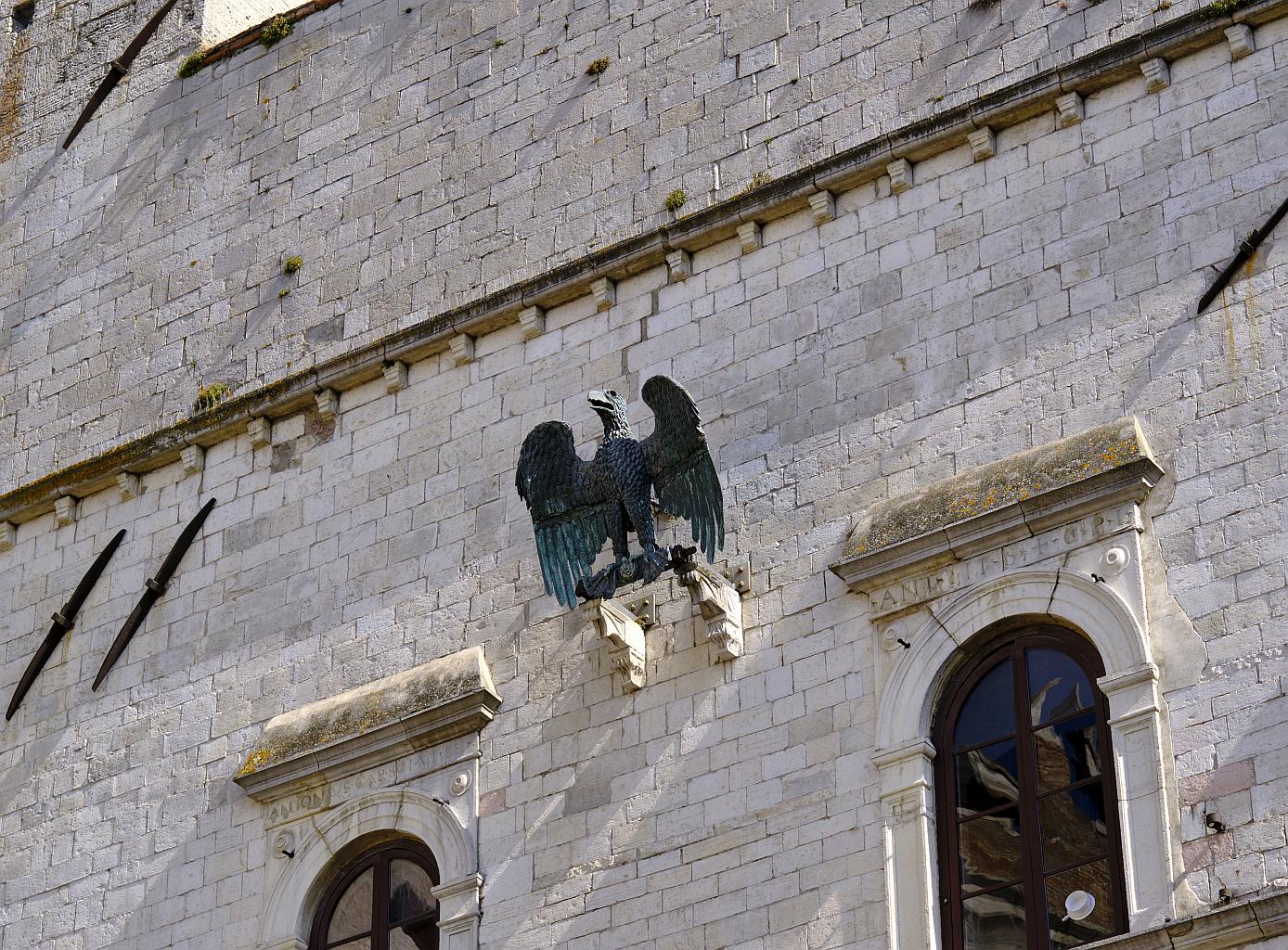
This very imposing bronze version of the eagle has been on the front of the Palazzo dei Priori since 1339. Fujifilm X-Pro 3 digital camera, 56mm lens (click to enlarge).

Fanciful though it all is, I rather like the fact that the very first event recorded in Todi’s long story is… lunch.

Umbrians, not Etruscans

Turning from legend to things of which we are a bit more confident, it seems that in pre-Roman times the Tiber marked the boundary between the territories of the Etruscans and the Umbri, the latter – unlike the Etruscans – being an Indo-European people who spoke a language related to Latin. We actually have some examples of the ancient Umbrian language thanks to the improbable survival of the “Iguvine Tablets” of Gubbio, something else I intend to write about some day.

So Todi was a frontier town, and its very name – Latin Tuder, Umbrian Tutere, is said to come from a word meaning “border” (although whether that original word was Etruscan or Umbrian depends on which source you read). Away to the north on a clear day, in the 21st Century AD as in the 6th Century BC, one can see Perugia, then the easternmost of the twelve cities of the original Etruscan league, and the Tiber winds down from the north as a constant reminder of the boundary between the two territories.

It is common in Todi to refer to anything from the pre-Roman era as “Etruscan”, which makes a sort of sense, as everyone knows that the Etruscans came before the Romans. So for example there is a Via Mura Etrusche which leads down to the pre-Roman walls, and many guidebooks assert that Todi was Etruscan. But as we have seen, it is not strictly accurate – Todi was Umbrian, not Etruscan. A couple of years ago we went on a guided walk through Todi organised by the Fondo Ambiente Italiano (a bit like the UK’s National Trust). The guide was a pleasant and very knowledgeable chap who pointed out many interesting things, but he got quite agitated when someone (not us, fortunately) referred to the pre-Roman period in Todi as ”Etruscan”. It was obviously a sensitive subject for him.

Not Etruscan Walls
On top of the (not) Etruscan walls. Fujifilm X-Pro 3 digital camera, 16mm lens (click to enlarge).

So what were the ancient Umbri like, apart from not being Etruscan? Well, according to a 2020 genetic analysis, quite like the modern Umbrians, it seems. In one way that’s not surprising – we talk about this culture having replaced that culture, but unless mass slaughter is involved (and it wasn’t in Italy), the people go on, and so the blood of the ancient Umbri and Etruscans obviously runs in the veins of modern Umbrians.

In another way it’s a bit unusual, because by and large Italians in most regions are anything but ethnically homogeneous – many waves of invasions, from the ancient Gauls to the Lombards and the Normans, have seen to that. Culturally, we can expect  that the Umbrian inhabitants of Tutere would have shared a lot with their Etruscan neighbours – not just because of proximity but because they were at a similar stage of technological development.

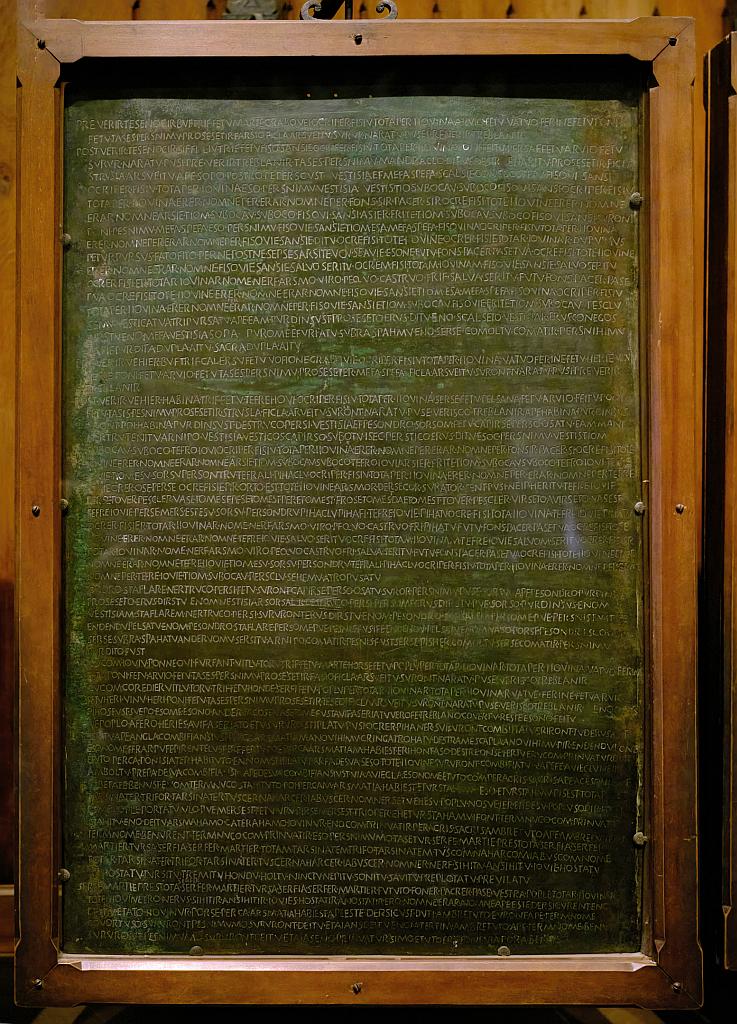
Certainly, like most other Bronze Age cultures, they seemed to live in a society shaped by warfare. Apart from the obvious fact of having built their towns on defensible hills (whether or not eagles told them to), there are some other clues. The Iguvine Tablets from Gubbio make several references to enemies.

Iguvine Tablet
One of the 3rd-Century BC “Iguvine Tablets” from Gubbio, in the ancient Umbrian language. Fujifilm GFX-50R digital camera, 32-64mm lens (click to enlarge).
Votive figures
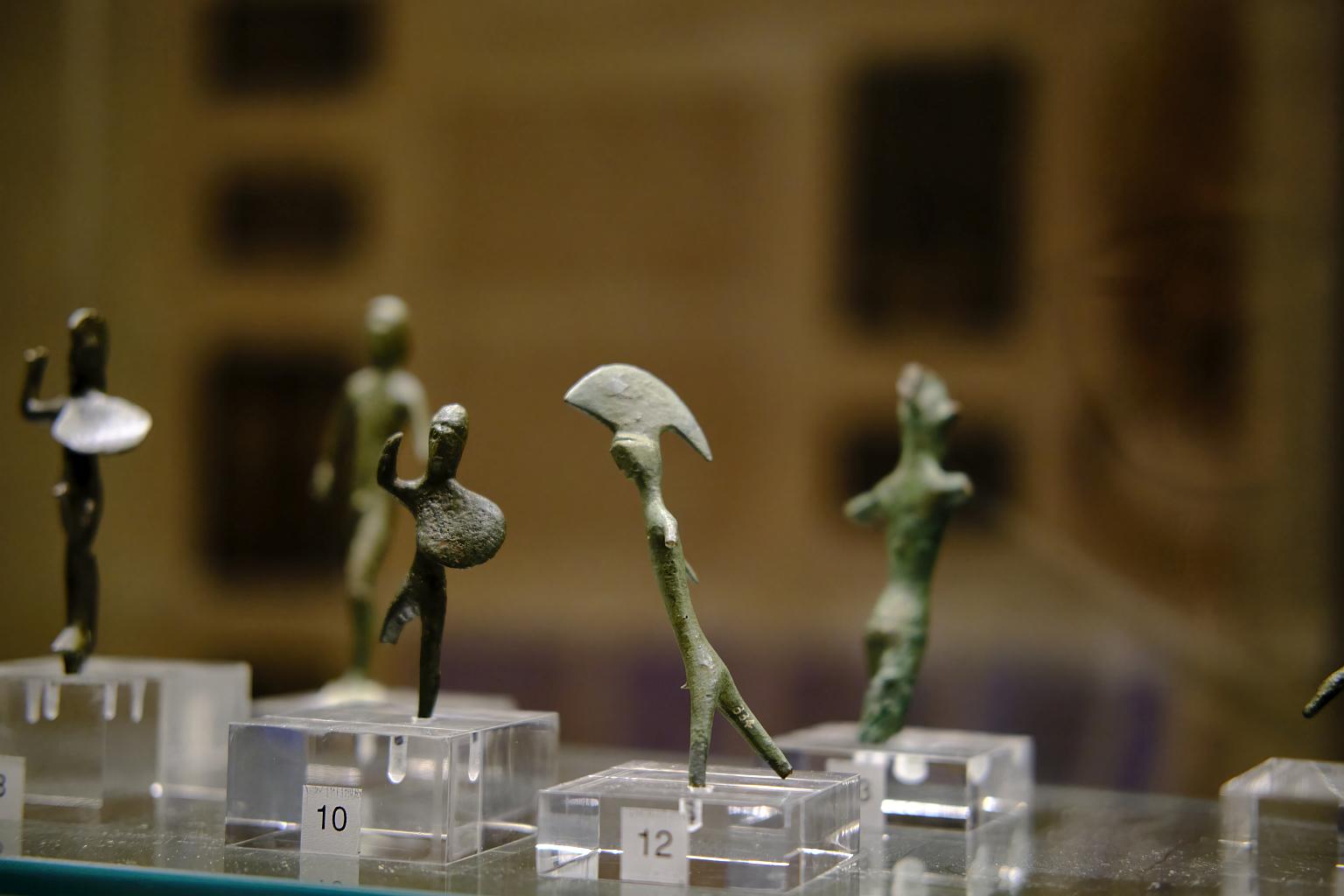
Votive figurines of warriors with plumed helmets and shields, Todi Museo Civico. Fujifilm X-Pro 3 digital camera, 35mm lens (click to enlarge).

Military equipment – Bronze swords, spear tips and helmets – also survive. Another clue is that in local museums you can see votive figures retrieved from sacred springs, where supplicants prayed to the gods for assistance. Some figures represent pregnant women, obviously offered in the hope of conceiving or of having a safe childbirth. But an awful lot of them clearly represent warriors, with plumed helmets and shields, and in aggressive stances. Not the sort of offering you would make if you were praying for a good harvest, but one you might make if you were hoping to come home alive from a battle in order to bring the harvest in. While most are tiny little figurines, the most famous and elaborate of such offerings is the so-called “Mars of Todi”.

Marte di Todi
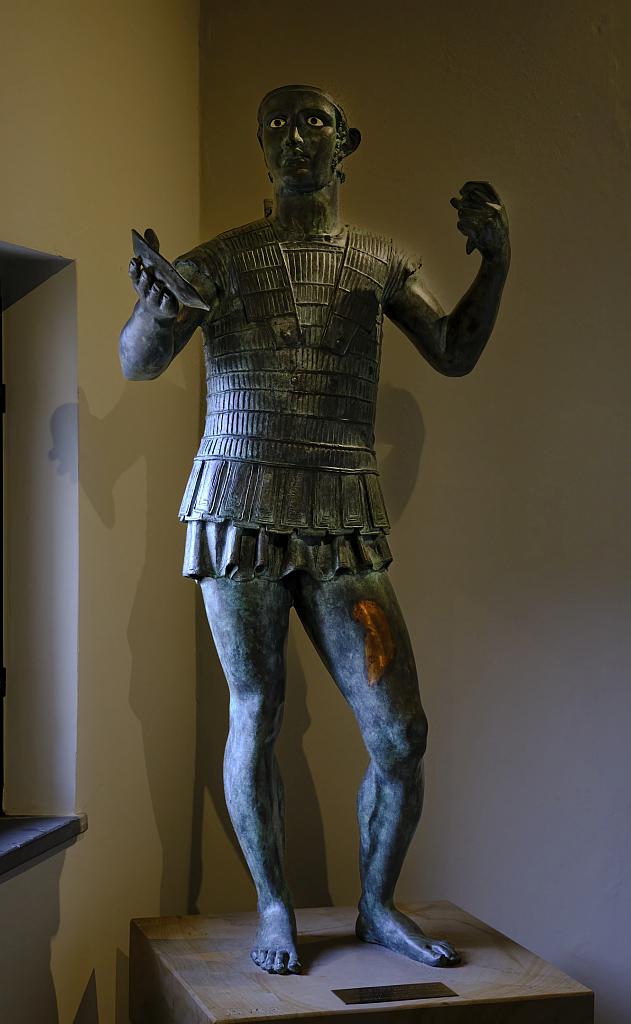
The so-called “Marte di Todi” or “Mars of Todi”, but despite that probably not a god of war. This is a facsimile in the Museo Civico di Todi, with the original now held in the Vatican Museum. Fujifilm X-Pro 3 digital camera, 35mm lens (click to enlarge).

This extraordinary life-size bronze statue, dated to the 5th or 4th Century BC, was dug up in 1835 at a place just outside Todi called Montesanto which at various times has been a monastery and a castle, and in ancient times was very likely some sort of religious precinct. Unfortunately for Todi, anything like that which came to light during the centuries of Papal domination went straight to the Vatican, which is where the Mars of Todi remains; what you can see in Todi’s Civic Museum is a facsimile made in the 1990s and paid for by a local citizens group. (That is one of the reasons why the local museum has such a comparatively poor showing: the other is what Italian historians call the “Napoleonic Despoliation”, when French troops methodically stripped northern and central Italy of the artworks that are now mostly in the Louvre. It’s strange – people go on and on about the Elgin Marbles, but no-one ever asks the French to give anything back. However I digress.)

Todi from the Northeast
Todi from the north-east. Montesanto, where the “Mars of Todi” was unearthed in 1835, is the smaller hill to the right of the picture. Fujifilm GFX-50R digital camera, 100-200mm lens (click to enlarge).
Montesanto
The convent of Montesanto at sunset, taken from Todi. Fujifilm GFX-50R digital camera, 32-64mm lens (click to enlarge).

The armoured figure, with (now missing) spear and helmet, was at first identified as a god of war, hence the name “Mars of Todi”. But modern scholars, pointing to the fact that the statue’s right hand probably held a libation bowl (the facsimile in my photograph is holding such a bowl, but that is not in the original), more plausibly suggest that this depicts a human warrior making an offering to the gods before battle. It was found under blocks of travertine stone, so it was deliberately buried. Whether it was made to be buried as an offering, or that was something that happened to it later, we will never know.

It is believed to have been made in the Etruscan city of Orvieto, a manufacturing centre for such bronzes, and it carries an inscription in Umbrian characters saying that it was a gift from someone called Ahal Trutitis. This is said to be a name of possible Celtic origin (the Celts, whom we now associate with Britain and Ireland, started out probably in central Europe and, as the Gauls, invaded Italy in about the 5th Century BC, not long before the statue was made). So someone, living in Todi and speaking Umbrian but perhaps of foreign ancestry, was wealthy enough to commission what must have been an extremely expensive artefact from Etruscan craftsmen, possibly to seek divine assistance in a war against someone. It is all rather tantalising.

It does tell us that the area was wealthy and that despite wars, societies traded with each other as they always have. Some of those trade links were surprisingly extended. On the southern slopes of Todi, near where you now see the Renaissance church of La Consolazione, an extensive pre-Roman necropolis or burial area was discovered in the 19th Century.

Todi from South
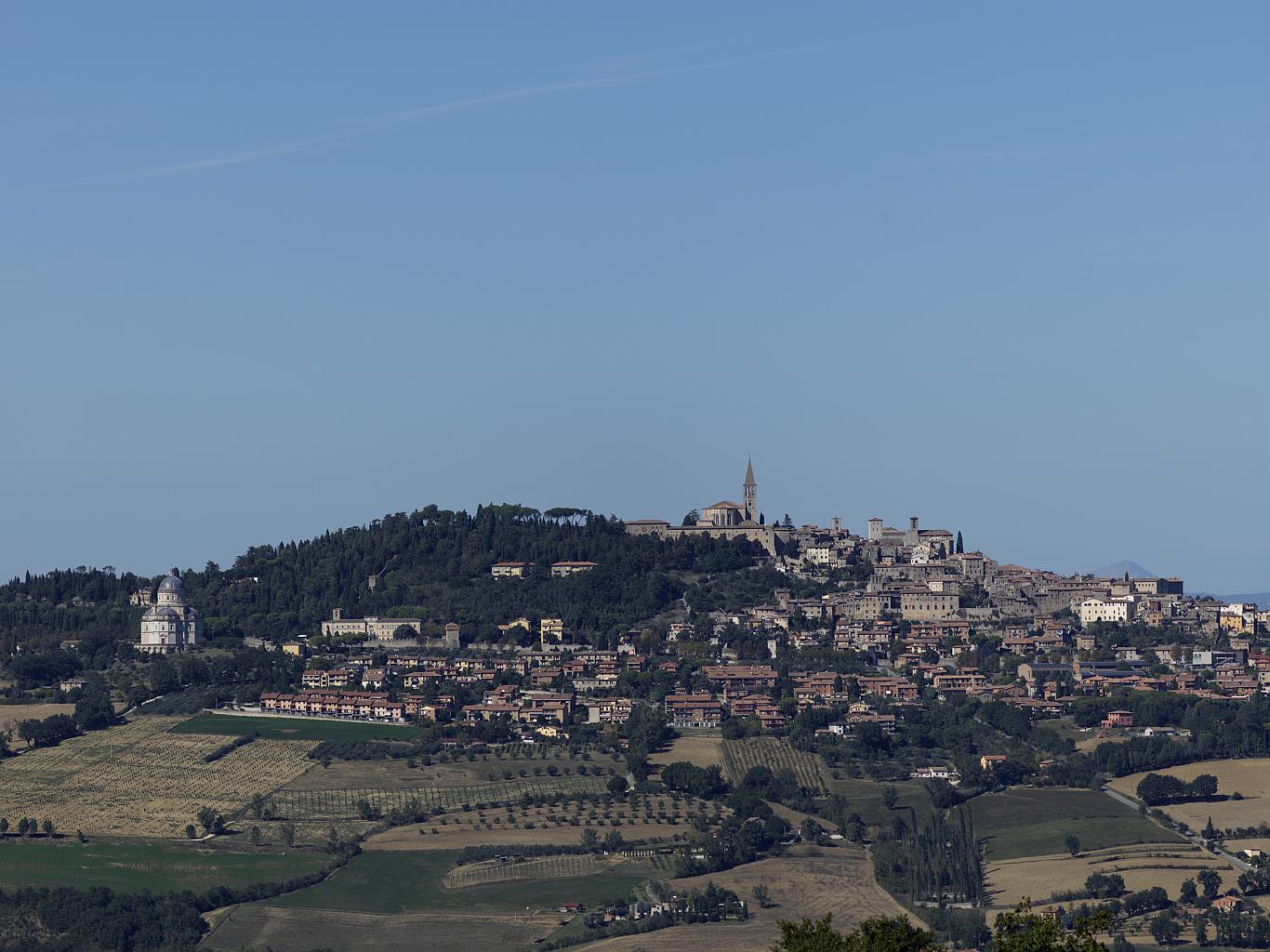
Todi from the south, with the domed Tempio della Consolazione on the left. The pre-Roman necropolis was found in the area now covered by modern housing, outside the town walls. Hasselblad 501 C/M camera, CFV-50C digital back, Zeiss Sonnar C 250mm lens (click to enlarge).

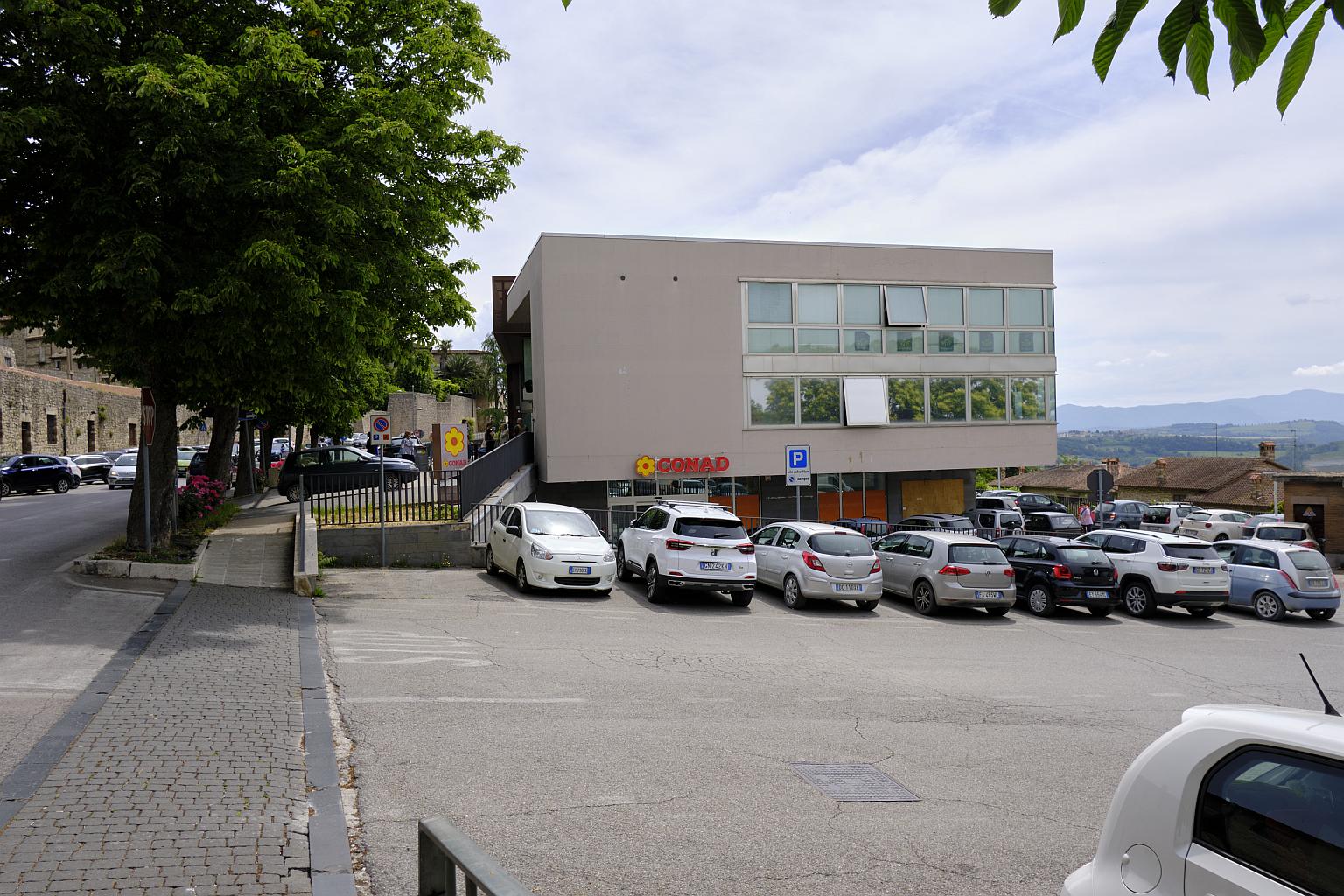
Most of the objects found here in the 19th Century were dispersed to collections elsewhere in Italy or overseas, but finds continue to be made. On the road which runs beside the south side of Todi’s medieval walls (Via Orvietana) is a rather ugly modern building which houses among other businesses a CONAD supermarket.

CONAD
The modern supermarket, on the site of a pre-Roman necropolis. Fujifilm X-Pro 3 digital camera, 35mm lens (click to enlarge)

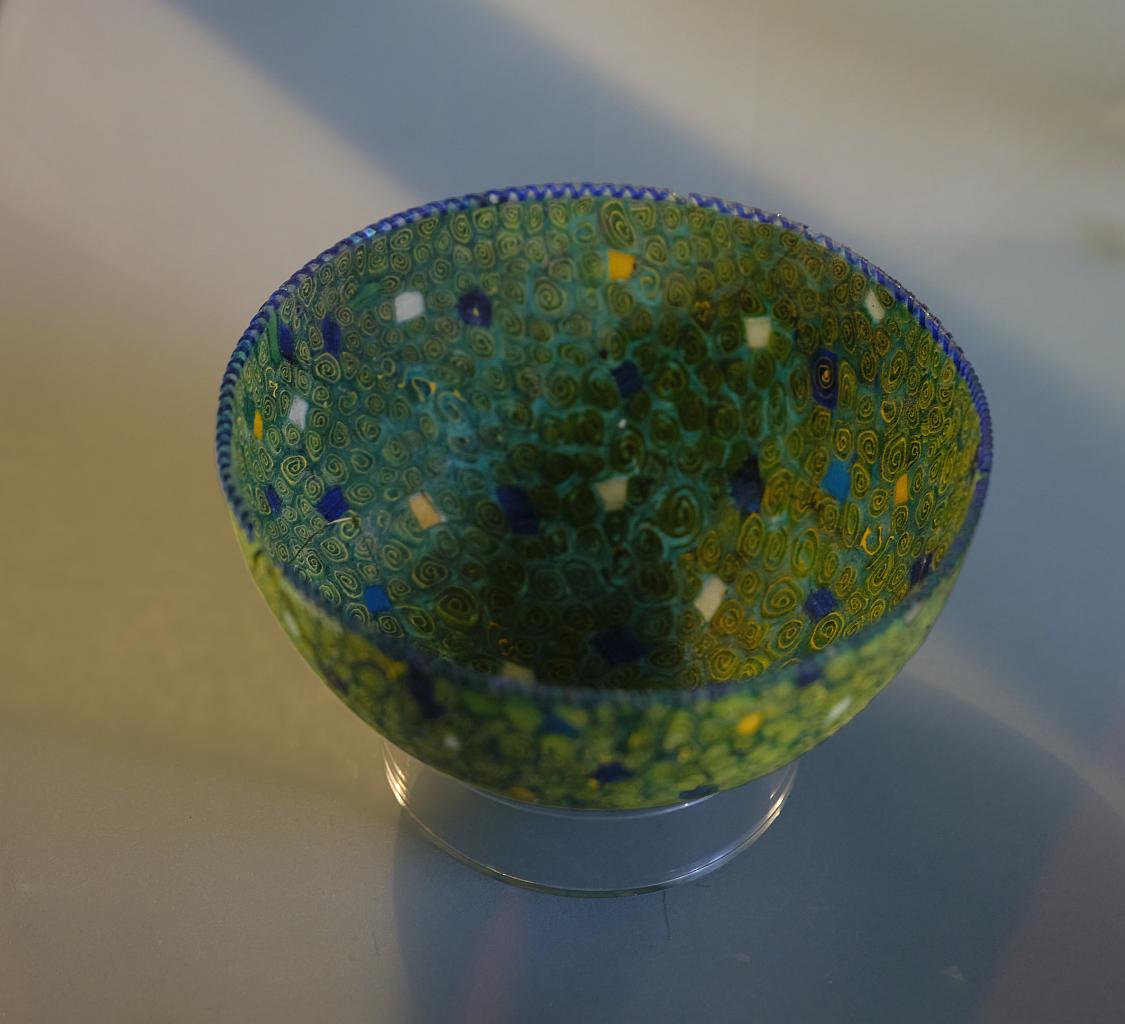
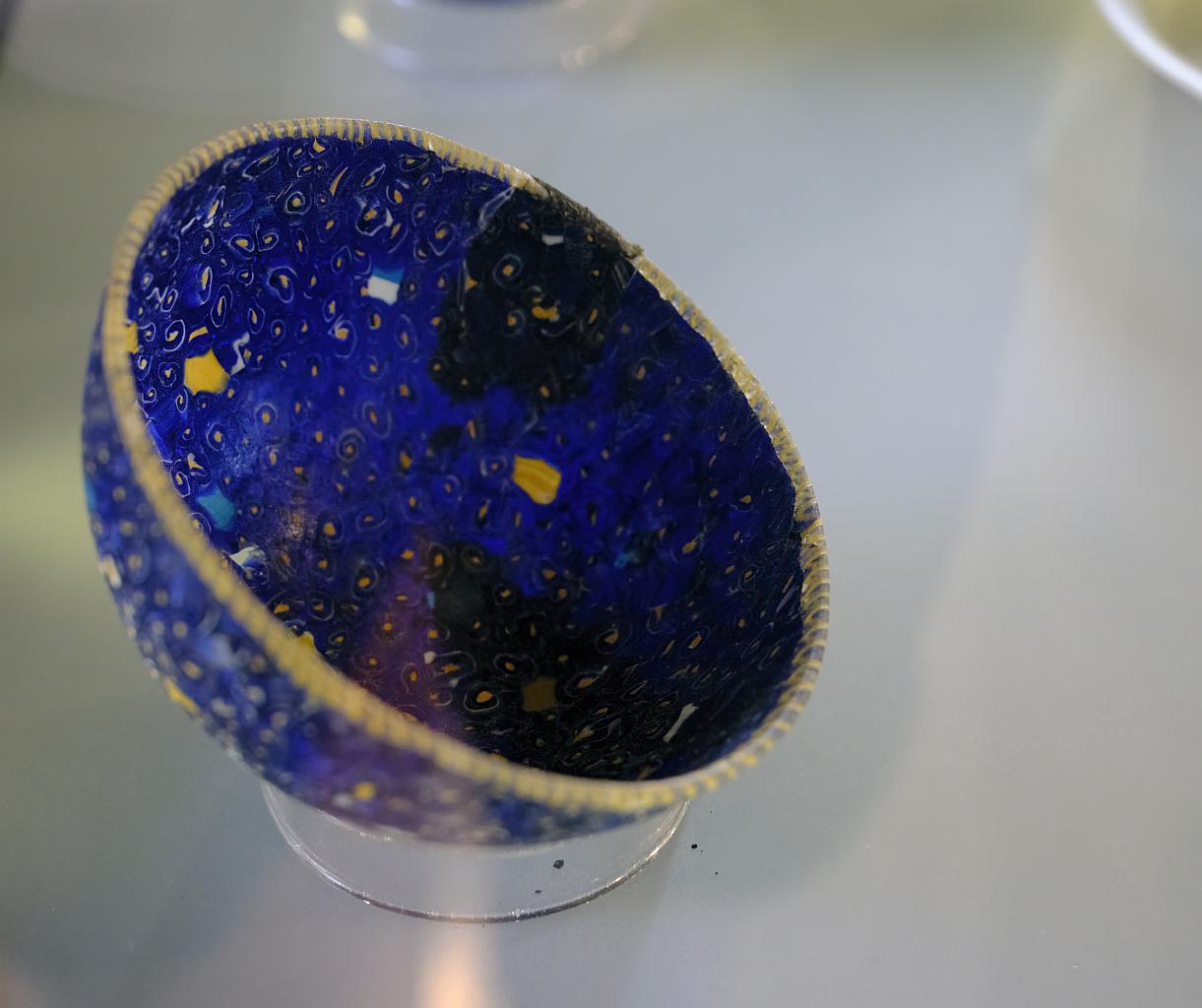
It was in 2007, while excavating for the foundations of this building, that they found pre-Roman graves containing many fine glass bowls of Alexandrian manufacture. These did not end up very far away and you can see some of them in an excellent display at the Museo Archeologico Nazionale dell’Umbria in Perugia.

Alexandrian glass bowl
Glass bowl from Alexandria, recovered from a grave discovered during the building of the supermarket in 2007. Museo Archeologico Nazionale dell’Umbria, Perugia. Fujifilm GFX-50R digital camera, 32-64mm lens (click to enlarge).
Alexandrian glass bowl
Glass bowl from Alexandria, recovered from a grave discovered during the building of the supermarket in 2007. Museo Archeologico Nazionale dell’Umbria, Perugia. Fujifilm GFX-50R digital camera, 32-64mm lens (click to enlarge).

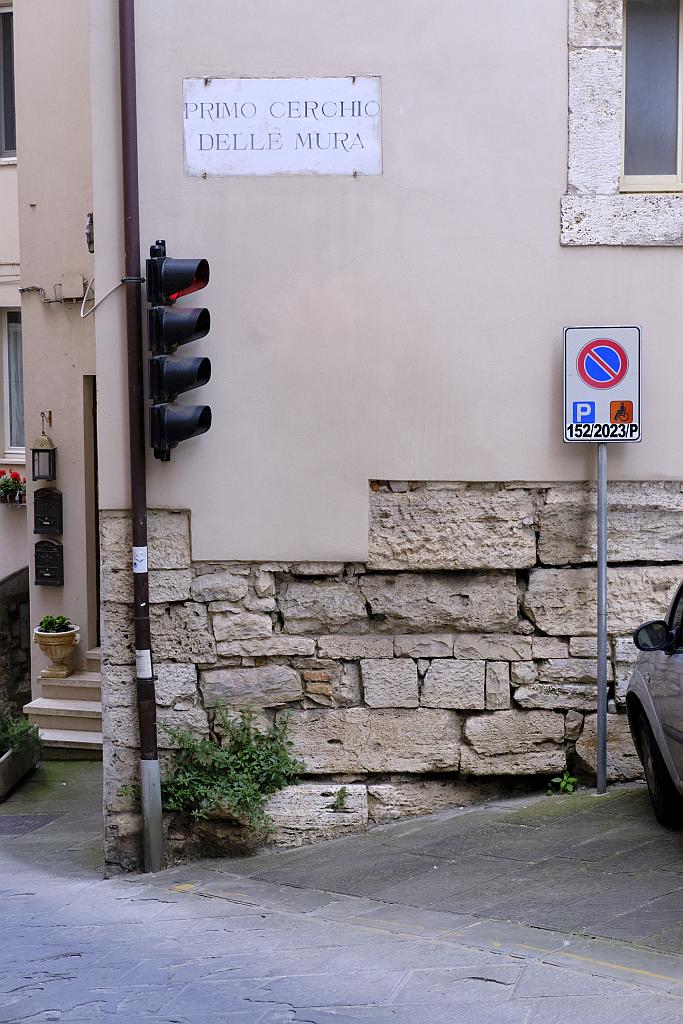
The most obvious reminder of Todi’s pre-Roman era, however, is in the stones that make up the first of the town’s three circles of walls.

Primo Cerchio delle Mura
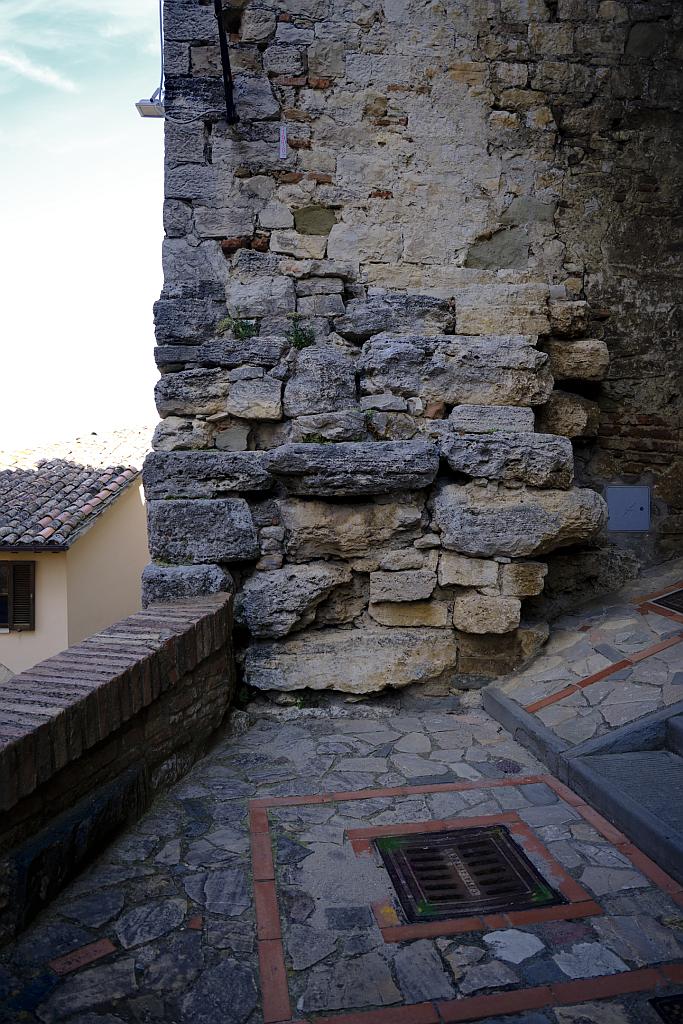
The “first circle of the walls” – vestigial pre-Roman walls in the foundations of a later house, Via Santa Prassede, Todi. There was an ancient town gate here which started to fall apart in the early 17th Century and was illegally demolished by a nearby landowner so he could enlarge his house. The town council retrospectively approved the demolition, on condition that the landowner erected a memorial stone saying that the gate had been there, but he didn’t (things like that happen in Italy). Fujifilm X-Pro 3 digital camera, 35mm lens (click to enlarge).

Todi’s first circle of walls dates, I understand, from the 6th or 5th Century BC, the second circle from the Roman period – some sources say in the late Republican period, others around the time of the Gothic invasion of the 6th Century AD – and the third is a rank newcomer from around 1200. The two later circles are largely complete and I will probably write about them separately one day, but the first and most ancient wall is fragmentary – in many places there are no traces, while in others it was incorporated into later walls and kept repaired.

Piazza Montarone
Remnants of Todi’s original pre-Roman walls in Piazza del Montarone, showing many signs of later repairs. The piazza has been a building site for the past three years and the bushes have been allowed to grow up and hide much of the wall. I hope the comune does something about that. Google Nexus 6P phone camera (click to enlarge).
1st circle of walls
Another part of the First Circle of Walls, where 2,500-year old stonework has been incorporated into the foundations of a modern house. Fujifilm X-Pro 3 digital camera, 35mm lens (click to enlarge).
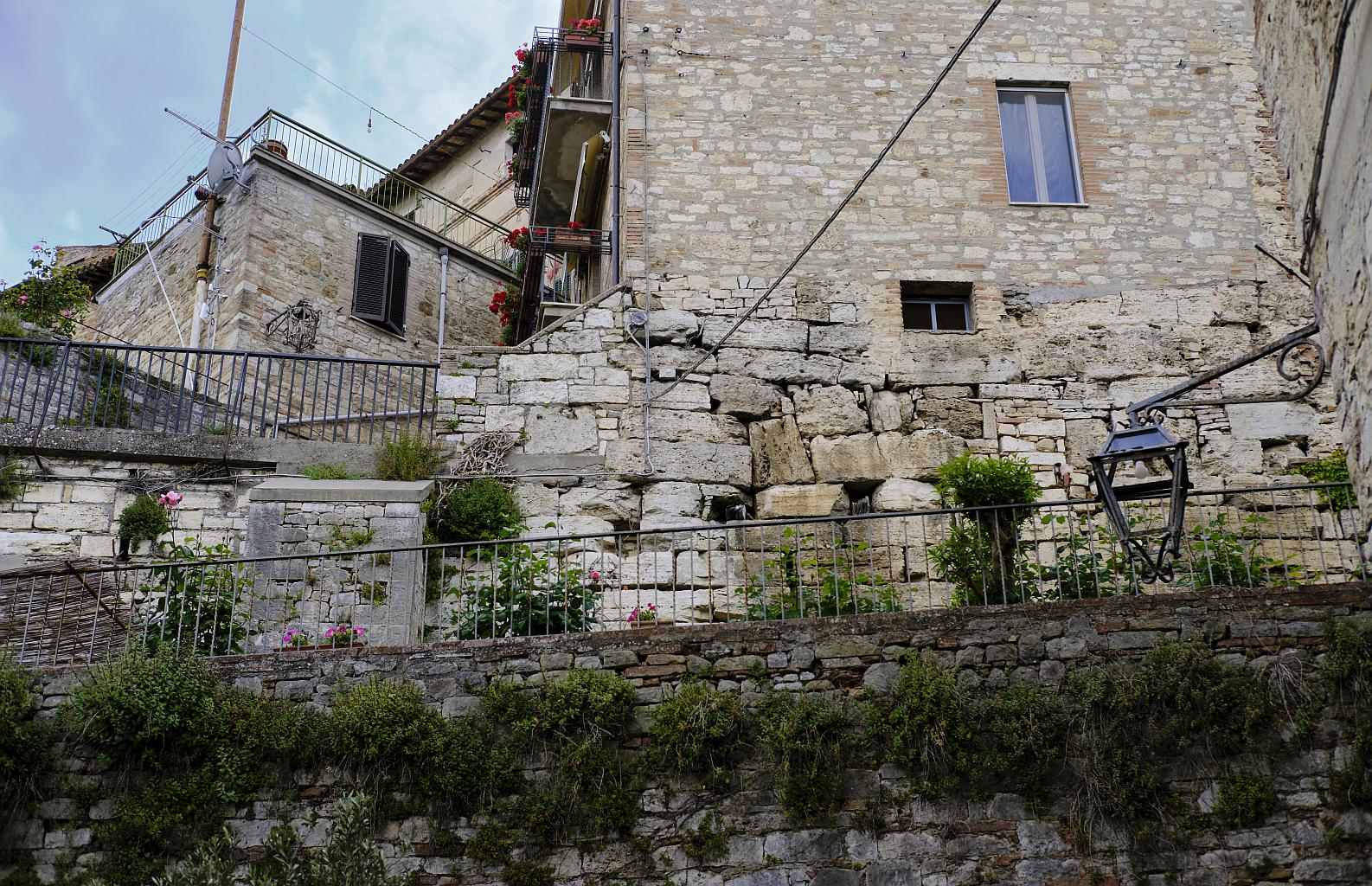
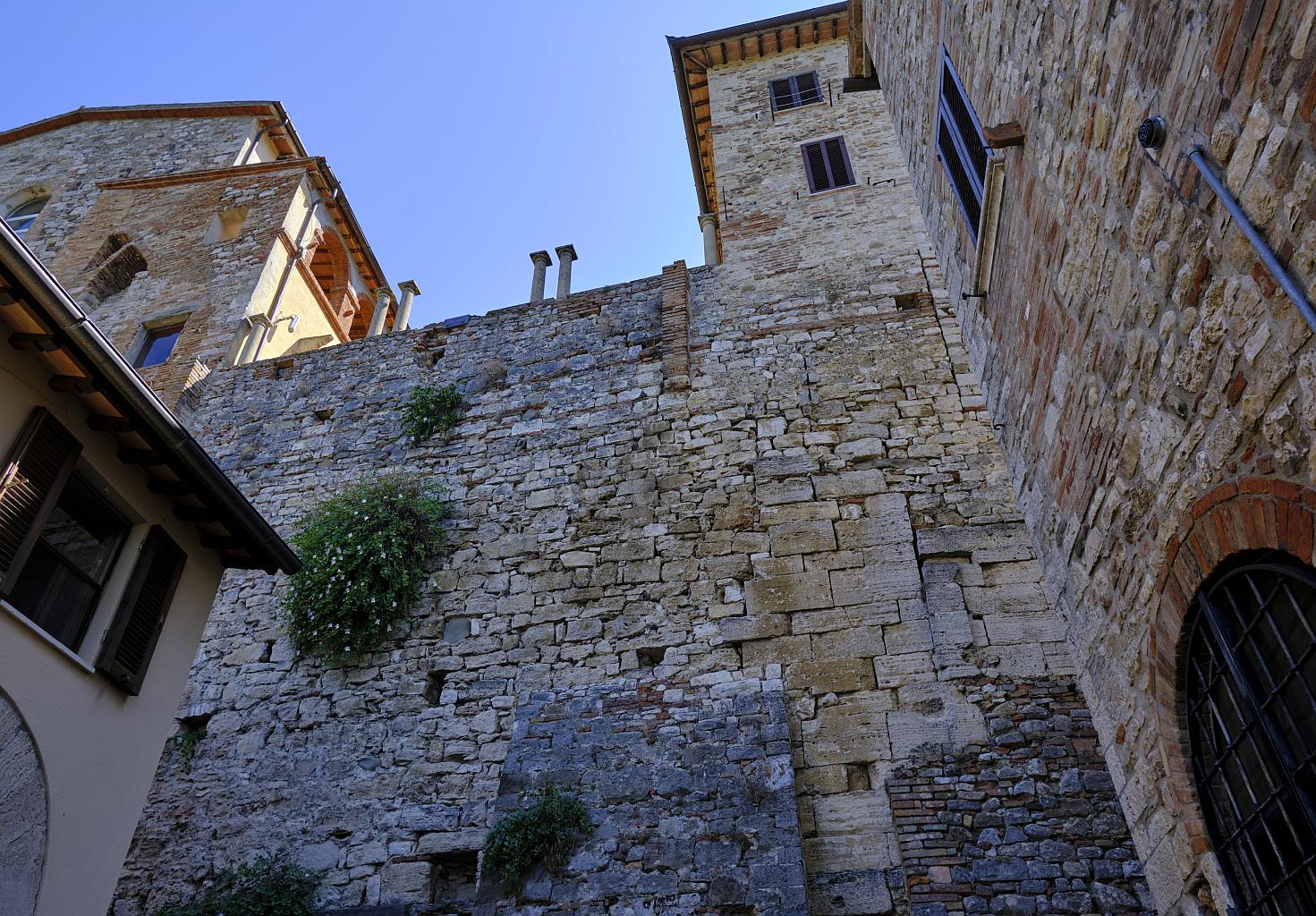
The walls beneath “The Eagles Nest”, looking up at the convent (now an art gallery and the town cinema) that occupies the site. Most of this stonework is late Roman or medieval, but the large regular travertine blocks are characteristically pre-Roman. Fujifilm X-Pro 3 digital camera, 16mm lens (click to enlarge).
Nido dell'Aquila
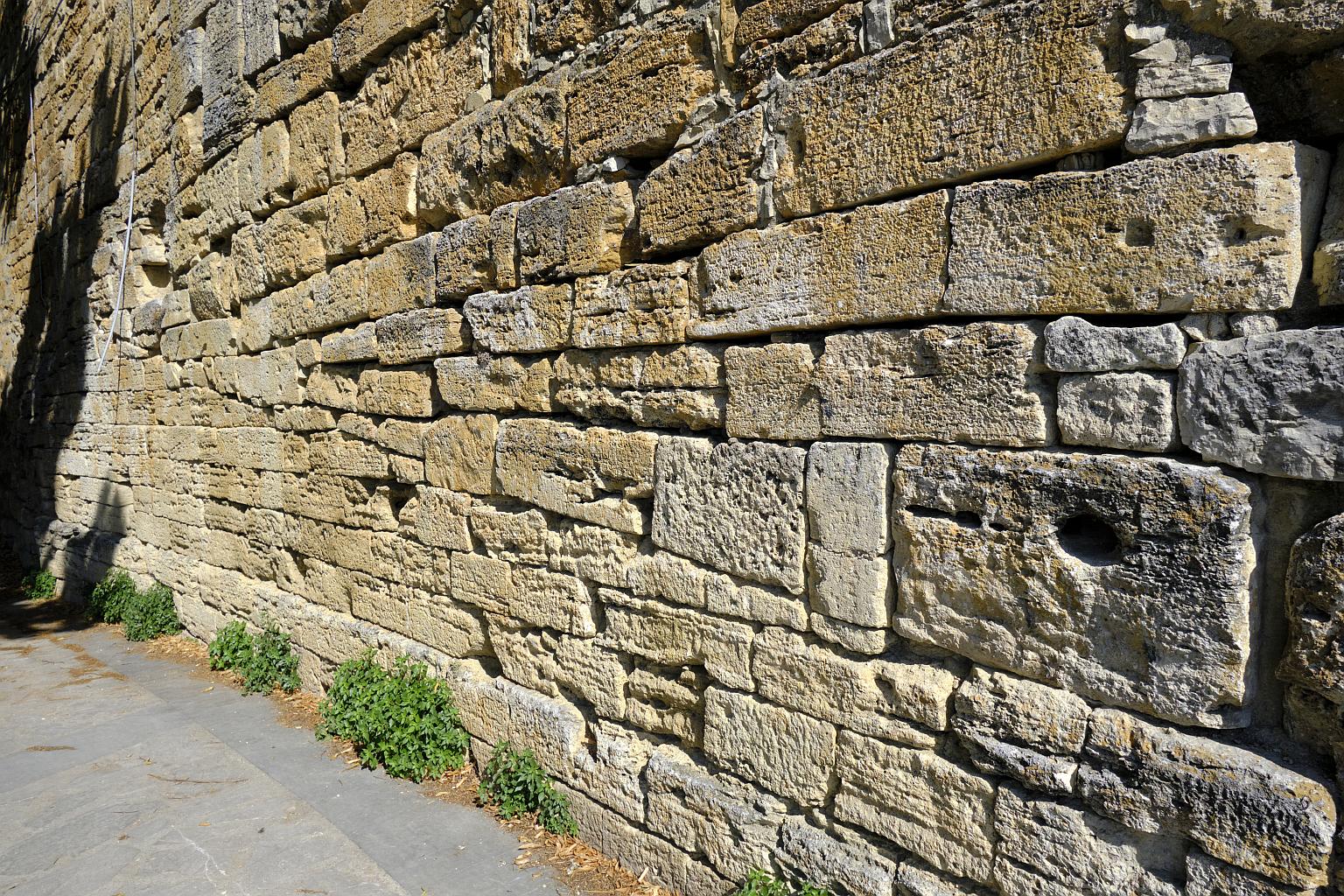
Another picture of the walls below the “Eagle’s Nest”, showing large ancient blocks below smaller later ones. According to Franco Mancini in his book “Todi e i Suoi Castelli” (1960), this was the location of a town gate in the pre-Roman period, so we can assume these stones to have been part of it. Fujifilm X-Pro 3 digital camera, 35mm lens (click to enlarge).
Western walls of Todi
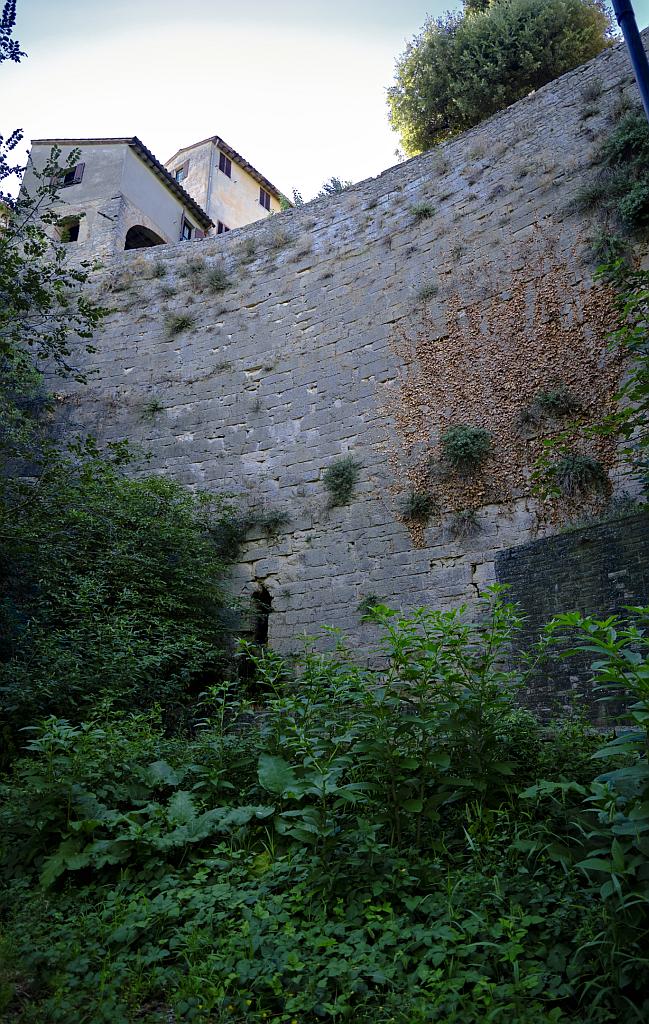
The massive western walls of Todi. Originally pre-Roman, these would have been maintained through the late Roman and medieval periods. The gap at the base of the wall is where one of the many freshwater springs comes out, and where thrifty locals who can stand the taste of limestone refill their bottles. Fujifilm X-Pro 3 digital camera, 16mm lens (click to enlarge).

My final example of pre-Roman stonework is easy to miss, and one that I would love to say that I discovered for myself, but in fact I first came across a picture of it in a book. It is just below the summit of Todi’s hill, leading up to what is now a park on the site of the medieval Rocca Albornoz.

Pre-Roman ramp
Wall showing original pre-Roman ramp. Fujifilm X-Pro 3 camera, 16mm lens (click to enlarge).

On first glance this is a stone wall that could have been built as a single edifice, but on closer inspection there is a discontinuity – a diagonal line running up from the lower right to the left of the photograph. Below that line, the lower part is a ramp built in the pre-Roman period leading up to the top of the hill. One can imagine processions heading up to the summit, as part of ceremonies for whatever gods the Umbri worshipped. Above that line, less regular than the ancient original, older stones were re-used in late Roman or early medieval times to turn the ramp into a wall. Further above that, several hundred years later, there was built a Franciscan monastery which now contains the town library and a high school, in the cloister of which they put on concerts in summer. And so the life of the town continues, on the most ancient of foundations.

Sources

My qualifications for writing this are simply that I am interested, and that in walking around Todi with a camera I have learned to look for patterns in the stone and ask myself what stories they tell. The guided walk sponsored by FAI was a good source, as is the municipal museum and the explanatory texts in it, while the Museo Archeologico Nazionale dell’Umbria in Perugia is excellent and well worth a visit. There is a section on local history in the town library (in the old monastery above the pre-Roman ramp illustrated above). We have found a couple of books in Italian which deal mainly in later art and architecture but which refer peripherally to the ancient period. These are Todi, storica ed artistica, written in 1961 by Carlo Grondona and updated and republished in 2009 by his son Marco.

Grondona

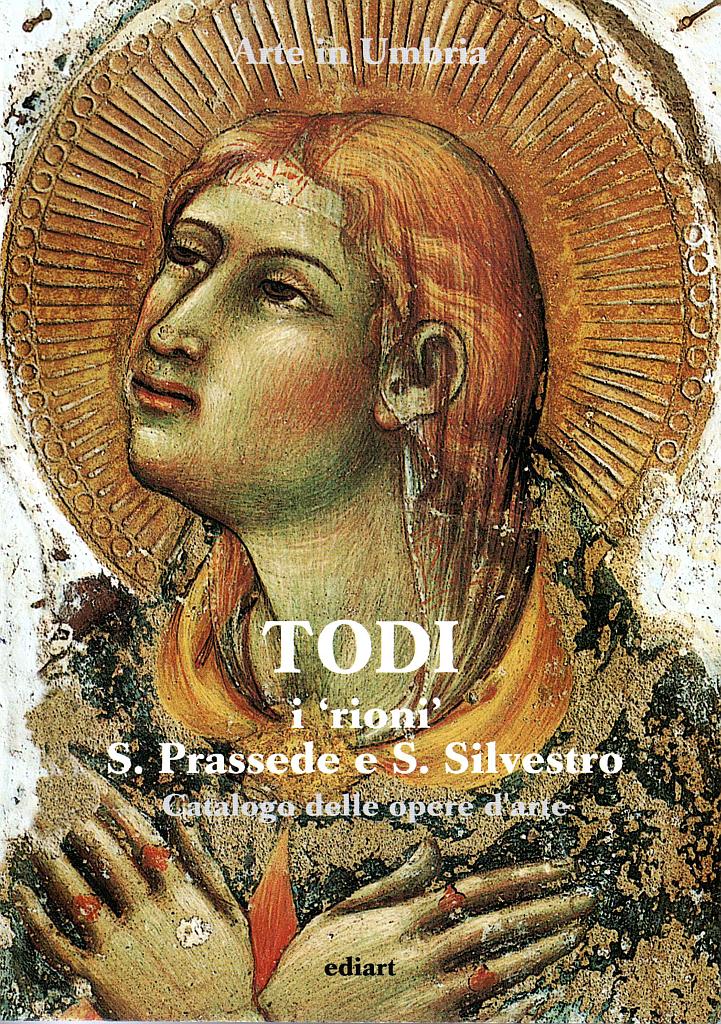
Another, dealing only with a couple of town districts, is TODI: i ‘rioni’ S. Prassede e S. Silvestro, Catalogo delle opere d’arte by Castrichini  et al., 1999. One chapter by Lorena Battistoni deals with the Roman and Medieval history of the districts.

Castrichini

In English there is not so much. Umbria, A Cultural Guide by Ian Campbell Ross, 1996, from which I have quoted before, has a couple of chapters dealing with the prehistoric and pre-Roman ages in Umbria generally, although he concentrates more on Perugia and its Etruscan history than he does on the Umbri.

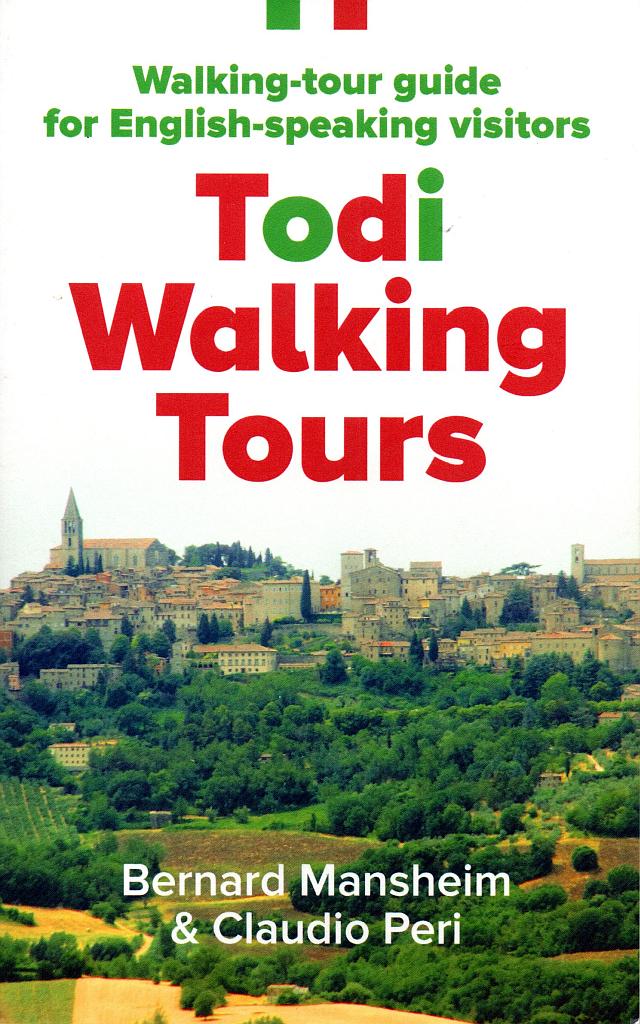
A slim book called Todi Walking Tours, self-published in 2018 by Bernard Mansheim and Claudio Peri is available in local bookstores. It is a good way to make an initial acquaintance of the town, although some of the historical assertions in it are debatable.

Todi Walking Tours

I intend to follow this post in due course with one on Todi in the Roman era, of which there are more substantial remains than from the pre-Roman.

Edit: since writing this post I have acquired a third book in Italian about the history of Todi: Todi e i Suoi Castelli by Franco Mancini, 1960. It promises to be a very useful source, although the somewhat ornate style in which it is written is going to make reading and translating it rather slow going. Also since writing this post, I have followed up with two more: Roman Todi 1 – Becoming Roman, and Roman Todi 2 – Architecture and Engineering.